


How to Set a Fixed Employee Code for Every Worker
Most employee codes break for the same reason: somebody asked them to describe a person as well as identify one. Here is a format that survives a transfer.
Listen to this article
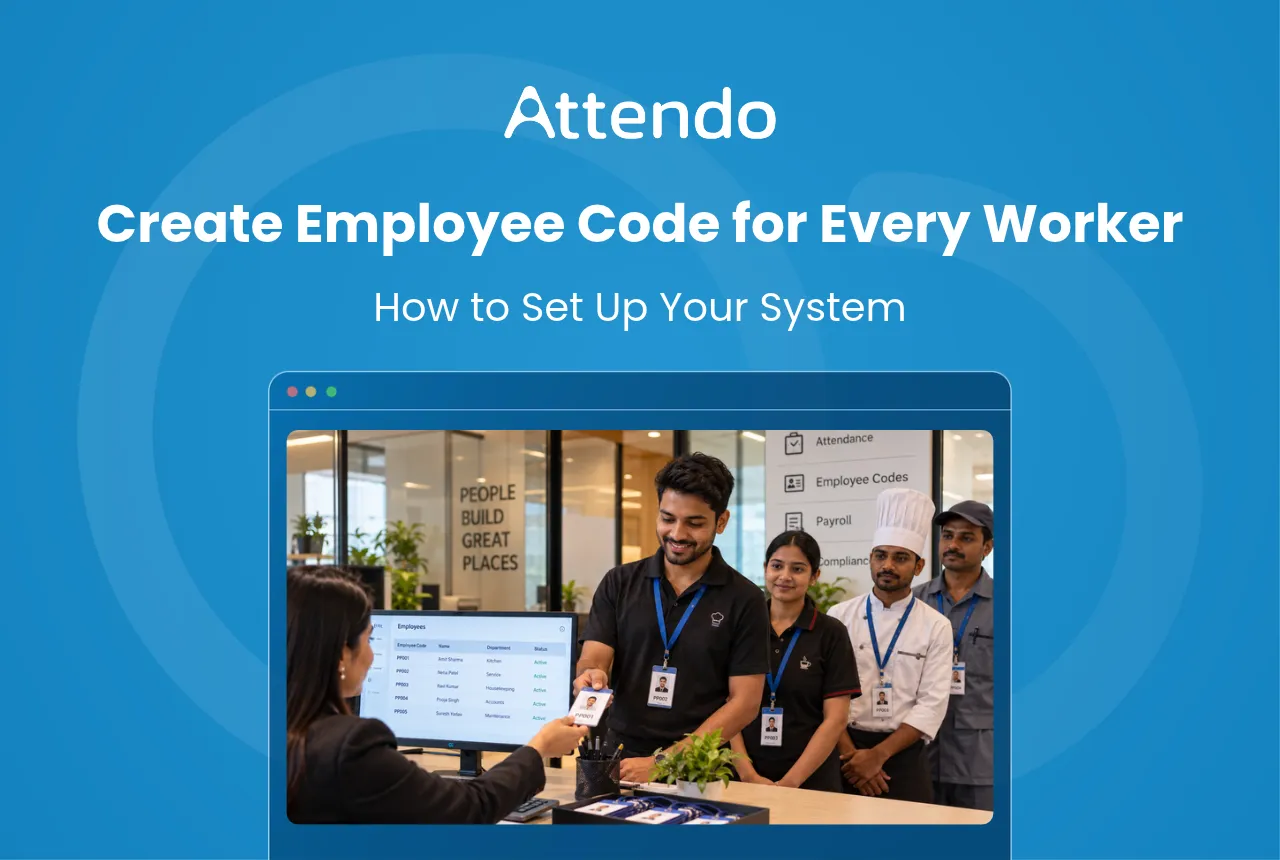
An employee code is the short number your business gives each person on the payroll, and gives to nobody else. It is how one Rakesh Sharma is told apart from the other one.
It sounds like paperwork until the first time it goes wrong. Then it is a settlement paid to the wrong bank account, or a year of one person’s attendance sitting under somebody else’s name.
A working code is a fixed number. One person holds it, they hold it for their whole service, and every system you run reads it the same way. Most of the trouble in this article comes from one of those three slipping.
This page covers what an employee code is for, what the law does and does not ask of it, and how to set a fixed number you will not have to undo.
Key Takeaways
- A fixed number, not a description: one per person, held for their whole service, identical in every record.
- The law does not name it: what the codes require is registers, wage slips and an appointment letter, and a code is how you keep them tied to one person.
- Never reuse a leaver’s code: the new joiner inherits the old one’s history.
- Keep meaning out of it: a number that describes a branch or a grade cannot stay fixed when those move.
- One code, every system: the register, the payslip, the device, the bank file and the final settlement all have to agree.
- Numbers are not the same as identity: a provident fund number and your own code do different jobs.
What Does an Employee Code Actually Do?
Three things, and only three. It belongs to exactly one person, it does not move while their records exist, and every report shows the same number.
That is as true for a hotel with sixty staff as for a textile mill with six hundred.
Anything else you ask it to do works against the first three. A number that also tells you the branch is useful right up to the morning somebody transfers, and then it is wrong and stuck.
A supermarket chain in Jaipur found this out the ordinary way. Codes built as branch plus serial number looked tidy for two years, until staff started moving between outlets and every transferred person needed either a new code or a code that now lied.
In Simple Words
An employee code is a short number that stands for one person. It must be theirs alone, and it stays fixed for as long as you keep their records.
Attendo (formerly Petpooja Payroll) is a complete workforce management system for every kind of business, running attendance, shifts, leaves, payroll and statutory filings in one place. It is built by Petpooja, serving Indian businesses since 2011, and used by 40,000+ businesses today.
Does the Law Require an Employee Code?
No. Neither the Occupational Safety, Health and Working Conditions Code, 2020 nor the Code on Wages uses the phrase at all.
What they require is the paperwork a code holds together. Section 33 of the OSH Code says an employer shall maintain a register in the prescribed form, electronically or otherwise, carrying the prescribed particulars of workers.
What the Register Has to Show
The Code names some of what it must show:
- Work performed, and the hours making a normal working day
- The day of rest allowed in every seven
- Wages paid, and the receipts given for them
- Leave, leave wages, overtime and attendance
- The employment of adolescents
That list is a floor, not a ceiling. Your government may prescribe more.
Section 50 of the Code on Wages, 2019 asks for much the same, in any establishment the Code applies to: a register with the details of persons employed, the muster roll and wages. It also requires wage slips.
There is one narrow carve-out. Those duties fall away to the extent an employer engages not more than five people for agriculture or domestic work.
Read that as a limit on how far the exemption reaches, not a free pass for the employer.
The Appointment Letter Duty
There is a second duty worth knowing. Section 6 of the OSH Code requires a letter of appointment for every employee, in the prescribed form. Anyone who did not have one when the Code commenced had to be issued one within three months.
None of that names a code. But a register, a wage slip and an appointment letter all describe the same person, and something has to say they are the same person. Our statutory register formats show the columns those records carry.
The four labour codes took effect on 21 November 2025, so these are the duties in force now, not a proposal.
What Makes an Employee Code Break?
Asking it to describe something. A code that carries meaning is a code with an expiry date.
Three failure modes cover almost everything that goes wrong, and each one starts as a reasonable idea.
Reusing a Leaver’s Code
The tidiest-looking mistake. Someone leaves, their code is free, the next joiner gets it.
Now two people share an identity. Last year’s attendance, last year’s payslips and last year’s full and final settlement all attach to whoever holds that code today.
An audit that asks what this person was paid in a given month gets an answer covering two people, and the appointment letter on file names only one of them.
The record outlives the employment. Somebody can ask about a month that person worked long after their last day, and the answer has to point at one human being.
Codes are cheap. Leavers keep theirs.
Putting Meaning Inside the Code
Branch, department, designation, grade and joining year all look like useful things to encode. Every one of them either moves with the person or stops being the thing you want to sort by.
A fabrication unit in Coimbatore that codes people as welder or fitter has to choose, the day somebody retrains, between a wrong code and a new one. Both are worse than a code that never meant anything.
Keep those facts in their own columns, where changing one does not rewrite who somebody is.
Undoing it later is the expensive part. The code is not just in your software, it is on printed rosters, signed registers and every sheet anyone has exported, and none of those update themselves.
Letting Two Systems Disagree
The attendance device, the payroll sheet and the bank file each hold a code. If they were set up at different times by different people, they hold different codes.
Month-end matches them up by name, names collide, and a payment lands somewhere it should not. Settle on one system as the place codes come from, and the problem stops travelling to the next branch.
You usually find out at the point of payment, which is the worst place to find out. Checking the codes agree before a run costs an hour. Getting money back after one costs a great deal more.
A school in Pune hit this when a payroll sheet and a biometric device were set up a year apart. A diagnostic lab chain in Hyderabad hit it opening a fourth branch, where nobody knew which system to ask.
How to Build an Employee Code Format
Start from what keeps a number fixed and add nothing. A prefix, a running number and enough digits to last are the whole design.
| Choice | What works | Why |
|---|---|---|
| Length | The same number of digits every time | For example write 0007, not 7, so codes sort and search properly |
| Prefix | One short prefix for the whole business, or none | A per-branch prefix breaks on the first transfer |
| Numbering | A simple running series | Gaps are fine. Reuse is not |
| Starting point | Not at 1 | A code of 1 reads like a placeholder, and gets treated as one |
| Leavers | Retire the code with the person | History stays attached to one human being |
| Changes | Do not renumber, ever | A renumbering breaks every record that already cites the old code |
Whatever you pick, apply it when the person is created rather than later. Our guide to adding an employee covers the record it belongs to, and bulk adding employees matters most here, because an import is where duplicate codes usually enter a system.
Where Must the Employee Code Match?
Everywhere the same person appears, which is more places than most businesses realise.
| Record | What it is for | What breaks if the code differs |
|---|---|---|
| Muster roll and attendance register | The statutory record of who worked when | Attendance cannot be reconciled to a person |
| Wage register and payslip | What was paid and why | A pay dispute has no single trail to follow |
| Attendance device or app | Where the punch comes from | Punches arrive for somebody payroll cannot place |
| Bank transfer file | Where the money goes | Payment to the wrong account, found after it clears |
| Full and final settlement | The closing calculation | Service history is taken from the wrong record |
Two other numbers get confused with the employee code, and neither is yours. The provident fund number follows a person between employers. The employee insurance number comes from the state insurance scheme.
Your code is internal, and you control it. Our guide to EPF forms covers the first of those.
That leaves the practical question. Where does the code live, so all five of those records end up reading the same one?
Where Attendo Fits
The employee master holds the employee code, which Attendo calls the employee ID, alongside name, department, designation and branch, so the things that change sit in their own fields rather than inside the code.
Every payroll table stacks the employee ID under the name, and the filter has an All, Name or Emp ID selector, so two people with the same name stay distinguishable on screen.
Excel and PDF exports keep name and ID as separate columns, which is what an auditor asking about one person actually needs.
If you want employee records kept this way, you can take a look at Attendo, or read how it works end to end first.
Your Employee Code Checklist
Most employee code trouble is not a bad format. It is a good format applied inconsistently, usually during an import or a branch opening.
If I had to check one thing before the next payroll run, it would be whether any code appears twice, counting leavers. That one check is where both the reuse problem and the import problem show up.
- Decide which system owns the code, and write the answer down where the next person to open a branch will find it.
- Pick a fixed width and a single prefix, or no prefix at all.
- Keep department, branch, grade and joining year out of the code and in their own fields.
- Retire a leaver’s code with them, and never issue it again.
- Check for duplicates after every bulk import, before the first payroll run that uses them.
- Check the code matches across attendance, payroll and the bank file once, then keep them in step.
The salary sheet and payroll register template shows where the code sits on the page. The attendance to salary run shows what it has to survive between a punch and a payment.
Frequently Asked Questions
1. What is an employee code?
2. Is an employee code legally required in India?
3. What is a good employee code format?
4. Can an employee code be reused after someone leaves?
5. Is the employee code the same as the provident fund number?
6. Should the employee code change on promotion or transfer?
Listen to this article
Related Articles You May Like
6 Employee Background Verification Checks Before You Hire
Hiring someone, or being checked yourself? Here are the six background verification checks, what each one proves, and the data rules that apply from May 2027.
Ashwiniba Vaghela
HR & Payroll Experts

Relieving Letter vs Experience Letter: Definition and Difference
What each document is, and why only the experience letter can be demanded, and only from a larger employer. A relieving letter rests on company practice alone.
Ashwiniba Vaghela
HR & Payroll Experts

Why Accrued Leave Is Not the Same as Earned Leave
The phrase earned leave is in the labour code on safety and working conditions. Accrued leave is not. And earned leave belongs to two jobs most of your staff do not hold.
Avani Joshi
HR & Payroll Experts
Top 5 Warning Letter to Employee Formats in Different Tones
Five warning letter formats, one per tone, ready to adapt, plus the path from warning to show cause to termination.
Avani Joshi
HR & Payroll Experts