


6 Employee Background Verification Checks Before You Hire
Hiring someone, or being checked yourself? Here are the six background verification checks, what each one proves, and the data rules that apply from May 2027.
Listen to this article
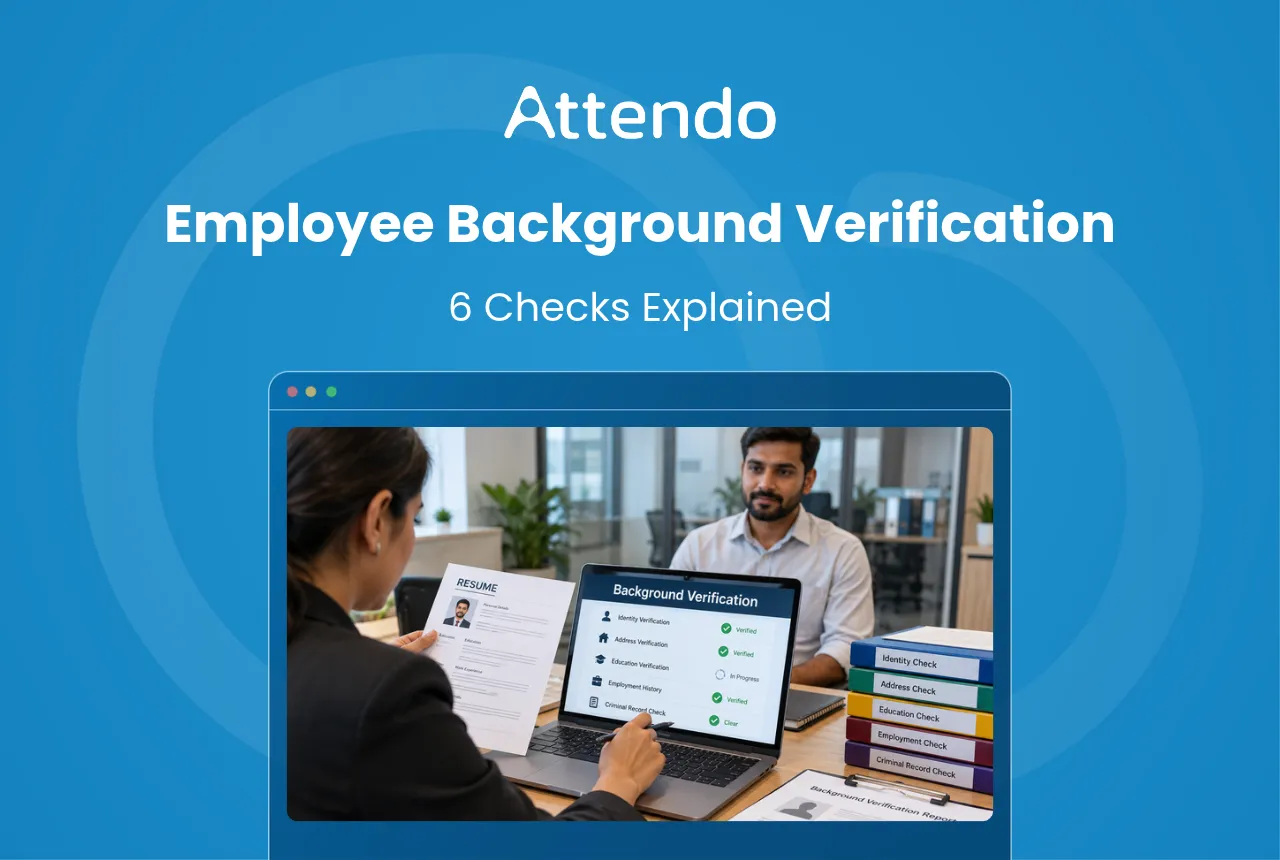
You are about to hire someone, or you have just been told your new employer will check your background. What do these checks look at, and what does each one prove?
Background verification confirms that what a candidate says about themselves is true. A full background check can cover six things: identity, address, education, past jobs, criminal record and references.
I used to think a background check was one check. It is really up to six separate checks, and each one proves something different.
Key Takeaways
- Background verification has six common checks. Identity, address, education, employment history, criminal record and references each check a different claim, and the role decides which ones you need.
- The law on candidate data is getting stricter. The data protection rules notified in November 2025 phase in over 18 months.
- Using a vendor does not move the duty. Under the data protection law, the employer will answer for the data even when a vendor runs the checks.
- Candidates should be told first. A clear consent form and a chance to explain a mismatch keep the process fair.
What Is Background Verification?
Background verification is the check an employer runs on a candidate’s documents and history before, or soon after, an offer. It confirms that the person is who they say they are and has the education and experience they claim.
Employers rely on it most where trust is part of the job, such as a hospital hiring nurses, a school hiring teachers, a retail chain hiring cashiers, or an IT services firm handling client data.
In Simple Words
The company checks that your papers are real. It looks at who you are, where you studied and where you worked.
6 Background Verification Checks
Each check answers one question. Most employers run some or all of these, depending on the role:
| Check | What it proves | How it is usually done |
|---|---|---|
| 1. Identity | The person is who they claim to be | Aadhaar or Permanent Account Number (PAN), checked against the original |
| 2. Address | Where the person actually lives | Address proof, sometimes a visit |
| 3. Education | The degrees and marks are real | Confirmation from the university or board |
| 4. Past employment | The jobs, dates and roles are true | Relieving letters and a call to past HR |
| 5. Criminal record | No relevant case or conviction | Police verification or a court records search |
| 6. References | How the person worked with others (an opinion, not proof) | Calls to past managers the candidate names |
Pick the checks the role needs. A cashier handling money needs a criminal record check more than a reference call; a senior hire may need all six.
1. Identity Check
This confirms the person’s name, photo and date of birth. HR matches the Aadhaar or PAN card with the person in front of them, and with the details on every other document.
2. Address Check
This confirms where the person lives, using a utility bill, rent agreement or Aadhaar address. Some roles add a physical visit.
3. Education Check
This confirms that the degrees and marks are genuine. The usual route is a confirmation from the university or board that issued them.
4. Past Employment Check
This confirms the employers, dates and job titles on the CV. Relieving and experience letters help, and the relieving vs experience letter guide explains how the two differ.
5. Criminal Record Check
This looks for relevant criminal cases or convictions. Police verification can be requested through the state police, and court records can also be searched.
6. Reference Check
This asks past managers how the person worked. It is the softest of the six, so treat it as context rather than proof.
The Background Verification Process
Whether HR runs the checks or a vendor does, the process usually follows these steps:
- Tell the candidate. Explain which checks will run and why, and take written consent.
- Collect documents. Ask only for what the chosen checks need.
- Run the checks. Contact universities, past employers and the police yourself, or use a background verification company such as AuthBridge, OnGrid or SpringVerify. Their sites list employment checks, and some also offer reference checks.
- Review mismatches. Give the candidate a chance to explain before you decide.
- Decide and record. Note the outcome, and keep the data only as long as you need it.
Many offers are made conditional on a clear result, and the appointment letter formats show how to word that condition.
Once the checks are done, the result belongs with the new employee’s record.
Attendo (formerly Petpooja Payroll) is a complete workforce management system for every kind of business, running attendance, shifts, leaves, payroll and statutory filings in one place. Attendo has more than 40,000 users today. It is Software By Petpooja, building helpful products for Indian businesses since 2011.
Background Verification and the DPDP Act
Background checks collect a lot of personal data, so the Digital Personal Data Protection Act, 2023 (DPDP Act) applies to them. Its main duties phase in by May 2027, and three of them matter most to an employer.
- A lawful reason. The DPDP Act allows personal data to be used for the purposes of employment without consent, but it does not say whether that covers candidates. Written consent before checking a candidate is the safer route.
- Vendors do not shift the duty. The employer will be responsible for data processed on its behalf, including by a background check vendor.
- Keep, then delete. The DPDP Rules ask for the data and its logs to be kept for at least one year. After that, data whose purpose is served has to be erased, unless another law needs it kept.
The DPDP Act’s penalties are steep, which is why background check files need care once these duties apply.
The government notified the DPDP Rules, 2025 on 14 November 2025 with an 18-month phase-in, as the government’s DPDP Rules explainer sets out.
So the retention and deletion rules apply from May 2027.
Background Verification for Candidates
If you are the one being checked, background verification is a routine part of joining. A few things help:
- Keep documents ready. Degree certificates, relieving letters, and identity and address proof.
- Be accurate on your CV (resume). Dates and job titles that do not match past records are a common reason for questions.
- Ask what will be checked. You can ask what will be verified and who handles your data.
- Explain gaps early. A career break or a closed company is easier to explain up front than after a mismatch.
If your offer depends on the result, read what you have been given, so you know whether the offer is final.
Background Verification Policy for HR
For employers, a written policy keeps checks fair and consistent. Settle these points:
- Which checks for which roles. Match the checks to the risk of the job.
- When checks run. Before the offer, or as a condition of it, and during probation if needed.
- Who runs them. HR or a named vendor, with a written agreement on data handling.
- What a mismatch means. When it is a query, and when it ends the offer.
- How long data is kept. At least the one year the DPDP Rules will require, then delete what you no longer need.
Pro Tip
I’d suggest running the same checks for everyone in the same role. Picking and choosing between candidates invites unfair treatment, and makes any later dispute harder to defend.
If checks finish after joining, the probation period is the natural window to complete them.
Where Attendo Fits
The checks themselves are run by HR or a verification company. Once the person joins, Attendo keeps their employee record.
HR can verify the employee’s Aadhaar in Attendo, by uploading the masked Aadhaar PDF or scanning its QR code in the Admin App. Once accepted, the record shows the Verified status.
Custom employee fields, such as a file upload or a toggle, let you note on the profile that the checks are complete. The add employee guide shows how a new joiner is set up.
If you want verified IDs and joining details in one place, attendo shows how it works.
So, Which Background Checks Do You Need?
Each check proves one thing: identity shows who the person is, address where they live, education their qualifications, past employment their work history, and the criminal record check that there is no relevant case or conviction. References add how they work with others.
Choose checks to suit the role, tell candidates what you will check, keep the data for at least the one year the DPDP Rules will require, and then delete what you no longer need. From May 2027, those rules turn the retention and deletion steps into legal duties.
For most roles, start with identity and past employment, and add the others only where the job needs them.
To keep identity checks with each employee’s record, see how Attendo handles them.
Frequently Asked Questions
1. Is background verification mandatory in India?
2. Can a company do background verification without my consent?
3. What happens if my background verification shows a mismatch?
4. Can an offer be withdrawn after background verification?
5. Does background verification check my previous salary?
6. How long is background verification data kept?
Listen to this article
Related Articles You May Like
Relieving Letter vs Experience Letter: Definition and Difference
What each document is, and why only the experience letter can be demanded, and only from a larger employer. A relieving letter rests on company practice alone.
Ashwiniba Vaghela
HR & Payroll Experts
Why Accrued Leave Is Not the Same as Earned Leave
The phrase earned leave is in the labour code on safety and working conditions. Accrued leave is not. And earned leave belongs to two jobs most of your staff do not hold.
Avani Joshi
HR & Payroll Experts
Top 5 Warning Letter to Employee Formats in Different Tones
Five warning letter formats, one per tone, ready to adapt, plus the path from warning to show cause to termination.
Avani Joshi
HR & Payroll Experts
Notice Period Rules in India and What Actually Applies
Three instruments set the notice period rules in India, and only two of them are the Code. The third is the letter you wrote when the person joined.
Avani Joshi
HR & Payroll Experts