


Top 5 Warning Letter to Employee Formats in Different Tones
Five warning letter formats, one per tone, ready to adapt, plus the path from warning to show cause to termination.
Listen to this article
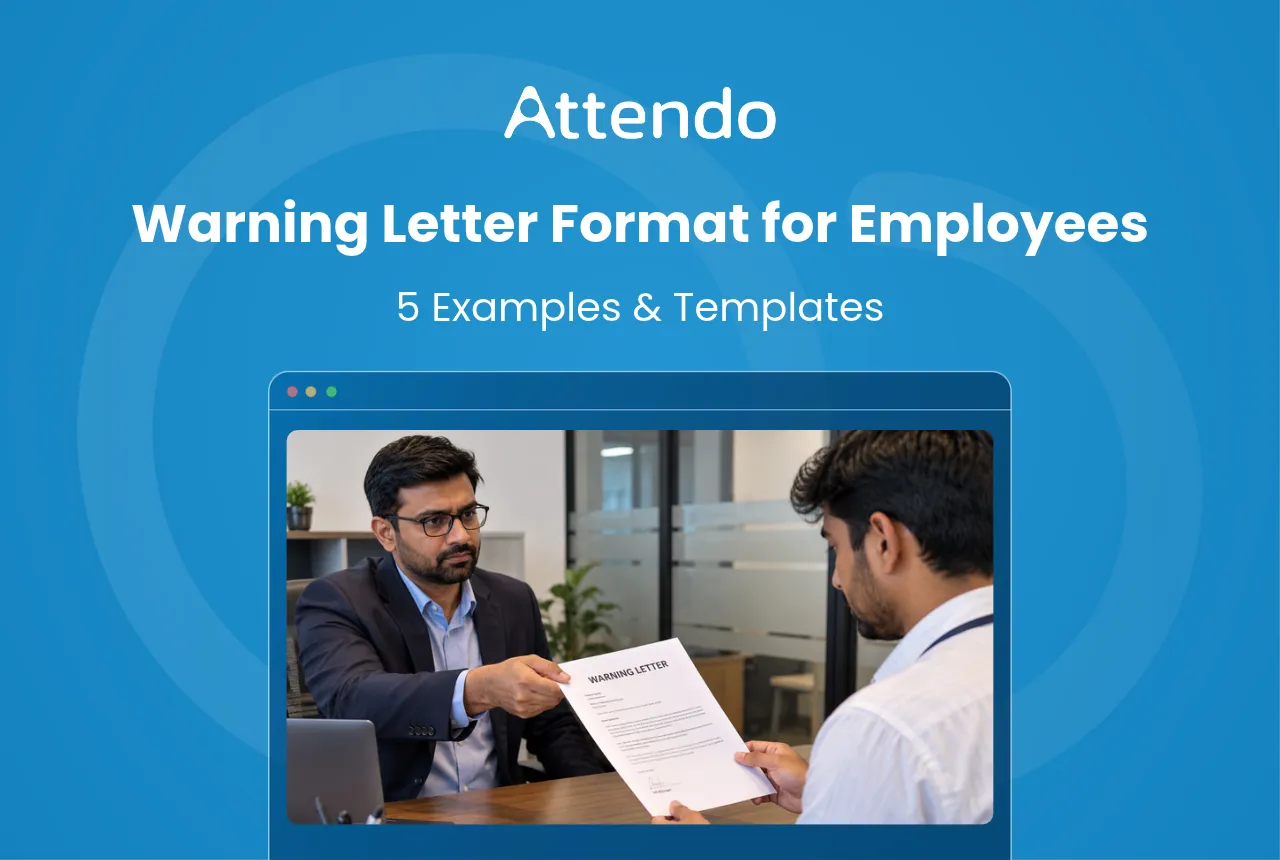
A warning letter to an employee puts a problem in writing and asks for it to stop. The right tone depends on the problem: formal, casual, strict, neutral, or a final warning.
Below are five formats, one for each tone. Then comes the point where a warning is not enough, and a show cause notice and a termination letter take over.
What surprised me in the Industrial Relations Code is that it never mentions a warning letter. Yet before a dismissal for a small lapse, it looks at the past record, and a warning letter is that record.
Key Takeaways
- Five tones cover most warnings, from a friendly note to a final warning.
- Match the tone to the problem, not to your mood on the day.
- A warning puts the problem on record; termination ends the job. The charge and hearing come between.
- Rush a dismissal over a minor lapse, ignoring the record, and the fine can reach ₹2 lakh.
What Is a Warning Letter to Employee?
A warning letter is a written record that a problem was raised. It names what happened, what has to change, and by when. It does not accuse the employee of misconduct that needs an inquiry.
Say a sales associate at an electronics store in Bengaluru arrives late six times in March 2026 (an example). A warning letter lists the dates, sets the expected start time, and says what happens if it continues.
Its real value comes later. If the lateness goes on and you act, the letter shows you weighed the past record, which the Second Schedule of the Industrial Relations Code, 2020 expects before a dismissal for a minor lapse.
5 Warning Letter to Employee Formats
Each format below fits one tone. Pick the tone that matches the problem, then change the details in the brackets. Where a letter mentions your human resources (HR) policy, use its real name.
| Tone | Use it for | Example |
|---|---|---|
| Formal | A first written warning for a repeated lapse | Late arrivals at a retail store |
| Casual | A small, first-time slip | Late timesheets at an IT services firm |
| Strict | A breach that puts people at risk | Missing safety gear at a factory |
| Neutral | Work that has slipped below the standard | Slow report turnaround at a diagnostic lab |
| Final | The last step before a show cause notice | Repeated unauthorised leave at a hotel |
Most formats share the same parts: the date, what happened, what must change, and what follows if it does not. The tone is what changes.
1. Formal Warning Letter
Use this for a first written warning about a repeated lapse, such as the late arrivals at the Bengaluru store.
Subject: Written warning for late arrival
Dear [Employee name],
Our attendance records show you arrived after the [start time] start on [number] days in [month]: [dates]. This is against the attendance rules in your appointment letter.
From [date], you are expected at work by [start time] every day. If late arrivals continue, further action may follow under our HR policy.
Please sign below to confirm you have received this letter.
[Name], [Designation]
2. Casual Warning Letter
Use this for a small, first-time slip, where a friendly note will do. It still goes on file, which is what makes it a warning.
Subject: A quick note about timesheets
Hi [Employee name],
Your timesheets for the last [number] weeks came in after the Friday deadline. I know it has been a busy stretch, but late entries hold up the team’s billing.
Could you get them in by the deadline every Friday from now on? Tell me if something is getting in the way.
This note will stay on your file as a first reminder.
Thanks, [Name]
3. Strict Warning Letter
Use this when a breach puts people at risk, such as a machine operator at a Coimbatore factory working without safety gear.
Subject: Warning for breach of safety rules
Dear [Employee name],
On [date], you were seen operating [machine] without [safety gear], in breach of the safety rules you signed on [date].
This is a serious breach. It puts you and others at risk. Any further breach will lead to disciplinary action, which may include a show cause notice.
Please sign below to confirm receipt.
[Name], [Designation]
4. Neutral Warning Letter
Use this when work has slipped and the facts should do the talking, such as slow report turnaround at a diagnostic lab in Hyderabad.
Subject: Warning about report turnaround
Dear [Employee name],
Between [date] and [date], [number] of the [number] reports you handled were released after the agreed turnaround of [time].
The expected standard is [time] for every report. Your manager will review your turnaround each week for [number] weeks, starting [date].
If the standard is not met, the next step will be a formal review under our HR policy.
[Name], [Designation]
5. Final Warning Letter
Use this as the last step before a show cause notice, such as for repeated unauthorised leave at a hotel in Jaipur.
Subject: Final warning for unauthorised leave
Dear [Employee name],
You were absent without approved leave on [dates]. You received a written warning for the same issue on [date], and a copy is attached.
This is your final warning. If there is another unauthorised absence, you will be issued a show cause notice and may face further disciplinary action under our HR policy.
Please sign below to confirm receipt.
[Name], [Designation]
For the stage-by-stage set, including show cause and suspension letters, our warning letter templates carry eight more formats.
Attendo (formerly Petpooja Payroll) is a complete workforce management system for every kind of business, running attendance, shifts, leaves, payroll and statutory filings in one place. Attendo has more than 40,000 users today. It is a product of Petpooja, building helpful products for Indian businesses since 2011.
Warning, Show Cause, Then Termination
A warning letter starts a path that can end in a show cause notice and then a termination letter. Each does a different job, and here they are side by side.
| What to compare | Warning letter | Show cause notice | Termination letter |
|---|---|---|---|
| What it does | Records a problem | Makes a specific charge | Ends the job |
| What it asks | Stop or improve | Explain, by a stated date | Nothing; it gives a decision |
| Usually comes after | Informal talks | A warning, or one serious act | A reply, and an inquiry if needed |
| Where it comes from | HR policy and practice | Practice, and the need for a fair hearing | The Code’s retrenchment rules, and standing orders at 300+ workers |
The next two parts cover what comes after the warning, starting with the charge.
When a Warning Is Not Enough
The next letter is a show cause notice. It is a formal charge: it states the specific act, with dates, and asks the employee to explain in writing why action should not be taken. The reply period is not fixed in the Code, so state it in the notice.
A pharmacist at a clinic chain in Hyderabad with a stock mismatch would get one that names the batch, the shortfall and the dates. “Misbehaviour” on its own is not a charge anyone can answer.
If the reply is not accepted, an inquiry usually follows, and the employee may be suspended while it runs. The rules on that are set out further down, with the rest of the law.
When It Ends in Termination
A termination letter gives the decision and the reason. There are two kinds, and mixing them up is costly. Our termination letter formats cover both.
- Dismissal after an inquiry is a punishment. The Industrial Relations Code’s definition of retrenchment (a job cut that is not a punishment), in section 2(zh), leaves it out, so the retrenchment rules on notice and compensation do not apply.
- Termination for any other reason, such as cutting a role, can be retrenchment, with its own notice and compensation.
Whichever kind it is, the letter should say so in plain words and give the reason. A letter that leaves the reason out is harder to defend later.
Is a Warning Letter Legally Required?
No. The Industrial Relations Code never requires a warning letter, or even names one. What it does is judge a dismissal in two ways that make the letters matter.
Unfair Labour Practices
The Second Schedule of the Code lists unfair labour practices, and section 84 bans them. One of them is dismissing a worker for a minor or technical lapse, without regard to the past record, so the punishment is out of proportion.
Another is dismissing someone “in utter disregard of the principles of natural justice”, meaning without a fair hearing, or “with undue haste”. Section 86(5) of the Industrial Relations Code, 2020 fines an unfair labour practice from ₹10,000 to ₹2 lakh.
Those two unfair practices are why the order of the letters matters.
Did You Know?
A second conviction for an unfair labour practice costs more. Section 86(6) sets a fine of ₹50,000 to ₹5 lakh, or up to three months in jail, or both.
The Code’s word is worker, which leaves out anyone employed mainly as a manager or administrator, and supervisors earning over ₹18,000 a month.
Suspension and Standing Orders
Standing orders are a firm’s formal service rules. The Code’s First Schedule lists what they cover, including misconduct, suspension and termination. The Labour Ministry’s compliance handbook confirms they apply at 300 or more workers.
Suspension has its own rule. Where the standing orders chapter applies, at 300 or more workers, section 38 expects the inquiry to finish ordinarily within 90 days.
Meanwhile the standing orders must provide a subsistence allowance: 50% of wages for those 90 days, rising to 75% after that if the delay is not the employee’s doing.
In Simple Words
First you warn the employee in writing. Then you ask them to explain. Only then do you decide, or the last letter can fail.
Employer Steps From Warning to Dismissal
This section is for the owner or HR manager sending the letters. Five steps keep the file sound.
- Write down what counts as misconduct. At 300 or more workers the Code’s standing orders chapter applies (section 28), and misconduct is one of the matters it lists. Smaller firms put it in the HR policy and the appointment letter.
- Warn in writing, and get a signature. A spoken warning leaves no past record to point to.
- Charge precisely in the show cause notice. Give the dates, the acts and the reply deadline.
- Read the reply before you decide. Deciding first risks the “undue haste” the Code lists as unfair.
- Match the penalty to the record. A first late arrival and a proven theft are not the same case.
The suspension rule in section 38 also applies at 300 or more workers, from the first day. Say a machine operator on ₹23,400 a month is suspended at a Coimbatore factory with 300 or more workers (an example).
The allowance is ₹23,400 × 50% = ₹11,700 a month for the first 90 days. If the inquiry runs longer through no fault of theirs, it becomes ₹23,400 × 75% = ₹17,550 a month.
When the job does end, section 17(2) of the Code on Wages, 2019 makes the final wages due within two working days. Our guide to writing an experience letter covers the paperwork that goes out with that final payment.
Disciplinary Letter Mistakes to Avoid
These five mistakes each weaken a case that was otherwise fair.
- The wrong tone, such as a casual note for a safety breach, which reads as if the breach did not matter.
- Opinions instead of facts, such as “careless attitude”, which the employee can dispute and you cannot prove.
- A copied letter with another employee’s name or dates left in, which undoes the record it was meant to build.
- Calling a dismissal a retrenchment, when section 2(zh) keeps the two apart and they follow different rules.
- A suspension with no allowance, when at 300 or more workers it is owed from day one.
A ChatGPT Prompt for Warning Letters
Here is my personal tip. If you are unsure of the tone, let an artificial intelligence (AI) assistant such as ChatGPT write the first draft from your notes, and keep the checking for yourself.
Paste the prompt below, fill in the brackets, and edit what comes back.
Write a warning letter to an employee in India.
Tone: [formal / casual / strict / neutral / final warning].
Business: [for example, a retail store].
What happened: [the issue, with dates].
Rule broken: [the policy or appointment letter clause].
What must change: [the expected behaviour], by [date].
Next step if it continues: [for example, a show cause notice].
Keep it to one page, stick to the facts I have given, use plain English, and end with a line for the employee to sign. Do not add any legal claims I have not given you.
Keep two cautions in mind. Leave out personal details such as the employee’s full name, ID and address, and add them to the final letter yourself. Then check every date against your attendance records, because the draft is only as accurate as the notes you give it.
My Opinion
I would treat the AI draft as a starting point only. Once the employee signs the letter, it becomes the past record a dismissal is judged against, so every line has to be true.
Where Attendo Fits
Many warning letters are about time: late arrivals, early exits, days missed. The letter is only as good as the record behind it.
Attendo’s daily punch report shows each employee’s raw punches for the day, and the attendance master shows first punch, last punch and hours worked. Both export to PDF for the file.
A mobile punch can capture a photo with every entry. The activity log shows who edited any attendance record, and when.
The attendance to salary workflow shows how those records reach payroll.
If you want the dates in a warning letter to come from a record rather than memory, you can see how Attendo works.
Got a Warning Letter as an Employee?
This section is for the employee who has received one of these letters, and these four steps put you on firmer ground.
- Read what it actually is. A warning asks you to change something, while a show cause notice needs a written reply.
- Reply in writing, on time. Keep a copy and note the date you sent it.
- Ask for the details behind a charge. A vague charge is hard to answer, and you can say so.
- If suspended, check your allowance. Where the Industrial Relations Code’s standing orders chapter applies, at 300 or more workers, section 38 makes it owed from the first day.
A front desk executive at a hotel in Jaipur (an example) who is warned about leave should keep the approved leave records. The reply is only as strong as the paper behind it.
Sending a Warning Letter to Employee
A warning letter to an employee works best when the tone fits the problem. Use formal for a repeated lapse and casual for a first slip. Use strict for a safety risk, neutral for slipping work, and final just before a show cause notice.
Whatever the tone, keep a signed copy on file. If the problem continues, a show cause notice and a termination letter will both rely on it.
If you want attendance records you can print straight into an employee’s file, attendohr.com is the place to start.
Frequently Asked Questions
1. How many warning letters before termination?
2. Can a warning letter be withdrawn?
3. Can an employee refuse to sign a warning letter?
4. Should a warning letter be in the employee’s language?
5. How long does a warning stay on an employee’s file?
6. Can a warning letter be sent by email?
Listen to this article
Related Articles You May Like
6 Employee Background Verification Checks Before You Hire
Hiring someone, or being checked yourself? Here are the six background verification checks, what each one proves, and the data rules that apply from May 2027.
Ashwiniba Vaghela
HR & Payroll Experts
Relieving Letter vs Experience Letter: Definition and Difference
What each document is, and why only the experience letter can be demanded, and only from a larger employer. A relieving letter rests on company practice alone.
Ashwiniba Vaghela
HR & Payroll Experts

Why Accrued Leave Is Not the Same as Earned Leave
The phrase earned leave is in the labour code on safety and working conditions. Accrued leave is not. And earned leave belongs to two jobs most of your staff do not hold.
Avani Joshi
HR & Payroll Experts
Notice Period Rules in India and What Actually Applies
Three instruments set the notice period rules in India, and only two of them are the Code. The third is the letter you wrote when the person joined.
Avani Joshi
HR & Payroll Experts