


Form 12BB vs Form 16, and the New Numbers That Replaced Them
One form carries the employee’s tax claims in, the other carries the employer’s certificate out. Both were renumbered on 1 April 2026.
Listen to this article
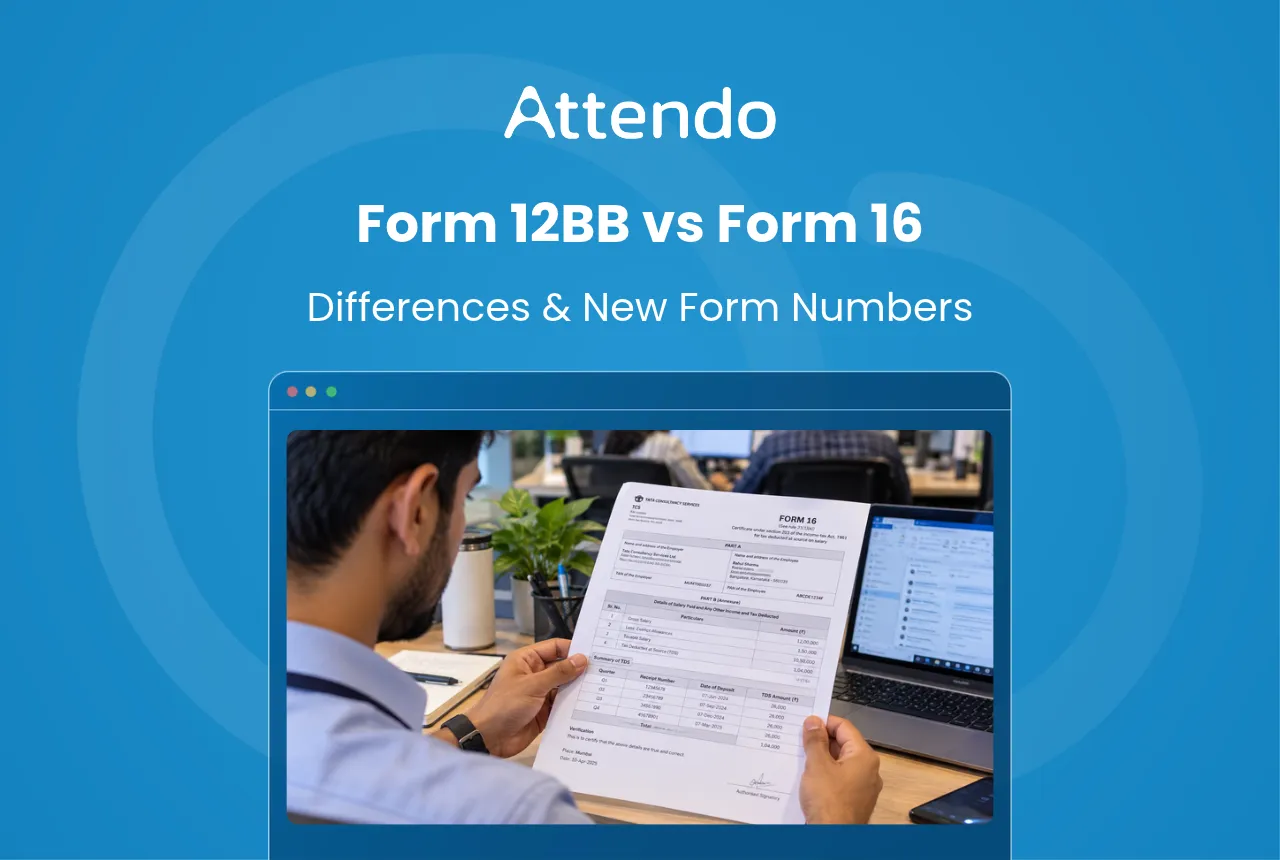
Form 12BB is what an employee gives the employer, to claim tax deductions. Form 16 is what the employer gives back after the year, to show the tax cut from salary.
Since 1 April 2026 both have new numbers. Form 12BB is now Form 124 and Form 16 is now Form 130, under the Income-tax Rules, 2026.
What struck me reading the new rules is that neither form’s job changed. Only the numbers did. This post shows who fills each form, when it is due, and how one leads to the other.
Key Takeaways
- Form 12BB goes in, Form 16 comes out. Claims set monthly tax; the certificate reports it.
- Both are renumbered, as Form 124 and 130, so old templates are out of date.
- High rent needs the landlord’s Permanent Account Number (PAN), or payroll cannot check it.
- Changed jobs? Each employer owes you a certificate for your months there.
Form 12BB vs Form 16 at a Glance
They travel in opposite directions, at opposite ends of the year. Here is the difference side by side.
| Form 12BB (now Form 124) | Form 16 (now Form 130) | |
|---|---|---|
| Who fills it | The employee | The employer |
| Who receives it | The employer | The employee |
| What it does | Lists claims, with proof or details | Certifies tax deducted |
| When | No date in the rule | By 15 June after the tax year |
| The rule | Rule 205 | Rule 215 |
Tax deducted at source (TDS) is the thread between them. The claims on Form 124 decide how much is cut each month, and Form 130 reports what was actually cut.
The next two sections take each form in turn, starting with the one the employee fills.
What Is Form 12BB, Now Form 124?
It is the employee’s statement of claims. Rule 205 of the Income-tax Rules, 2026 says the employee gives it to the employer so the employer can estimate the year’s income and work out the tax to deduct.
The rule lists four kinds of claim, and what has to come with each:
| The claim | What the employee gives |
|---|---|
| House rent allowance (HRA) | Landlord’s name, address and PAN if rent crosses ₹1,00,000 a year, and any relationship with the landlord |
| Leave travel concession or assistance | Evidence of expenditure |
| Home loan interest, under house property | Lender’s name, address and PAN |
| Deductions for investments and similar spending (Chapter VIII) | Evidence of investment or expenditure |
PAN is the Permanent Account Number. The relationship detail is the one people miss: a store manager at a garment showroom in Surat who pays rent to a parent has to say so.
Our Form 12BB template is already on the Form 124 layout, if you need the form itself rather than the explanation.
What Is Form 16, Now Form 130?
It is the employer’s certificate of tax deducted from salary. Rule 215 says it is generated and downloaded from the income tax portal, and issued by 15 June of the year after the tax year.
So for the tax year that began on 1 April 2026, the certificate is due by 15 June 2027.
The certificate comes in three parts, which the rule names Parts A, B and C. Rule 215 names the parts without describing them; the form itself sets out what each holds.
Our Form 16 guide for employers explains each part. The split matters most when somebody changes jobs, which the employee section below covers.
Did You Know?
Rule 215(4) lets the employer sign Form 130 digitally. It is an option, not a requirement.
How Does Form 12BB Feed Into Form 16?
Form 124 opens the tax year and Form 130 closes it. Every salary in between carries tax worked out from the claims, and rule 215 wants the certificate out by 15 June. Here is that year in order, for a single employee.
- At the start of the tax year, the employee says whether they stay on the default tax rates or opt out, which is their tax regime, and hands in Form 124 with the claims they expect to make.
- Every month, payroll works out the tax on the year’s estimated income, after those claims, and cuts a share from salary.
- Every quarter, the employer files the salary TDS return, now called Form 138.
- Before year end, the employee sends proof of the claims, and payroll settles the last months on what was proved.
- By 15 June, the employer issues Form 130, which reports the tax actually deducted.
In Simple Words
Form 124 goes to your employer and lists your claims. Form 130 comes back after the year. It shows the tax taken from your pay.
TDS is one of several deductions payroll makes each month. Professional tax is another, and it follows state rules instead of the Income-tax Act.
Form 130 reports the tax actually deducted, so it rests on the claims payroll accepted.
Attendo (formerly Petpooja Payroll) is a complete workforce management system for every kind of business, running attendance, shifts, leaves, payroll and statutory filings in one place. Attendo has more than 40,000 users today. It is a product of Petpooja, building helpful products for Indian businesses since 2011.
Collecting Form 12BB and Issuing Form 16
This section is for the person running payroll. Four things fall to the employer.
1. Collect Form 124 Early
Rule 205 sets no deadline, so the date is yours. A hotel in Jaipur that asks in April can cut the right tax from the first salary. One that asks in January has taxed nine months as if there were no claims, and has three months left to correct it.
2. Check the Details the Rule Asks For
Look for the landlord’s PAN on any rent above ₹1,00,000 a year, and the lender’s PAN on home loan interest. A blank is easier to fix in April than in March.
3. Apply the Right Tax Regime
Section 202(1) of the Income-tax Act, 2025 makes the new tax rates the default unless the employee opts out. Under it, section 202(2) switches off Chapter VIII, the part of the Act that holds deductions for investments and similar spending, except for a few named sections.
Section 202(2) also switches off several exemptions. So ask for the regime before you read the claims. An analyst at an IT services firm in Pune with a long list of investments may save nothing on the default.
4. Issue Form 130 by 15 June
Say a diagnostic lab in Hyderabad loses a technician in October. It still owes that person a certificate for April to October. Rule 215(1) covers every employee whose tax was deducted, and makes no exception for leavers.
How to Submit Form 12BB and Read Form 16
This section is for the employee. There are four steps, and the fourth, checking the certificate, is the easiest to forget.
- Choose your regime first. It decides which of your claims can lower your tax.
- Hand in Form 124 early, with the landlord’s PAN ready if your rent crosses ₹1,00,000 a year.
- Keep proof as you pay. Receipts gathered in March are the ones that go missing.
- Check Form 130 against your payslips. The tax on the certificate should match the total cut across the year’s payslips.
If you changed jobs, ask each employer for its Parts A and B. Rule 215(2) lets you choose whether Part C comes from each employer or only the last one. A machine operator who moved between two auto component plants in Chennai needs a certificate from each plant.
Common Form 12BB and Form 16 Mistakes
Five mistakes come up again and again, on both sides of the payroll desk.
- An old Form 12BB template. The 2026 rules ask for Form 124, so use the new layout.
- No relationship with the landlord. Rule 205 asks for it next to the PAN.
- The regime asked last. Under the default regime, most Chapter VIII claims reduce nothing.
- One certificate after a job change. Each employer issues Parts A and B for its own months.
- A certificate after 15 June. Rule 215 fixes the date, and makes no exception for leavers.
Most of the five are cheaper to prevent in April than to fix in June. If your payroll still runs on a spreadsheet, our Attendo vs manual payroll comparison sets the two ways of working side by side.
My Opinion
I would write a Form 124 deadline into your human resources (HR) policy and tell every new joiner about it. A date nobody wrote down is the one everybody misses.
Where Attendo Fits
Most of the work between the two forms is recalculation. A claim is added, a proof goes missing, a regime changes, and the tax for the rest of the year has to move.
In Attendo, TDS is worked out under the regime chosen for each employee. When declarations change mid-year, it can be recalculated in bulk for a whole payroll group.
A single month can also be adjusted by hand, for a correction after a proof arrives. For a mid-year joiner, salary and TDS from the previous employer go into the yearly projection.
The attendance to salary workflow shows where tax sits in the monthly run.
If you want TDS to follow the declarations without a spreadsheet, you can see how Attendo works.
Using Form 12BB and Form 16 Now
Form 12BB and Form 16 still do the same two jobs. Form 12BB takes the employee’s claims to the employer. Form 16 brings the tax certificate back.
From the tax year that began on 1 April 2026, the Income-tax Rules, 2026 use new numbers: Form 124 for the declaration and Form 130 for the certificate. Collect early, check the regime first, and issue by 15 June.
To work out the house rent exemption, use our HRA exemption calculator. If you want TDS recalculated in one go when declarations change, attendohr.com is the place to start.
Frequently Asked Questions
1. What is the difference between Form 12BB and Form 16?
2. Is Form 12BB still valid?
3. Does Form 124 go to the income tax department?
4. What if an employee loses Form 130?
5. Do pensioners get Form 130 too?
6. Which other forms sit next to Form 124?
Listen to this article
Related Articles You May Like

Why Dearness Allowance Keeps Rising and Who Actually Gets It
Does dearness allowance reach private pay as well? See the current central DA rate, how it is set, VDA in minimum wages, and how DA is taxed.
Avani Joshi
HR & Payroll Experts

Retention Bonus Means Extra Pay for Staying, Taxed as Salary
Offered money to stay on? A retention bonus falls due on the agreed date, is taxed as salary, and is hard to claw back once paid.
Avani Joshi
HR & Payroll Experts
5 Examples to Calculate Bonus for Employees
The statutory bonus follows the Code on Wages, while performance and festival bonuses follow policy. Five worked examples show how each is calculated.
Avani Joshi
HR & Payroll Experts

Is a Diwali Bonus Taxable? What TDS You Must Deduct
Tax on a festival payout is not a flat percentage, and the money does not always move in the same tax year the charge lands. Both catch payroll teams out.
Ashwiniba Vaghela
HR & Payroll Experts