


Attendo (formerly Petpooja Payroll) vs Manual Payroll
Spreadsheet payroll rarely breaks loudly. It leaks an hour here and a wrong deduction there. Here is what changes once a system does the counting.
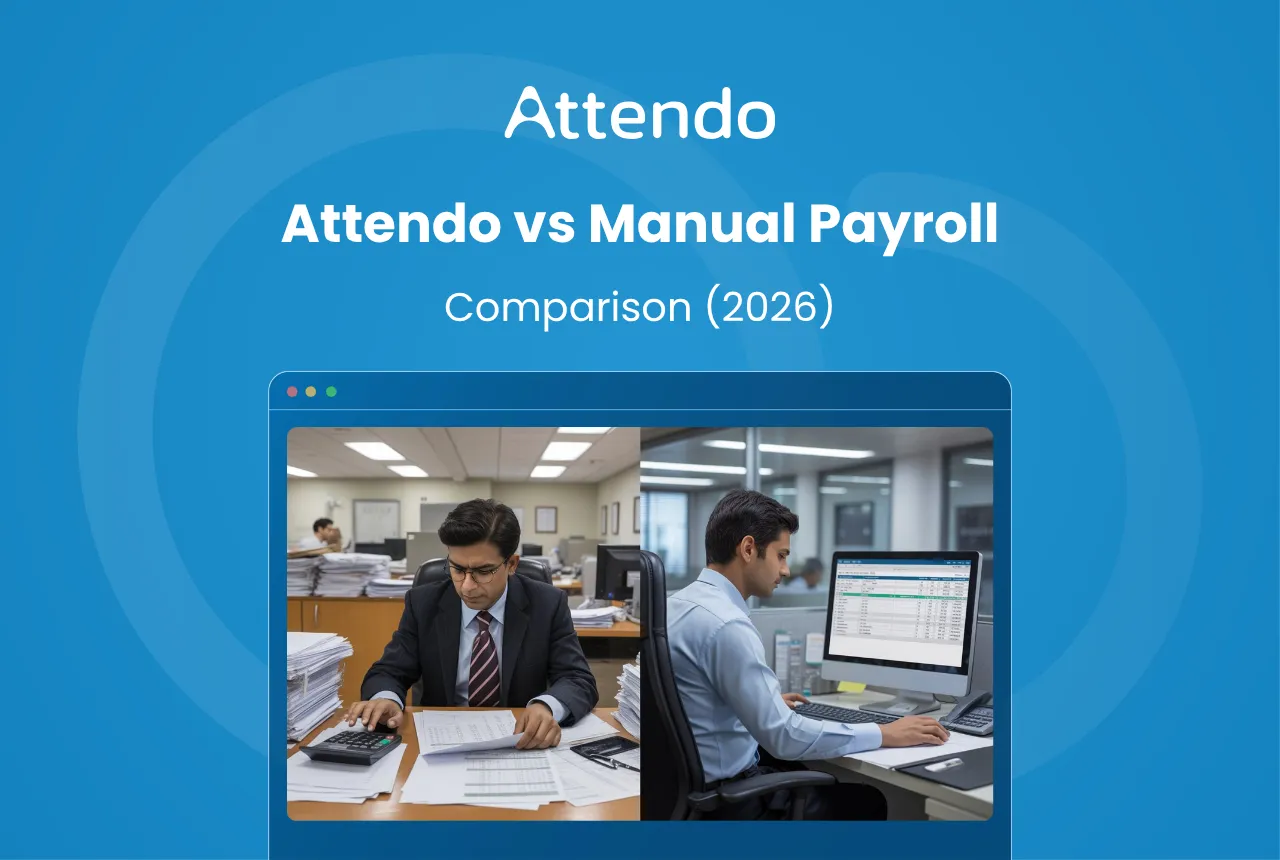
If you’re still running payroll on spreadsheets and registers, month-end probably eats the best part of a working week. Collecting attendance, reconciling leave, working out overtime and building payslips by hand is slow whichever way you cut it.
With India’s payroll services market growing at 7.41% CAGR and projected to hit USD 2.74 billion by 2031 (Mordor Intelligence, 2025), businesses are clearly moving away from manual methods. But is payroll software actually worth it for your business?
Attendo is a complete workforce management system for every kind of business, running attendance, shifts, leaves, approvals, payroll and statutory compliance in one place. This guide compares it with manual payroll across five categories: accuracy, time, compliance, cost and scalability.
Key Takeaways
- Payroll errors are common in Indian businesses, and most of them trace back to manual data entry rather than the rules themselves.
- Automating the attendance-to-payslip chain turns a multi-day job into a review-and-approve one.
- The cost of manual payroll is mostly hidden: rework, penalties and the staff time spent chasing attendance every month.
- Attendo suits any business where attendance drives pay; a handful of people on flat salaries can still manage by hand.
Quick Comparison: Manual Payroll vs Attendo
Here’s a side-by-side look at how the two methods stack up across the metrics that matter most.
| Category | Manual Payroll | Attendo |
|---|---|---|
| Best for | Micro-businesses with <5 employees | Any business where attendance feeds pay |
| Monthly processing time | Most of a working week | Review and approve, then done |
| Error rate | High, and rises with headcount | Near-zero (automated calculations) |
| PF/ESIC/TDS compliance | Manual tracking, error-prone | Auto-calculated, deadline alerts |
| Attendance tracking | Paper registers or basic Excel | Biometric + face recognition + geo-tagged app |
| Employee self-service | None | Mobile app for payslips, leave requests |
| Multi-outlet support | Extremely difficult | Built-in, centralised dashboard |
| Reporting | Manual compilation | One-click PDF reports, plus a daily attendance summary on WhatsApp |
| Scalability | Breaks down as headcount and sites grow | Scales to any headcount |
| Overall verdict | Risky and time-consuming | Winner for most Indian businesses |
Which Method Has Fewer Payroll Errors?
Payroll errors are common wherever salaries are worked out by hand, and most of them come from manual data entry: wrong attendance counts, miscalculated overtime, or incorrect deduction amounts.
When salary calculations happen on spreadsheets, even a small typo in one cell cascades through the entire payroll. One missed decimal point on an overtime rate can mean 20 employees get the wrong amount. Fixing it takes days, and staff trust takes longer to rebuild.
Attendo eliminates this by pulling attendance data directly from biometric devices and calculating salaries automatically. There’s no manual entry step where errors can creep in. The system applies PF, ESIC, and TDS rules on its own, so deductions are accurate every single time.
Verdict: Attendo wins on accuracy by a wide margin.
Which Saves More Time Every Month?
Manual payroll is a time sink. The month-end job is collecting attendance records, calculating overtime, applying deductions and preparing salary slips, one after another. In a business of any size that is most of a working week.
Here’s where those hours go in a manual setup:
- Attendance compilation: gathering paper registers or Excel sheets from every department
- Leave reconciliation: cross-checking leave applications against actual absences
- Salary calculation: applying different pay structures, overtime rates, and shift allowances
- Deduction processing: calculating PF, ESIC, TDS, and professional tax for each employee
- Payslip generation: creating individual salary slips and distributing them
With Attendo, attendance flows in from the device and the mobile app, and the system handles the calculations. What is left is review and approval.
The relief owners describe is rarely the hours. It is not having to chase department heads for attendance data at month-end.
For a business owner, that is time back for the work only they can do.
Verdict: Attendo wins. It turns a week-long process into a few hours.
Why Compliance Penalties Catch Businesses Off Guard
Usually because the deadlines are tracked in someone’s head. Manual tracking of PF, ESIC and TDS dates is one of the most common reasons a penalty lands.
The penalties aren’t small either. On provident fund arrears the employer owes damages of 1% of the amount for every month it is late, which is 12% a year under the EPFO notification of 14 June 2024, plus interest of a further 12% a year under Section 7Q.
With manual payroll, you’re relying on someone to remember every deadline, apply the right rates, and file correctly. One missed date means penalties that eat directly into your profit.
Attendo handles this automatically. It calculates PF, ESIC, and TDS based on current rules, sends deadline reminders, and generates compliance-ready reports. You don’t need to track regulatory changes yourself, because the system stays updated.
Verdict: Attendo wins. Automated compliance tracking removes the biggest financial risk of manual payroll.
Which Costs Less in the Long Run?
Most business owners think manual payroll is cheaper because there’s no software subscription. That’s a mistake. The hidden costs add up fast.
Errors cost real money before any penalty is counted: the rework, the corrected payments, and the hours spent finding what went wrong in the first place.
Here’s what manual payroll actually costs when you add it all up:
- The hours someone spends collecting and reconciling attendance every month
- Corrections and repayments when a calculation is wrong
- Statutory penalties when a deadline slips
- The goodwill lost when someone is paid late or short more than once
That last one is the expensive one. Replacing someone who leaves costs far more than the software that would have paid them correctly.
Attendo bundles the biometric device into the package with a lifetime warranty, so the comparison is not software against nothing. It is one annual fee against the hours and the risk that manual processing carries every month.
Verdict: Attendo wins on total cost. Manual payroll only looks cheaper on the surface.
Which Scales Better as Your Business Grows?
The pattern across multi-site businesses is the same: manual payroll holds up at one location, then stops holding up once there are three.
Manual payroll doesn’t scale because every new employee adds complexity. Different shift patterns, different locations, different overtime rules. An HR manager handling 20 employees on spreadsheets might manage. At 50 employees across multiple outlets? Errors multiply, deadlines get missed, and the process consumes entire weeks.
Attendo is built for exactly this growth path. It supports multi-outlet businesses from a single dashboard, handles flexible shift modules, and tracks attendance across locations through both biometric devices and a geo-tagged mobile app. Adding 10 new employees doesn’t mean more work just more rows processed automatically.
With more than 40,000 businesses already using Attendo across manufacturing, corporate offices, retail and hospitality, the system is proven at scale. Whether you have 10 employees or 500, the processing time stays roughly the same.
Who Should Choose What?
Micro-businesses with fewer than 5 employees and simple salary structures: Manual payroll can still work if you have a flat salary, no overtime, and minimal compliance requirements. But even here, the risk of errors exists.
Businesses with 10 to 50 employees: Choose Attendo. At this size, manual payroll is already costing you more than software in time, errors, and compliance risk. The biometric attendance and auto-compliance features alone justify the switch.
Multi-outlet businesses or chains: Attendo is the only practical option. Managing payroll manually across multiple locations is a recipe for inconsistency and missed deadlines. If you’re running restaurants, retail stores, or manufacturing units across cities, check how Attendo’s features handle multi-outlet complexity.
Still unsure? If your current payroll process takes more than a day each month, or if you’ve faced even one compliance penalty in the past year, it’s time to automate.
| Category | Winner |
|---|---|
| Accuracy | Attendo |
| Time savings | Attendo |
| Compliance | Attendo |
| Long-term cost | Attendo |
| Scalability | Attendo |
| Overall | Attendo |
Conclusion
Manual payroll costs Indian businesses more than they realise in time, money, compliance penalties and employee trust. For any business with 10 or more employees, Attendo is the clear winner across every category that matters.
Every step a system does for you is a step where nothing can be mistyped, forgotten or lost.
If you would rather stop paying for payroll mistakes in rework, penalties and staff goodwill, explore Attendo to get started.
Want to understand the full feature set first? Read our detailed guide on what Attendo offers or learn how to calculate payroll step by step.
Frequently Asked Questions
Is payroll software worth it for a business with just 10 employees?
Can I switch from manual payroll to Attendo mid-year?
Does Attendo work for restaurants and retail stores?
Is manual payroll still legal in India?
Related Articles You May Like
What a Day of Leave Without Pay Actually Costs
Leave without pay does more than dock a day’s salary. It reaches your provident fund, your ESI, the service behind a gratuity payment and the balance you build for the year ahead.
Ashwiniba Vaghela
HR & Payroll Experts
How to Complete the ESI Registration Process in 8 Steps
Registration is online, real time, and needs no paper at all. The state that wants 20 workers where its neighbour wants 10, what the C-11 letter proves, and why the amnesty no longer helps.
Ashwiniba Vaghela
HR & Payroll Experts
Expected CTC: 7 Ready-to-Use Answers for Your Next Interview
The question asks what you would cost, not what you would receive. Seven lines to use in an interview, the reasoning that backs each of them, and why the law measures a different figure from the one in an offer.
Avani Joshi
HR & Payroll Experts

How the ESIC Claim Process Works for Employees
One form per benefit, one office, and a three-day rule on medical certificates that quietly costs people money. What each claim pays, and how fast ESIC has to pay it.
Avani Joshi
HR & Payroll Experts