


How the ESIC Claim Process Works for Employees
One form per benefit, one office, and a three-day rule on medical certificates that quietly costs people money. What each claim pays, and how fast ESIC has to pay it.
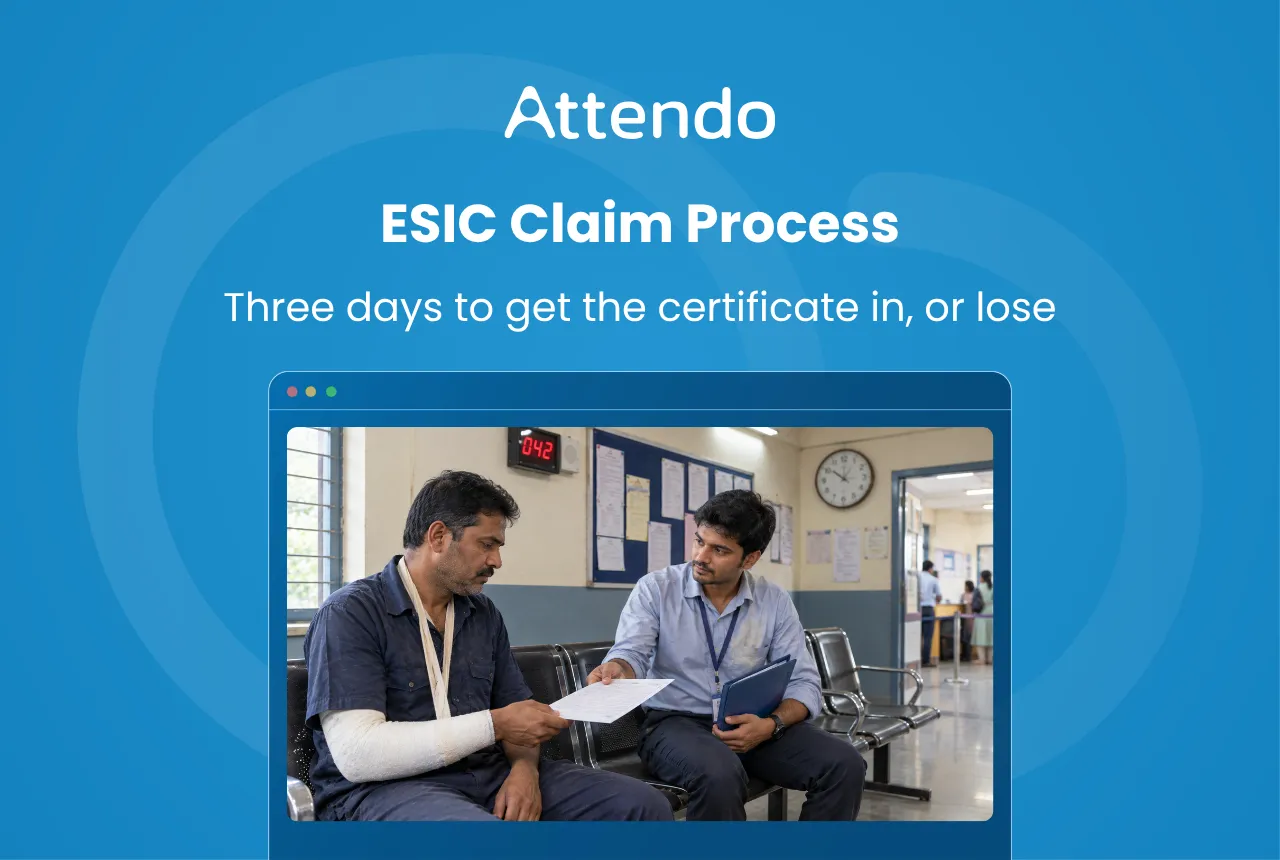
The ESIC claim process runs on one form per benefit. You hand it in at your branch office, the local arm of the Employees’ State Insurance Corporation. With it goes the certificate that proves the claim.
The form decides everything after it. Form 9 for sickness, Form 19 for maternity, Form 15 for a death caused at work, Form 22 for funeral expenses.
The part people lose money on is timing. A medical certificate that sits in a drawer for a week costs real days of benefit.
This page covers what you can claim and which form each one needs. It also covers how quickly ESIC must settle it, and what to do about medical bills you paid yourself.
Key Takeaways
- What it is: the ESI (Employees’ State Insurance) claim process is how an insured employee turns a benefit into money.
- Where it goes: your ESIC branch office, in writing, on the form for that benefit.
- What it pays: 70% of wages for ordinary sickness, 90% for an injury, full wages for maternity.
- On a death at work: 90% of wages as a monthly pension to the dependants.
- On any death in insurable employment: ₹15,000 towards the funeral, to whoever paid for it.
- How fast: seven days for sickness, three months for a first dependants’ payment.
- The trap: a medical certificate that reaches the office more than three days after it was issued starts costing you benefit days.
- Medical bills you paid: reimbursable in listed situations within a year, and the one claim that does not go to your branch office.
What the ESIC Claim Process Covers
This section covers what is actually claimable: cash for the events that stop you working, each at its own rate, with treatment running alongside.
Most people know ESIC as a hospital card. The cash side is the part that gets left on the table, by staff who were never told it was there.
| What has happened | What ESIC pays | For how long |
|---|---|---|
| You are ill and certified unfit | 70% of wages | Up to 91 days in a year |
| A long-term illness on the approved list | 80% of wages | Up to two years |
| You were hurt at work | 90% of wages | As long as the disability lasts |
| The injury left lasting damage | 90% of wages, cut to match how much earning power was lost | Monthly, for life |
| You are pregnant | Full wages | 26 weeks |
| An insured worker died of a work injury | 90% of wages to the dependants | Monthly, for as long as each dependant qualifies |
| An insured worker died, any cause | ₹15,000 towards the funeral | One payment |
ESIC publishes these rates with the conditions attached to each, and the conditions are where the differences sit. Funeral expenses, for one, are payable from day one of insurable employment with no waiting period.
In Simple Words
Ordinary sickness pays 70%, an injury pays 90%, maternity pays the full wage. The worse the event, the higher the rate, and an injury at work needs no contribution history behind it.
There is one more, for unemployment. An insured person out of work can claim unemployment relief at 50% of wages, for up to 90 days, once in a lifetime.
It becomes payable 30 days after the job ends, and needs a year of insurable employment behind it.
That scheme runs for a set period at a time, and the period gets extended. Ask your branch office whether it is currently open before you count on it.
Who Can Claim, and What It Takes
This section covers the contribution test. Sickness asks for 78 paid days, maternity for 70, unemployment relief for a year on the books, and an injury at work for nothing at all.
Cover from day one is wider than it first looks. It reaches the pension paid to dependants after a fatal injury, and the funeral payment is free of the test as well.
Everything else is earned by days paid in, and the days are counted inside a contribution period. That is one of the two halves ESIC splits the year into, April to September and October to March.
Three tests use those halves:
- Sickness needs 78 days of contribution in the relevant contribution period.
- Maternity needs 70 days, across the one or two contribution periods immediately before.
- Unemployment relief needs a year of insurable employment, and 78 days in the completed contribution period before the job ended.
What you are paid is worked out on the standard benefit rate, not on your last payslip. ESIC defines that rate as the total wages paid in the contribution period, divided by the days those wages covered.
Did You Know?
A person who joined last month and broke an arm on the shop floor is covered in full. A person with ten years of service and a bad fever is not, unless the 78 days are there.
The ESIC Claim Process, Step by Step
This section walks the sequence, from the event to the money. Each benefit uses its own form, and the ESI (General) Regulations, 1950 set both the form and the deadline.
- Report it, the same day where you can. For an accident, the employee tells the employer as soon as practicable, by word or in writing. Somebody else may give that notice on their behalf, which matters when the worker is in no state to give it.
- Make the employer file Form 12. A fabrication unit whose welder falls has to send the accident report immediately if the injury is serious, and within 48 hours otherwise.
- Get the certificate from an ESIC doctor. Sickness and temporary disablement both run on medical certificates issued by an Insurance Medical Officer, not by a doctor of your choosing.
- Get it in within three days of the date on it. This is the step that costs people money, and it is worth its own explanation below.
- Fill the form for that benefit. The table below maps each one. Getting it wrong is survivable: the regulations let ESIC treat a claim made on the wrong approved form as though it were on the right one.
- Take it to the branch office. Claims go to the branch office in writing, by post or by hand.
- Wait out the statutory clock. Sickness is seven days, maternity fourteen, funeral expenses fifteen, disablement a month and a first dependants’ payment three months. A payment that misses its limit is reported to the regional office rather than quietly dropped.
Which Form, and Who Signs It Off
| What you are claiming | Form | Who certifies eligibility |
|---|---|---|
| Sickness, or disablement while it is temporary | Form 9 | Branch office |
| Maternity | Form 19, with the Form 18 certificate | Branch office |
| Funeral expenses | Form 22 | Branch office |
| Permanent disablement | Form 14 | Regional office |
| Dependants’ benefit, first claim | Form 15 | Regional office |
| Dependants’ benefit, later payments | Form 16 | Regional office |
Read that last column carefully. It names who signs the claim off, not where you post it. Every claim in the table goes to the branch office.
What changes is who signs it off. The branch office settles sickness, maternity, temporary disablement and funeral expenses itself.
Permanent disablement and dependants’ benefit go up to the regional office, which is why those two take longer to pay.
The Three-Day Certificate Rule
A medical certificate has to reach the branch office within three days of the date it was issued.
Miss it, and the benefit only starts running three days before the day you actually hand the certificate in. Everything earlier is gone.
On a second or later certificate for the same illness, that window is fourteen days rather than three.
The certificate is not the claim. It is the evidence, and evidence goes stale on a schedule.
If Maternity Is the Claim
Maternity runs on two certificates and two separate clocks.
The expected-confinement certificate is issued in the last 50 days before the due date, and not before that. The confinement certificate goes in within 30 days of the birth itself.
How to Claim ESIC Medical Expenses
This section covers money you have already spent, which follows a different route from every other claim on this page.
ESIC normally gives treatment rather than money. Where that was not possible, reimbursement is allowed in eleven listed situations.
They include an emergency admission elsewhere, a medicine the dispensary did not have, and an ambulance that was not available.
It goes to the ESI Scheme office run by your state government, not to your branch office.
The claim has to carry the actual receipts and vouchers. Your branch office can point you to the right address.
You have one year from spending the money. That is generous against the three-day certificate rule, and it is still missed, because a pharmacy bill is not something most people think to file.
In Simple Words
Keep every bill, every prescription and every receipt from the day something goes wrong. Without the paper there is no reimbursement, however genuine the emergency was.
ESIC Death Claim Amount, and Who Gets It
This section covers what is payable when an insured worker dies, which splits into two separate claims.
Where the death came from an injury at work, the dependants’ benefit is a monthly pension, divided among the dependants in set shares. The rate is 90% of wages, and there is no contribution condition to satisfy.
The funeral payment is separate and much simpler. ₹15,000 goes to whoever actually bore the cost, and it is payable on any death in insurable employment, not only a death at work.
| Who is claiming | How long it runs |
|---|---|
| The widow | For life, or until she remarries |
| A son | Until he turns 25 |
| An unmarried daughter | Until she turns 25, or marries, whichever is first |
| A child who is infirm | For as long as the infirmity lasts |
Three months is the longest of the payment deadlines. A family with no income coming in should file the Form 15 claim immediately rather than waiting for the paperwork to feel complete.
Where the ESIC Claim Process Goes Wrong
The failures repeat, and they usually start on the employer’s side of the desk.
| Type of business | What goes wrong |
|---|---|
| Manufacturing unit | The accident report is filed late, so the injury is argued about instead of paid |
| Retail chain | Staff are never told the cash benefits exist, so only the hospital card is used |
| Hospital or diagnostic lab | Contribution gaps in the record, so the 78-day test fails on paper |
| School or coaching institute | Part-time staff assumed to be outside the scheme, so no claim is ever made |
| Hotel or restaurant group | Certificates collected at the outlet and sent on weekly, past the three-day window |
Read down that second column and the pattern is the same each time. What fails is the paperwork or the awareness, not the entitlement.
Attendo (formerly Petpooja Payroll) is a complete workforce management system for every kind of business, running attendance, shifts, leaves, approvals, payroll and statutory compliance in one place.
The contribution record is built from the attendance to salary workflow every month. So the paid days behind a claim are already counted when somebody asks for them.
Your ESIC Claim Process Checklist
Run any claim past six questions before it leaves your hands.
- Does this benefit need contribution days, and are they in the record?
- Is the certificate from an Insurance Medical Officer rather than a private doctor?
- Is the certificate still inside its three-day window?
- Is it the right form for this benefit, and is it signed?
- Is this one the regional office has to certify, so it will take longer?
- For a bill you paid yourself, are the receipts still together and inside the year?
Keep the worker’s insurance number, which is their ESIC number, and the e-Pehchan identity card somewhere the family can reach them. Our guide to finding an ESIC number covers how to trace one that has gone missing.
Getting Your ESIC Claim Paid
The scheme is procedural, and the procedure runs on dates.
The contribution days behind a claim are settled long before anybody falls ill. Whether the paper arrives on time is the part still in your hands.
So the useful habit is small. When something happens, get the certificate that week, keep the paper together, and get it to the branch office while the three days are still running.
For the other statutory claim your staff will ask about, see our guide to EPF (Employees’ Provident Fund) forms.
Frequently Asked Questions
Q1. What is the ESI claim process for an employee?
Q2. How long does ESIC take to pay a claim?
Q3. What is the ESIC death claim amount?
Q5. Does an employee need contribution days to claim for an accident at work?
Related Articles You May Like
How to Complete the ESI Registration Process in 8 Steps
Registration is online, real time, and needs no paper at all. The state that wants 20 workers where its neighbour wants 10, what the C-11 letter proves, and why the amnesty no longer helps.
Ashwiniba Vaghela
HR & Payroll Experts
Expected CTC: 7 Ready-to-Use Answers for Your Next Interview
The question asks what you would cost, not what you would receive. Seven lines to use in an interview, the reasoning that backs each of them, and why the law measures a different figure from the one in an offer.
Avani Joshi
HR & Payroll Experts

How the ESI Salary Limit Works, and Who It Covers
₹21,000 a month, unchanged since 2017. The three routes that bring a workplace into the scheme, why a raise in July does not end cover in July, and the 135 districts still outside it.
Avani Joshi
HR & Payroll Experts
How Many PF Advance Withdrawals Can You Claim?
Education now allows ten claims and marriage five, where three covered both before. What the October 2025 rules changed, who qualifies after 12 months, and why the COVID advance is no longer on the list.
Avani Joshi
HR & Payroll Experts