

How Many PF Advance Withdrawals Can You Claim?
Education now allows ten claims and marriage five, where three covered both before. What the October 2025 rules changed, who qualifies after 12 months, and why the COVID advance is no longer on the list.
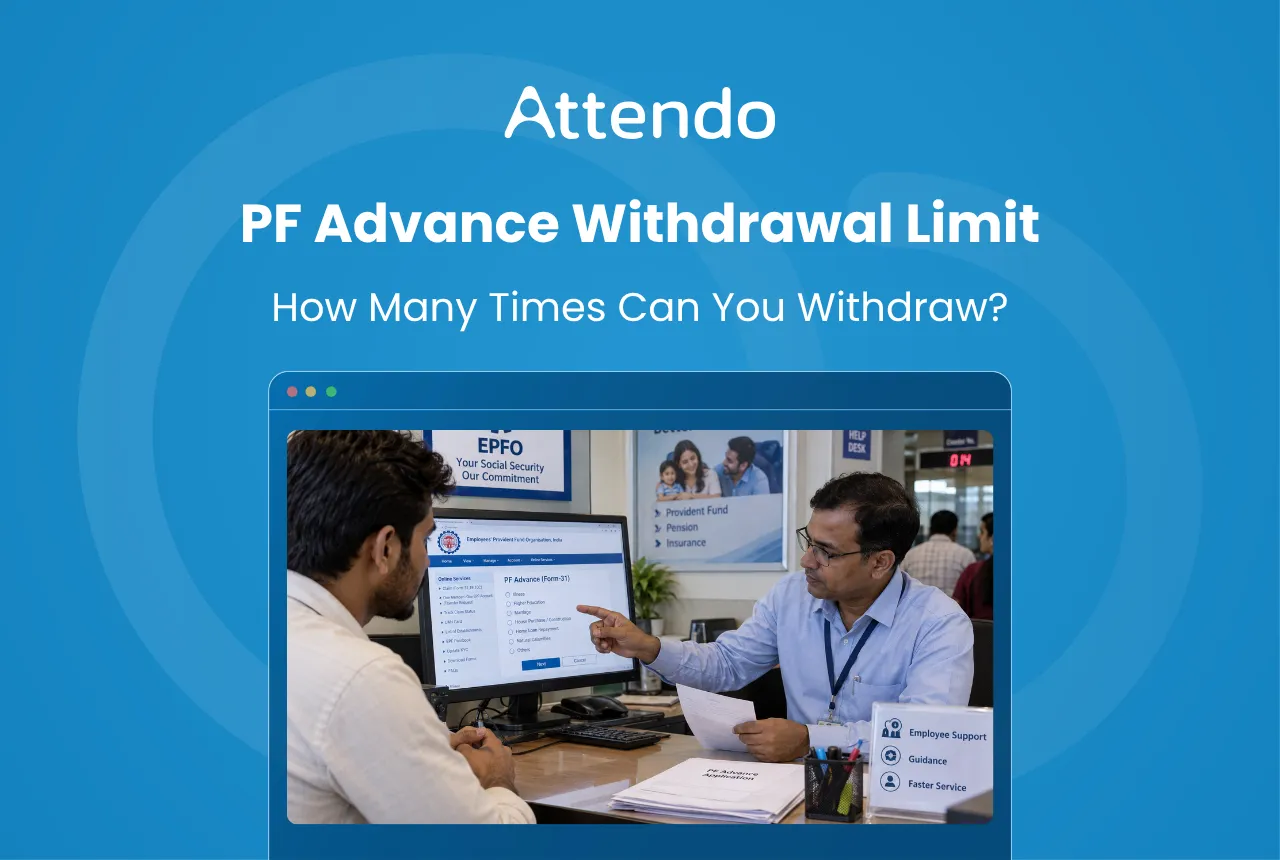
The number of times you can take a PF advance changed in October 2025.
It used to be three partial withdrawals for marriage and education put together. But education alone now allows ten, and marriage allows five.
This guide sets out how many claims each reason allows. It also covers what you need before you can make one, and what happens to the money you leave behind.
Key Takeaways
- How many times: Education up to 10, marriage up to 5. Housing and Special Circumstances have no separate count.
- Who qualifies: Anyone with 12 months of service, for every kind of partial withdrawal.
- How much: Up to 75% once you have the 12 months, with no papers to submit. A quarter stays behind.
- If you are out of work: 75% straight away, the rest after a year.
- The COVID advance: Discontinued. Special Circumstances covers the same ground, and you no longer have to say which situation applies.
- What to do: Check your UAN and your date of exit are correct before you claim anything.
Is the COVID PF Advance Still Available?
No, it was discontinued, and EPFO said why.
EPFO’s circular of 12 June 2024 reads: “As Covid-19 is no more a pandemic, the competent authority has decided to discontinue the said advance with immediate effect.”
It was added in March 2020, and a second one was allowed from May 2021. Both are gone, including for companies that run their own PF trust.
If you are looking for it because you need money in a hurry, what replaced it is wider, not narrower. Special Circumstances lets you apply without saying which situation applies.
In Simple Words
The COVID scheme was a special door opened during the pandemic, and it has been closed. What replaced it is a wider door. You no longer have to say which situation applies. You just apply.
Which raises the question the rest of this guide answers. How often can you actually claim?
How Many PF Advances Can You Take?
Education allows up to ten claims and marriage up to five. Housing and Special Circumstances sit under the same single rule, with no separate count of their own.
The quickest way to see the whole change is side by side.
| What | Before | After the October 2025 decision |
|---|---|---|
| Marriage and education claims | 3 in total, for both together | Education up to 10, marriage up to 5 |
| Minimum service | Varied, up to seven years | 12 months, for everything |
| What you can draw on | Mostly your own contribution | Your share and the employer’s |
| Reason required | Had to fit a listed ground | None under Special Circumstances |
| Left in the account | No fixed floor | 25% minimum balance |
| Premature final settlement | 2 months | 12 months |
The counts are the part that changed most. The old rulebook had 13 separate rules, each with its own conditions. The Ministry’s year end review for 2025 records them being merged into three categories.
| Category | What it covers | How many times |
|---|---|---|
| Essential Needs | Illness, education, marriage | Education up to 10, marriage up to 5 |
| Housing Needs | Housing. The decision names the category without listing what sits inside it | Under the same single rule |
| Special Circumstances | Situations such as natural calamity, closure of the establishment, continuous unemployment or an epidemic. You no longer have to say which | Under the same single rule |
The old limit was three partial withdrawals for marriage and education combined. So ten and five, counted separately, is a large increase on that.
Special Circumstances is the one to know. Because it asks you to name nothing, the question of whether you qualify mostly disappears.
Who Can Claim a PF Advance Withdrawal?
Several different waiting periods used to apply, and one number now covers all of them.
Twelve months of service. The 238th meeting of EPFO’s Central Board of Trustees set the minimum service requirement at 12 months for every partial withdrawal, which removes one of the things that used to cause rejections and delays.
Different reasons used to carry different waiting periods. So a member could qualify for one thing and be refused another on the same day. The single 12-month rule ends that.
The second half of that decision matters just as much, and it is about paperwork.
There are no papers to submit and no reason to prove. So the Board expects the change to lead to 100% auto settlement of partial withdrawal claims. And a claim that needs nobody to read a document should not sit in a queue.
That is the real difference for anyone who has claimed before. The old process asked you to prove your reason was on the list, and refusals often came from that step rather than from the money.
Two questions used to decide a claim. Have you served long enough, and is your reason on the list. The first now has one answer for everybody, which is twelve months. The second has largely gone away.
Can You Withdraw the Full PF Amount?
Not usually, and the limit is deliberate.
You can take up to 75% at any time, with no papers to submit. Those are the Ministry of Labour and Employment figures.
But the other 25% is a minimum balance. It stays in the account.
That is because repeated withdrawals were leaving people with almost nothing at retirement. Half of members had under ₹20,000 at final settlement, and three quarters had under ₹50,000.
There is one more change worth knowing. What you can withdraw now includes the employer’s share, not just your own. Before, it was mostly limited to what you had put in. So 75% of the new figure often beats 100% of the old one.
Full withdrawal, including that last 25%, is still allowed in specific situations:
- Retirement after the age of 55
- Permanent disability, or not being able to work
- Being laid off, which the scheme calls retrenchment
- Voluntary retirement
- Leaving India permanently
How Long After You Resign?
This is where the timings are easiest to get wrong, so take them one at a time.
- Straight away. If you are unemployed, 75% of the balance can be withdrawn immediately. That includes the employer share and the interest.
- After one year. The remaining 25% becomes available.
- Closing the account early. The wait for a final settlement before retirement went from 2 months to 12.
- The pension pot is separate. It has its own wait, now 36 months where it used to be 2.
The pension change has a purpose behind it. EPFO’s pension scheme page says you need at least 10 years of service to get a pension. Membership runs to age 58.
But about 75% of members empty the pension account within four years of service, and lose that right for good.
Your pension entitlement at 58 is completely unaffected. The 58 there is the pension age; the 55 further up is the provident fund one.
Whether an exit is clean often comes down to the paperwork more than anything else. A correct relieving and experience letter and an accurate last working day are what stop a settlement stalling later.
Your PF Advance Withdrawal Checklist
Four things, whether you are claiming this month or not.
- Check your UAN is active and your KYC is complete.
- Check your date of exit is recorded correctly if you have left a job.
- Work out which of the three categories your need falls under, and remember that Special Circumstances needs no reason.
- Leave the 25% alone unless you qualify for full withdrawal. It earns 8.25%.
The PF interest calculator will show what the balance you leave behind is likely to be worth.
Where Employers Get PF Withdrawal Wrong
Everything above is from the employee’s side. This last part is for whoever keeps the records.
A member makes the claim from the member portal. What an employer controls is not the claim itself, but whether the record behind it holds up.
That record breaks in different places depending on how a business hires.
| Type of business | Where the record breaks |
|---|---|
| Manufacturing unit with contract workers | People move between contractors, so the exit date is recorded late or not at all. |
| Retail chain across several stores | A joiner is added at store level without a UAN, and the gap only shows years later. |
| Hospital or diagnostic chain | Staff rotate between branches, and wages on record drift from wages paid. |
| School or coaching institute | Seasonal staff leave at the end of a term with no exit date entered. |
| Corporate office in one location | Fewest moving parts, so the usual fault is incomplete KYC rather than a missing date. |
Some rows are missing dates, some are missing numbers. Either way, a claim is checked against what the employer filed, so it is only as good as that record.
Whatever the industry, the same three records decide whether a claim clears.
- The date of exit is missing or wrong. Nothing after resignation works properly until it is right.
- The UAN was never linked, or the KYC is incomplete. That is work for the joining day, not the leaving day.
- Wages on record do not match wages paid. The balance is built from what was filed, month after month.
All three are kept by hand somewhere, and they drift apart when attendance, salary and PF each sit in a different place.
In Attendo (formerly Petpooja Payroll) they sit together. Joining dates, exit dates and PF numbers sit beside the attendance to salary workflow, so the record a claim is checked against comes out of the same system that paid the wages.
Getting it right at onboarding is what prevents the argument years later.
What to Remember About PF Advances
The whole change comes down to three things:
- You can claim far more often. Ten times for education, five for marriage.
- You qualify after twelve months, whatever the reason.
- Under Special Circumstances you do not have to give a reason at all.
One more change is still on its way. At its 239th meeting on 2 March 2026, the CBT approved the EPF Scheme 2026 to replace the current one. The same meeting set 8.25% interest for 2025-26.
These are the Board’s decisions rather than settled scheme text. So check the portal for the position on the day you claim.
Frequently Asked Questions
1. How many times can I withdraw a PF advance for education?
2. Can I still claim the COVID-19 PF advance?
3. How long after resigning can I withdraw my PF?
4. Why can I not withdraw my whole PF balance?
5. Does taking an advance reduce my pension?
Related Articles You May Like
How to Complete the ESI Registration Process in 8 Steps
Registration is online, real time, and needs no paper at all. The state that wants 20 workers where its neighbour wants 10, what the C-11 letter proves, and why the amnesty no longer helps.
Ashwiniba Vaghela
HR & Payroll Experts
Expected CTC: 7 Ready-to-Use Answers for Your Next Interview
The question asks what you would cost, not what you would receive. Seven lines to use in an interview, the reasoning that backs each of them, and why the law measures a different figure from the one in an offer.
Avani Joshi
HR & Payroll Experts

How the ESIC Claim Process Works for Employees
One form per benefit, one office, and a three-day rule on medical certificates that quietly costs people money. What each claim pays, and how fast ESIC has to pay it.
Avani Joshi
HR & Payroll Experts
How the ESI Salary Limit Works, and Who It Covers
₹21,000 a month, unchanged since 2017. The three routes that bring a workplace into the scheme, why a raise in July does not end cover in July, and the 135 districts still outside it.
Avani Joshi
HR & Payroll Experts