


Expected CTC: 7 Ready-to-Use Answers for Your Next Interview
The question asks what you would cost, not what you would receive. Seven lines to use in an interview, the reasoning that backs each of them, and why the law measures a different figure from the one in an offer.
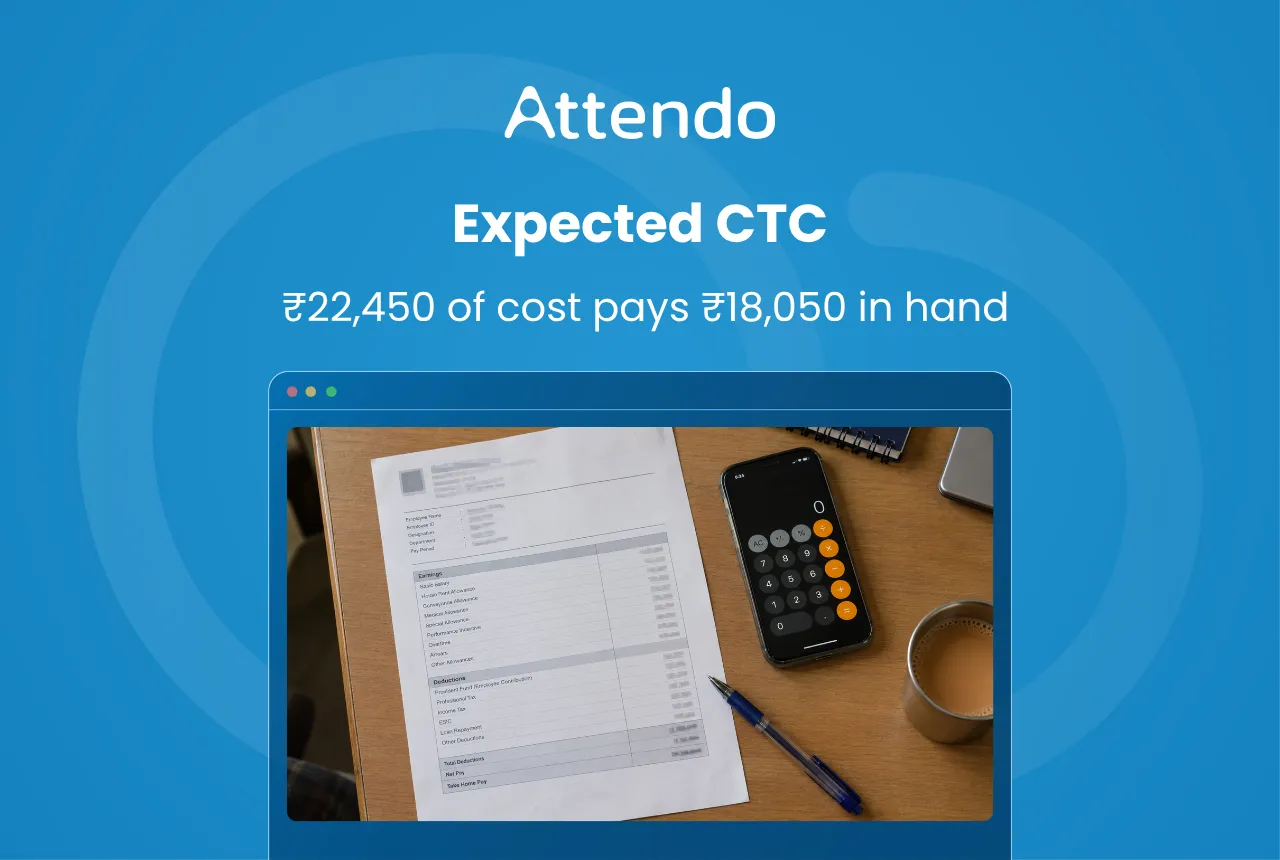
You put 12 lakh in the expected CTC box. The offer comes back at 12 lakh. And it still feels short, because the number you had in mind was the one that reaches your bank account.
Expected CTC is the most misread field on an application form, and the confusion runs both ways.
This page sets out what the question is actually asking, seven answers you can use depending on where you are standing, and the reason each one holds.
Key Takeaways
- What it means: the total yearly cost an employer would carry to employ you, not the money you take home.
- What it includes: your pay, plus what the employer pays on top, such as their provident fund share.
- What it is not: a legal term. CTC appears in no statute and has no fixed definition.
- What the law does define: wages, under section 2(y) of the Code on Wages, 2019, which is a different figure.
- Does your answer bind you: no. A number in a form binds nobody. The offer letter is the document that does.
- How to answer it: label the figure as CTC, give a range whose lower end you would accept, and say what the range is based on.
What Expected CTC Means
Cost to company. The total a business spends in a year to employ somebody, expressed as one annual figure.
Asked as “expected CTC”, it means: what total annual cost are you looking for. Answer it with your take-home figure and you have answered a different question.
The word expected is doing work too. It marks the figure as an opening position, not a demand and not an offer.
Three figures get quoted for the same job, and only one of them is CTC.
- CTC: everything the employer spends in a year, including what never reaches you.
- Gross: the pay itself, before anything is deducted from it.
- In hand: what lands in your bank after provident fund, ESI where it applies, and tax.
In Simple Words
It asks what you would cost, not what you would receive. Those are two different numbers for the same job.
7 Expected CTC Answers You Can Use
Pick the one that matches your situation. Each has a line you can say and the reason it holds, because a number nobody can justify is the one that gets talked down.
| Where you are standing | The move |
|---|---|
| You know the range | Give a range and stay open on structure |
| The role is still vague | Ask for their band once, then answer |
| Your current pay is low | Price the scope, not your last payslip |
| Another offer is live | Cite it, and say you would rather be here |
| You are a fresher | Admit you have no benchmark, name a figure anyway |
| You are switching industry | Name the discount before they apply it |
| It is a form, not a conversation | Add the label and one more word |
When You Know the Market Range
Give a range rather than a point, label it, and stay open on how it is built.
“I am looking at ₹X to ₹Y as CTC, and I am flexible on how it is structured.”
Why it holds. Saying CTC out loud removes the gross and in-hand confusion before it starts. Flexibility on structure tells them you will work inside their salary bands, which is usually what they are worried about.
When You Do Not Know the Role Yet
Turn it back once, politely, and then answer. Asking once is normal, but asking twice starts to read as evasion.
“Before I put a number on it, could you tell me the band for this role? I would rather answer against the scope than against my last job.”
Why it holds. Most employers have a band in mind already. Asking for it is not a refusal to answer, and it moves the conversation to the work, which is the ground you want to be standing on.
When Your Current Pay Is Low
Answer on the role rather than on your last payslip, and say that is what you are doing.
“My current CTC is ₹X. I am pricing this on the scope of the role, and for that I am looking at ₹Y.”
Why it holds. A low current figure anchors the offer if you let it sit there unexplained. Naming the role’s scope in the same breath gives the other side a different reference point to work from.
When You Have Another Offer
Name the number and the reason together, and make clear you would rather join them.
“I have an offer at ₹X as CTC. I would rather join you, and I need the number to be comparable.”
Why it holds. A live offer is evidence, and evidence justifies a figure better than a preference does. Saying so out loud keeps it evidence rather than a threat.
When You Are a Fresher
You have no history to defend, so price the role and say plainly what matters most to you.
“I do not have a last CTC to quote. For this role I am looking at ₹X, and in the first year I care more about the work than the number.”
Why it holds. Nobody expects a fresher to have a benchmark. Admitting that and then still naming a figure reads as prepared, where a blank answer reads as unprepared.
When You Are Changing Industry
Price the switch out loud, before they discount it quietly.
“I am moving from one industry to another, so I am not asking you to pay for the years. I am asking you to pay for the part that carries across.”
Why it holds. Employers do discount a switch. Naming the discount yourself means you decide how large it is, rather than finding out when the offer arrives.
When the Form Has Only a Box
Put the number down, and then add one word beside it, because a blank box rarely helps you.
“₹X CTC, negotiable”
Why it holds. The word CTC stops the figure being read as take-home. The word negotiable keeps the conversation open without lowering the number itself.
What I Think
A range beats a single number, but only if you would genuinely accept its lower end. Quoting a bottom you would refuse is how a negotiation ends before anybody has said anything useful.
What an Expected CTC Includes
There is no standard list, because CTC is a convention rather than a defined term. In practice it gathers three kinds of money.
| Kind | Examples | Does the employee see it? |
|---|---|---|
| Pay | Basic, allowances, any fixed monthly components | Yes, in the payslip |
| Employer contributions | The employer’s provident fund share | No, it goes to the fund |
| Conditional amounts | Performance pay, a bonus that depends on a target | Only if the condition is met |
The third row is where most disappointment comes from. A CTC built with a large conditional component is a larger number on paper than in a normal month, so ask how much of the figure depends on a target.
A Worked Example at ₹20,000 a Month
Take somebody on ₹20,000 a month. That sits under the ₹21,000 ESI limit, so both ESI and provident fund apply.
| Line | Monthly | Where it goes |
|---|---|---|
| Pay | ₹20,000 | The employee, before deductions |
| Employer provident fund, 12% of the ₹15,000 ceiling | ₹1,800 | The fund, not the employee |
| Employer ESI at 3.25% | ₹650 | ESIC, not the employee |
| Cost to company | ₹22,450 | ₹2,69,400 a year |
Now the other direction. The employee pays ₹1,800 of provident fund and ₹150 of ESI at 0.75%, leaving ₹18,050 before any tax.
So a package costing ₹22,450 a month puts ₹18,050 in a bank account. Ask which of the two a number refers to before you compare two offers, because the gap between them is not a pay cut.
Why CTC Is Not the Same as Wages
This part is not convention. The Code on Wages, 2019 defines wages at section 2(y), and the Ministry has since said which parts of a package count towards it.
According to the Ministry’s FAQ on the labour codes, only statutory components such as the employer’s provident fund and pension contributions and statutory bonus are counted towards the 50% of wages that must form part of remuneration.
Gratuity, ESI and other retirement benefits are not counted. Overtime is. Annual performance-based incentives are not wages at all under the codes.
So two packages with the same CTC can carry different statutory wages, and therefore different provident fund, gratuity and bonus behind them.
In Simple Words
CTC is what the employer spends, while wages is what the law measures. Matching one figure does not match the other.
Does Your Answer Bind You?
It does not. A figure in an application form is an opening position, and that is true on both sides of the table.
What binds is the offer, once you accept it, and then the appointment letter. Our guide to appointment letter formats covers what belongs in that.
Three things do carry weight, in this order.
- The offer, once you have accepted it.
- The appointment letter, which sets out the terms in full.
- The minimum wage, which applies whatever either side wrote in a form.
That last one is not negotiable by anybody. The same Ministry FAQ says an employer is legally prohibited from paying below the minimum wage fixed by the appropriate government.
What to Watch in Their Offer
The faults repeat, and they differ by the kind of employer making the offer.
| Type of employer | What to check before you agree |
|---|---|
| IT services firm | How much of the CTC is variable pay, and what target releases it |
| Manufacturing unit | Whether the figure quoted to you is a staff CTC or a worker’s in-hand wage |
| Retail chain | Whether each branch uses the same CTC convention, so two offers are comparable |
| Hospital or diagnostic chain | Whether gratuity sits inside the CTC, which the law does not count as wages |
| School or coaching institute | Whether the employer’s provident fund share is shown, or quietly left out |
The first three are comparison problems rather than pay problems, where the two sides are measuring different things.
The last two are costing problems. Money counted in the wrong place, or left out of the total altogether.
On the employer’s side of the table, the structure agreed in your offer is what the payroll then runs on. In Attendo (formerly Petpooja Payroll), that structure feeds the attendance to salary workflow directly, so the figure in the offer and the figure on the payslip come from one place.
Your Expected CTC Checklist
Before the interview, run your number past five questions.
- Have you decided a range, and would you accept its lower end?
- Can you say in one sentence what the range is based on?
- Will you label the figure as CTC when you say it?
- Do you know what your current package costs your employer, not just what it pays you?
- If they ask why, is your reason about the role rather than about your last salary?
The short version is this. Expected CTC asks what you would cost, one of the seven answers above will fit the room you are sitting in, and the offer letter is the thing that actually binds.
For the statutory side of what you agree, see our guide to EPF forms.
One caution is worth keeping. CTC has no legal definition, so two employers can use the word for different things. Ask what theirs includes rather than assuming it matches the last one you saw.
Frequently Asked Questions
Q1. What does expected CTC mean?
Q2. Is expected CTC the same as expected salary?
Q3. Does the number I write in the form bind me?
Q4. Why is my in-hand pay so much lower than the CTC?
Q5. Is CTC defined anywhere in law?
Related Articles You May Like
How to Complete the ESI Registration Process in 8 Steps
Registration is online, real time, and needs no paper at all. The state that wants 20 workers where its neighbour wants 10, what the C-11 letter proves, and why the amnesty no longer helps.
Ashwiniba Vaghela
HR & Payroll Experts

How the ESIC Claim Process Works for Employees
One form per benefit, one office, and a three-day rule on medical certificates that quietly costs people money. What each claim pays, and how fast ESIC has to pay it.
Avani Joshi
HR & Payroll Experts

How the ESI Salary Limit Works, and Who It Covers
₹21,000 a month, unchanged since 2017. The three routes that bring a workplace into the scheme, why a raise in July does not end cover in July, and the 135 districts still outside it.
Avani Joshi
HR & Payroll Experts
How Many PF Advance Withdrawals Can You Claim?
Education now allows ten claims and marriage five, where three covered both before. What the October 2025 rules changed, who qualifies after 12 months, and why the COVID advance is no longer on the list.
Avani Joshi
HR & Payroll Experts