


EPF Forms List: What You Actually File Now
One monthly return, one declaration at joining, and a nomination nobody can file on your behalf. The rest of the numbered forms left years ago.
Search for a list of EPF forms and you will find the same names, repeated everywhere: Form 5, Form 10, Form 12A, Form 3A, Form 6A, and more.
None of them appears in the EPFO guidance this post uses: its member booklet, its published rates, or its manual for the monthly return.
The lists survive because they get copied, not because anyone checked them against what EPFO publishes today.
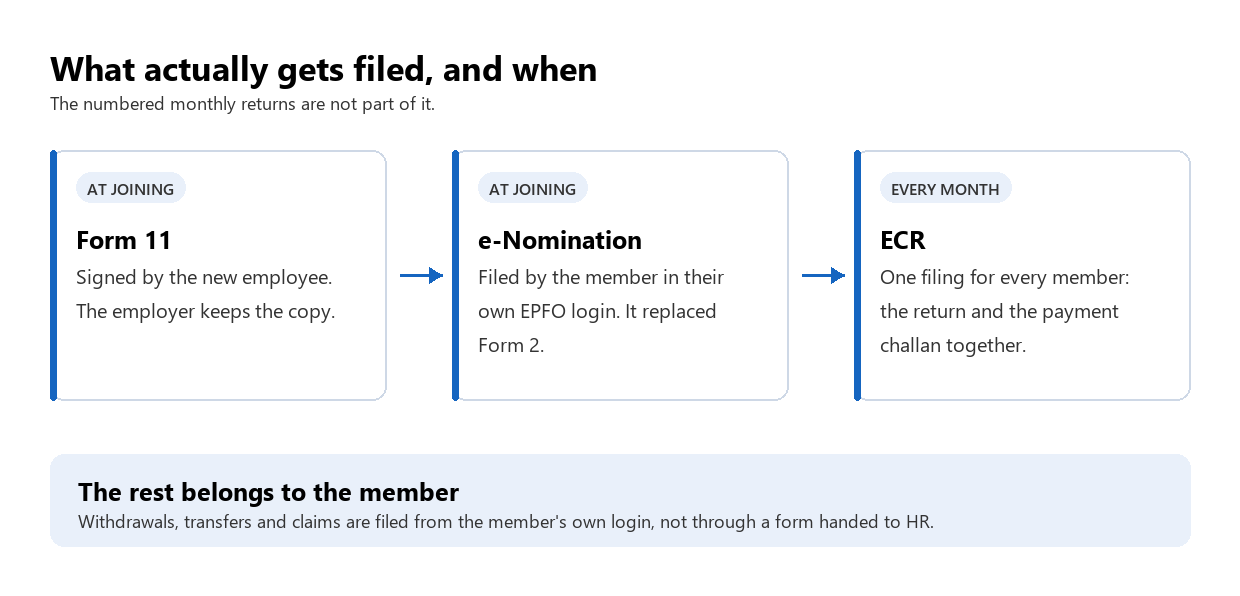
This guide covers what an employer and an employee actually submit today. One declaration is signed at joining. One return goes in every month. The rest has moved into the member’s own login.
Key Takeaways
- The monthly filing is the ECR: one return and challan together.
- Form 11 is still required from every new joiner.
- e-Nomination has replaced Form 2, and the member files it.
- Withdrawals go through the member’s EPFO login, not through HR.
- An old form number in a checklist means nobody has reviewed it.
Why Most EPF Form Lists Are Out of Date
This section explains what changed, and why the old form numbers keep appearing in guides that nobody has revisited.
The Employees’ Provident Fund runs under the EPF and Miscellaneous Provisions Act, 1952. The schemes made under that Act set what has to be filed. What changed is not the duty but the paperwork that meets it.
EPFO’s own ECR user manual lists three things an employer sends in: a regular return, a supplementary return and a revised return. None of them is a numbered paper form.
So a guide that tells a factory in Coimbatore to file Form 5 for every new weaver is describing a form EPFO’s current guidance does not mention.
EPFO moved its website, and the old form addresses went with it. Its own member booklet still points readers to a Form 11 download link that no longer resolves. Anything you saved to a shared drive from the old site is worth opening before you rely on it.
Did You Know?
A form number is easy to copy and hard to check. It can sit in a checklist long after the filing it named has changed, because nothing in the monthly process forces anyone to look at it again.
The EPF Return Employers File, Not the Old Forms
Below is the one filing that carries a whole month, and the parts of it that have to be right.
The ECR is a single upload holding every member’s wages and contributions for the month. It is a return and a payment challan at once. EPFO’s manual splits it three ways:
- Regular return: the ordinary monthly filing for the current wage month.
- Supplementary return: for members left out of a return already filed.
- Revised return: for correcting a return that has already gone in.
The contributions inside it are set by statute, not by the employer. EPFO publishes the current rates of contribution:
| What | Rate |
|---|---|
| Employee share | 12% of wages, or 10% for the establishments listed below |
| Employer share | The difference between the employee share and the pension contribution |
| Pension (EPS) | 8.33% |
| EDLI | 0.5% |
| EPF administrative charges | 0.5%, subject to a minimum of ₹500 a month |
The lower 10% rate is not a choice. It applies where a firm has fewer than 20 employees, or has been declared sick, or has losses as large as its net worth. It also applies to five trades: jute, beedi, brick, coir and guar gum.
Getting the wage figure right each month is the part that goes wrong, and it is a timekeeping problem before it is a filing problem. If the attendance data is wrong, the return is wrong. That is the case for treating the attendance to salary walkthrough as one process rather than two.
Which EPF Forms a New Joiner Still Signs
Two declarations still travel with a new hire. Here is what each one settles.
1. Form 11, the self-declaration
Form 11 is still there, and still on EPFO’s employer documents page. Every person you take on has to fill it in. It asks for their past job details, UAN, PF account number and KYC. It also asks whether they hold a scheme certificate, and whether they are an international worker.
It matters more than its length suggests. It decides whether someone is a member of the Employees’ Pension Scheme, 1995. Keep the copy: the Regional PF Commissioner can ask for it.
A retail chain hiring twelve people before a festival needs this on file for each of them. So does a lab opening a second centre. Not at the month end, at joining. Collecting it during employee onboarding is the only version of this that works.
2. Form 2, now filed as e-Nomination
Form 2 names who receives the balance if the member dies. e-Nomination has replaced it, so The member files it in their own login instead of handing paper to HR, and the employer keeps a copy. How that is done is the next section.
How the EPF Nomination Form Is Filed Now
Here are the steps the employee takes, so an HR team can answer the question when it comes up.
Nomination is filed on the EPFO member portal. The member needs their mobile number linked to Aadhaar, because the form is approved with an Aadhaar e-sign and a one-time password. A profile photo and a current address have to be on the record first.
More than one nominee is allowed, with the share set as a percentage. If a nominee is a minor, a guardian’s details go in as well.
Push people to do it early, because of what happens if they have not. With a nomination already in the system, the family can claim online after a death. The OTP goes to the nominee’s own phone. Without one, they are chasing an employer the member may have left years ago.
Pro Tip
Of everything on this page, the nomination is the one worth chasing hardest. It is the part an employer cannot put right afterwards, and the moment it matters is the moment nobody wants to be making phone calls.
What Your EPF Money Pays For, and When
What follows is money a member can draw before they leave, plus the two schemes riding on that same monthly filing. Every figure below comes from EPFO’s member information booklet.
Partial withdrawal is allowed on set grounds, and these need no supporting documents. Each ground carries its own service condition and limit:
| Ground | Service needed | How much |
|---|---|---|
| Purchase or construction of a house | 5 years | 24 times monthly salary for a site, 36 times for a house |
| Medical treatment | None | The employee share with interest, or 6 times monthly salary, whichever is lower |
| Renovation of a house | 5 years | 12 times monthly salary |
| Wedding, or education after matriculation | 7 years | 50% of the employee’s contribution with interest |
| Within one year of retirement | Due to retire within a year | 90% of the balance |
Claims go through the member portal or the UMANG app. A manager in a Pune office and a supervisor at a Rajkot fabrication unit use the same route. It belongs to the member, not the employer.
Interest is the part people underestimate. A PF interest calculator makes the cost of taking money out early concrete in a way a policy note never does.
The same booklet sets out what the pension scheme pays. The 8.33% pension share is not a second cut from the employee. The member pays nothing towards it, and it comes out of the employer’s share.
- Minimum member pension is ₹1,000 a month, on ten years of eligible service and reaching 58.
- A widow or widower receives 50% of the member pension, or ₹1,000, whichever is higher.
- Children receive 25% of that, for up to two children, until they turn 25.
- An orphan receives 75% of the widow pension, or ₹750, whichever is higher.
The insurance sits in the same monthly figure. It is the Employees’ Deposit Linked Insurance Scheme. Since 15 February 2018 it has paid a dead member’s family between ₹2,50,000 and ₹7,00,000.
Where Software Fits Around EPF Forms and Filing
Worth being plain about what software does here, because it is narrower than most product pages suggest.
Attendo (formerly Petpooja Payroll) is a complete workforce management system. It runs everything from attendance at the door through to salary, in one place.
Nothing removes the duty to file. What software removes is the copying. Attendance turns into wage days, then into contributions, then into the monthly return. Each step is a place a spreadsheet loses a person, and that is the whole case against a spreadsheet for anything past a handful of employees.
The five statutory deductions come out of the same run rather than five separate reconciliations. Branches in different states draw their own rates without anybody remembering to switch.
My Opinion
The forms are not the hard part of EPF and never were. The hard part is that the wage figure feeding them is assembled from attendance nobody has checked since the 15th. Fix the input and the filing stops being an event.
What to Do With Your EPF Forms Checklist
Take the EPF checklist your team is using and look for Form 5, Form 10, Form 12A, Form 3A or Form 6A. If any of them are on it, the checklist has not been checked against EPFO’s current guidance, and everything else on it deserves a second look.
What EPFO does document is short. Collect Form 11 at joining and keep it. Point people at e-Nomination and follow up until it is done. File the ECR every month against wage data you trust. The rest belongs to the member and their login.
Frequently Asked Questions
1. How many EPF forms are there?
2. Are Form 5 and Form 10 still required?
3. What is Form 11 in EPF?
4. Has e-Nomination replaced Form 2?
5. What EPF records must an employer keep?
Related Articles You May Like
How to Complete the ESI Registration Process in 8 Steps
Registration is online, real time, and needs no paper at all. The state that wants 20 workers where its neighbour wants 10, what the C-11 letter proves, and why the amnesty no longer helps.
Ashwiniba Vaghela
HR & Payroll Experts
Expected CTC: 7 Ready-to-Use Answers for Your Next Interview
The question asks what you would cost, not what you would receive. Seven lines to use in an interview, the reasoning that backs each of them, and why the law measures a different figure from the one in an offer.
Avani Joshi
HR & Payroll Experts

How the ESIC Claim Process Works for Employees
One form per benefit, one office, and a three-day rule on medical certificates that quietly costs people money. What each claim pays, and how fast ESIC has to pay it.
Avani Joshi
HR & Payroll Experts

How the ESI Salary Limit Works, and Who It Covers
₹21,000 a month, unchanged since 2017. The three routes that bring a workplace into the scheme, why a raise in July does not end cover in July, and the 135 districts still outside it.
Avani Joshi
HR & Payroll Experts