


Labour Welfare Fund: Rates by State
₹2 a year in Telangana, ₹35 a month in Haryana. Six states with full rates, every state accounted for, and the deadline most businesses miss.
There is a line on your payslip called LWF. It takes a few rupees and explains nothing.
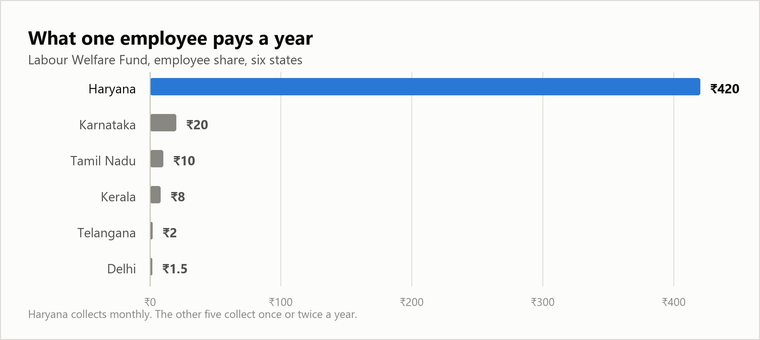
In Telangana that line costs ₹2 for the whole year. In Haryana it can cost ₹35 in one month.
Same job, same salary, different state.
Below you will find what the deduction is and what each state charges. I have covered six states in full, one table apiece.
A single list further down names all 36 states and union territories, so yours is in there either way.
Key Takeaways
- LWF stands for Labour Welfare Fund.
- It is a state fund for worker welfare, not a tax and not a savings scheme.
- Your employer takes a small amount from your salary and adds a larger amount of its own.
- Only 16 states and union territories charge it. The other 20 do not.
- The amount ranges from ₹2 a year in Telangana to ₹35 a month in Haryana.
- You cannot get the money back. It is not a deduction you claim at tax time.
What Does This Guide Cover?
Six states get a full rate table: Haryana, Karnataka, Kerala, Tamil Nadu, Telangana and Delhi.
Nine more charge it but have no table here: Andhra Pradesh, Chandigarh, Chhattisgarh, Goa, Gujarat, Madhya Pradesh, Odisha, Punjab and West Bengal. Their boards publish no rate you can read, and a wrong rate in somebody’s payroll costs more than a missing one.
Maharashtra needs a word of its own. Most articles still give its rate as ₹12 from the employee and ₹36 from the employer. That is the Act as it read before 2024. Section 6BB was substituted by Maharashtra Act 25 of 2024, and the substituted sub-section sets the employee share at ₹25 every six months and the employer share at three times that, ₹75. The old split that charged less below ₹3,000 a month is gone, so the same amount now applies whatever the salary. The register is read on 30 June and 31 December.
What Is LWF, and What Does the Full Form Mean?
LWF stands for Labour Welfare Fund, a state fund that pays for worker welfare schemes. This section explains the name and where the money goes.
Each state that charges it runs its own Labour Welfare Board. The board pools the small amounts taken from workers and employers, then spends them on schemes for those workers and their families.
It is not a tax, because tax goes into general revenue and pays for anything. This money can only be spent on worker welfare, and each state board is answerable for how it spends it.
It is also not like provident fund. Your PF is your money and comes back to you, whereas LWF money is pooled and comes back to nobody in particular.
What Is LWF in Your Salary Slip?
The LWF line on a payslip is your share of the state welfare fund, usually a few rupees. This section is for anyone who found it and wants to know what it is.
The line usually reads LWF, sometimes EE LWF. EE means employee, so that is your share. Where a payslip shows ER LWF, that is the employer’s share. The business pays it on top of your pay rather than taking it from you.
Did You Know? Your employer pays more into this fund than you do. In Haryana the business pays twice your amount, and in Delhi three times. In Karnataka the state government adds a share as well, so ₹20 from you becomes ₹80 in the fund.
Who Has to Pay LWF?
LWF applies if your state has the law and your business meets its size test. This section covers who is caught by it and who carries the risk.
Two things decide whether the rule applies to you.
- Your state. If yours is not one of the sixteen, there is nothing to pay and nothing to file.
- Your type of business, and its size. Each state sets its own test. Odisha covers every factory, and covers shops, societies and trusts once they employ 20 or more people.
Most states leave out managers and apprentices. Kerala goes further. It leaves out anyone who has worked fewer than 30 days in the past year.
The rule follows the workplace, not the head office. Take an IT services firm in Bengaluru with an office in Gurugram. It pays the Karnataka rate for one office and the Haryana rate for the other, which is ₹40 a year against ₹840 for the same salary.
What Are the LWF Rates in Each State?
The employee share runs from ₹2 a year in Telangana to ₹35 a month in Haryana. This section takes the six states one at a time, each with its own table and a link to the board that publishes the figure.
1. Haryana LWF Rates
Haryana is the outlier. It collects every month, and the amount moves with your wages.
| From | Employee, per month | Employer, per month | Total |
|---|---|---|---|
| January 2026 | 0.2% of wages, up to ₹35 | ₹70 | ₹105 |
| January 2025 | 0.2% of wages, up to ₹34 | ₹68 | ₹102 |
| January 2023 | 0.2% of wages, up to ₹31 | ₹62 | ₹93 |
2. Karnataka LWF Rates
Karnataka collects once a year, and the state government pays in as well.
| Who pays | Per employee, per year |
|---|---|
| Employee | ₹20 |
| Employer | ₹40 |
| State government | ₹20 |
| Total in the fund | ₹80 |
3. Kerala LWF Rates
Kerala collects twice a year, and the amounts are among the smallest in the country.
| Who pays | Per half year |
|---|---|
| Employee | ₹4 |
| Employer | ₹8 |
| Total | ₹12 |
4. Tamil Nadu LWF Rates
Tamil Nadu collects once a year, and the state government adds a share.
| Who pays | Per employee, per year |
|---|---|
| Employee | ₹10 |
| Employer | ₹20 |
| State government | ₹10 |
| Total in the fund | ₹40 |
5. Telangana LWF Rates
Telangana charges the least of the six, by a wide margin.
| Who pays | Per employee, per year |
|---|---|
| Employee | ₹2 |
| Employer | ₹5 |
| Total | ₹7 |
6. Delhi LWF Rates
Delhi is the only one of the six where the amount is in paise.
| Who pays | Per half year |
|---|---|
| Employee | ₹0.75 |
| Employer | ₹2.25 |
| Total | ₹3 |
Which States Charge LWF, and Which Do Not?
Sixteen states and union territories charge LWF and twenty do not. This section lists all 36, whether or not a state appears among the six detailed above.
| State or union territory | Charges LWF | Rate table in this guide |
|---|---|---|
| Andaman and Nicobar Islands | No | Not applicable |
| Andhra Pradesh | Yes | No |
| Arunachal Pradesh | No | Not applicable |
| Assam | No | Not applicable |
| Bihar | No | Not applicable |
| Chandigarh | Yes | No |
| Chhattisgarh | Yes | No |
| Dadra and Nagar Haveli and Daman and Diu | No | Not applicable |
| Delhi | Yes | Yes, above |
| Goa | Yes | No |
| Gujarat | Yes | No |
| Haryana | Yes | Yes, above |
| Himachal Pradesh | No | Not applicable |
| Jammu and Kashmir | No | Not applicable |
| Jharkhand | No | Not applicable |
| Karnataka | Yes | Yes, above |
| Kerala | Yes | Yes, above |
| Ladakh | No | Not applicable |
| Lakshadweep | No | Not applicable |
| Madhya Pradesh | Yes | No |
| Maharashtra | Yes | Rate in the text above |
| Manipur | No | Not applicable |
| Meghalaya | No | Not applicable |
| Mizoram | No | Not applicable |
| Nagaland | No | Not applicable |
| Odisha | Yes | No |
| Puducherry | No | Not applicable |
| Punjab | Yes | No |
| Rajasthan | No | Not applicable |
| Sikkim | No | Not applicable |
| Tamil Nadu | Yes | Yes, above |
| Telangana | Yes | Yes, above |
| Tripura | No | Not applicable |
| Uttar Pradesh | No | Not applicable |
| Uttarakhand | No | Not applicable |
| West Bengal | Yes | No |
Uttar Pradesh, Rajasthan, Bihar and Assam are the largest states with no LWF law at all.
One caveat on the smaller union territories. Goa’s Act was originally the Goa, Daman and Diu Act, and those territories have been reorganised since. If you employ in Daman, Diu, Dadra and Nagar Haveli or Puducherry, confirm the position locally.
When Is LWF Due?
Most states want the money by 15 July and 15 January. This section covers the dates state by state, because Haryana and Karnataka do not follow that pattern.
| State | How often | Due |
|---|---|---|
| Haryana | Monthly | With the monthly return |
| Kerala | Twice a year | 15 July and 15 January |
| Delhi | Twice a year | 15 July and 15 January |
| Karnataka | Once a year | 15 January |
| Tamil Nadu | Once a year | Set by the state board |
| Telangana | Once a year | Set by the state board |
Pro Tip: these are payroll dates, not accounting dates. The money leaves with the salaries, so whoever runs the pay cycle should own the deadline. Filed away with the tax paperwork, it usually surfaces a fortnight too late.
Miss one and interest runs from the due date, the same way it does on a late provident fund deposit. Our PF interest calculator shows what that costs on a statutory payment left late.
What Do You Get for Your LWF Money?
LWF money pays for scholarships, medical help and maternity and funeral assistance. This section covers what each board offers and how to claim, since that is the part nobody explains.
What is on offer varies by board, so Haryana does not run what Kerala runs. Scholarships are the most used scheme almost everywhere, and several states add help with a daughter’s wedding or a housing loan.
Claims go through the state board, not your employer. Most schemes also want you registered first. That registration is the step most workers never take, and it is why the money sits unclaimed.
The schemes are worth more than the contribution for anyone who uses them. A scholarship runs to a few thousand rupees a year against a deduction of ₹20. Ask your employer which board you are registered with, then apply on that board’s own site.
How Do You Register for LWF?
A covered business registers with its state board within about 30 days of opening. This section is the employer side: what to register, and what Form A means where you are.
Form A means different things in different states. In Odisha it is the notice of opening. In Tamil Nadu it is the statement of contribution paid. Read your own state’s rules rather than assuming the letter means the same job everywhere.
A register of wages and a register of fines are expected alongside the payment in most states. If you have none yet, our register formats will save you drafting them.
Registration is a one-off job, and the filing that follows is not. Put the board login somewhere the payroll person can reach it, because the person who registered is often not the person filing two years later. That handover is a quiet argument for software over a spreadsheet.
What Actually Goes Wrong With LWF?
What goes wrong is almost never the rate, it is the second state. This section is my own reading of why that happens.
My Opinion: LWF is the smallest line in payroll and the easiest to get wrong. Those two facts are connected. The amounts are tiny, two rupees a year in Telangana and three a half year in Delhi. Nobody sets a reminder for that.
Then the business opens in Haryana, where the same line is ₹105 a month per employee and falls due every month. The habit built on ₹2 a year does not survive that.
It bites hardest where headcount is large.
A garment unit in Tiruppur with 300 workers pays it 300 times over. So does a supermarket chain across two states, or a diagnostic lab opening in Gurugram.
The trap is assuming this is one rule wearing different numbers. It is not. The frequency changes, the base changes, and Form A means two different things.
If you employ in more than one state, the thing worth checking is not the rate. It is whether anybody is filing at all in the states you entered most recently.
How Does Attendo Handle LWF?
Software applies each branch’s own state rate inside the payroll run. This section covers what changes when it does that instead of a spreadsheet.
Attendo (formerly Petpooja Payroll) is a complete workforce management system. It runs everything from attendance at the door through to salary, in one place.
Each branch draws its own state rate automatically when the pay run happens, next to PF, ESIC, professional tax and TDS rather than in five separate jobs.
In one state that is a modest saving. Across three it takes away the thing that actually goes wrong, which is a person having to remember.
Our feature breakdown sets out the statutory side, and the attendance to salary walkthrough shows the deduction in its place in the month.
Conclusion
LWF is a small deduction with a real purpose, and most of the money sits unclaimed because nobody registers.
For an employer the job is small. Get the state right, get the frequency right, and check the board once a year. Haryana has raised its rate in most recent Januaries. Nobody writes to tell you.
If you want the mechanics, the Attendo features page covers how all five statutory deductions are handled in one run.
Frequently Asked Questions
1. What is the full form of LWF in salary?
2. What is LWF deduction in a payslip?
3. How much is LWF in Haryana?
4. Is LWF applicable in every state?
5. Can I claim LWF back?
Related Articles You May Like
How to Complete the ESI Registration Process in 8 Steps
Registration is online, real time, and needs no paper at all. The state that wants 20 workers where its neighbour wants 10, what the C-11 letter proves, and why the amnesty no longer helps.
Ashwiniba Vaghela
HR & Payroll Experts
Expected CTC: 7 Ready-to-Use Answers for Your Next Interview
The question asks what you would cost, not what you would receive. Seven lines to use in an interview, the reasoning that backs each of them, and why the law measures a different figure from the one in an offer.
Avani Joshi
HR & Payroll Experts

How the ESIC Claim Process Works for Employees
One form per benefit, one office, and a three-day rule on medical certificates that quietly costs people money. What each claim pays, and how fast ESIC has to pay it.
Avani Joshi
HR & Payroll Experts
How the ESI Salary Limit Works, and Who It Covers
₹21,000 a month, unchanged since 2017. The three routes that bring a workplace into the scheme, why a raise in July does not end cover in July, and the 135 districts still outside it.
Avani Joshi
HR & Payroll Experts