


How to Write an Experience Letter: What to Put In and Leave Out
The law names two things an experience letter must carry. Everything else is your choice, including the sentences that come back to bite. Here is what to write, and what to leave alone.

Somebody resigned on Friday. On Monday they want their experience letter, and you are looking at a blank page.
The format is the easy part. The hard part is the wording. How much do you say about how they worked? What if they left in the middle of notice? What if money is still owed?
This guide covers what goes in the letter and what stays out. The law names only two things. Everything after that is your choice, and that is where the risk sits.
Key Takeaways
- The law asks for two things: the job they did and how long they did it.
- Praise is optional. Once written, you cannot take it back.
- Never make the letter conditional on money owed.
- Write the dates from records, not from memory.
- A short letter you can defend beats a warm one you cannot.
What the Law Asks an Experience Letter to Say
Start here, because it is shorter than most people expect.
The Model Standing Orders sit in the Industrial Employment (Standing Orders) Central Rules, 1946. Schedule I-B covers service records for all industries. On certification of service it says a workman is entitled to a service certificate giving the nature of work, meaning the designation, and the period of employment, in days, months and years.
That is the whole statutory requirement, and it comes to two facts.
It is due at discharge, termination, retirement or resignation. Resignation matters: an earlier version of the rule covered only dismissal, discharge and retirement, so somebody who quit was outside it. That gap is closed.
Did You Know?
The law asks for the two things that are checkable and says nothing about the parts people agonise over. The wording everyone worries about is the wording that matters least.
Who Gets an Experience Letter, and at What Size
Two questions decide it:
- How many people you employ.
- Whether the person counts as a workman.
The Industrial Employment (Standing Orders) Act, 1946 applies to an industrial establishment with 100 or more workmen, counting anyone employed on any day in the previous twelve months. Two states lowered that:
| Where | The Act applies at |
|---|---|
| Most of India | 100 or more workmen |
| Karnataka | 50 or more workmen |
| Maharashtra | 50 or more workmen |
Below those sizes, and for staff who are not workmen, the statutory entitlement does not bite. Many state Shops and Establishments Acts ask for a service certificate anyway, so check your own state before deciding you are exempt.
In practice the size question is the wrong one. A supervisor leaving a 30-person fabrication unit in Rajkot needs the letter for their next job just as much as someone leaving a 300-person plant. Refusing on a technicality costs more goodwill than the letter costs to write.
It also travels further than people expect. A nurse moving between diagnostic labs, a teacher moving between coaching centres, a floor manager moving between retail showrooms: in all three the next employer asks for the letter before the offer, and a gap in it stalls the hire.
What to Put in an Experience Letter
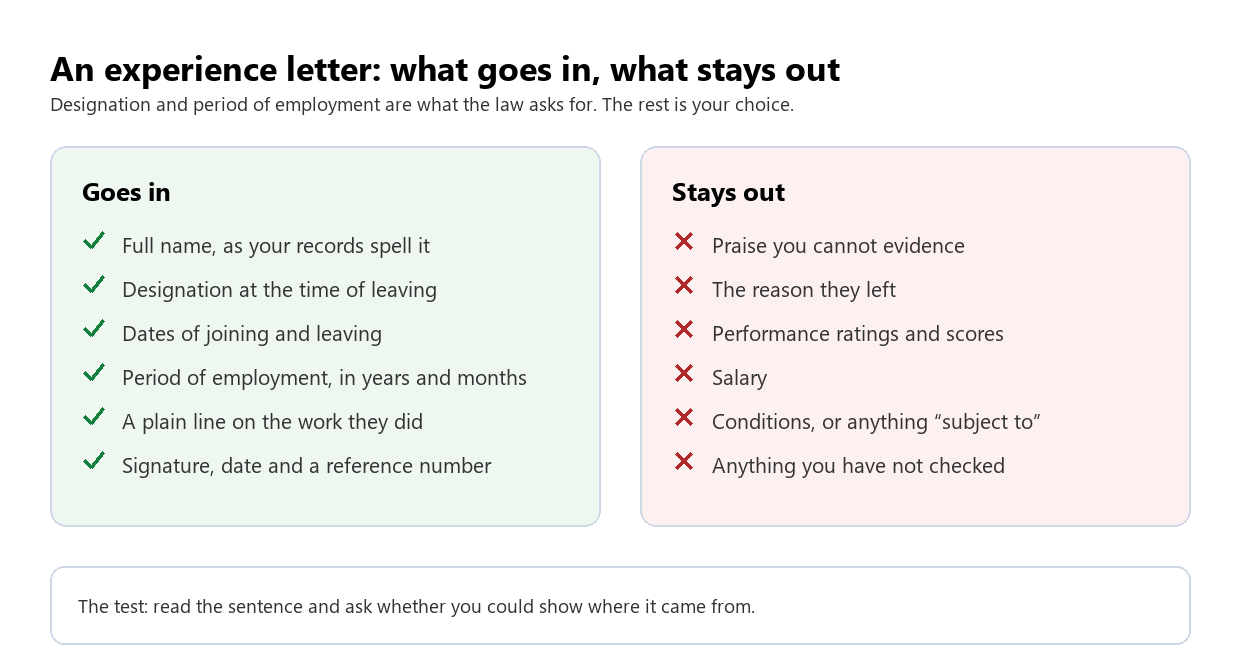
Six things belong in it. The designation and the period of employment are the two the law asks for; the rest make the letter useful to the person reading it next.
- Full name, as it appears in your own records.
- Designation at the time of leaving, and earlier ones if they were promoted. The dates for those sit in the appraisal and increment letters already on file.
- Dates of joining and leaving, in full.
- The period of employment spelled out in years and months.
- A plain line on the work they were responsible for.
- Signature, designation of the signer, date and a reference number.
The reference number does more work than it looks. When a background checker calls in two years, it is the only way to find the letter again. Put it on the copy you keep.
On letterhead, signed by someone with the authority to sign. A letter signed by a team lead who has since left is a letter nobody can verify.
If you want the wording already laid out, the experience and relieving letter formats cover the full set, including the service certificate and the relieving letter.
What to Leave Out of an Experience Letter
This is the shorter list, and the more useful one.
- Praise you cannot evidence. “An asset to the organisation” sounds harmless until you are asked to justify it in a dispute.
- The reason they left. The letter records service, not circumstances.
- Performance ratings and appraisal scores. Those belong in the file.
- Salary. If they need it, a salary certificate is the document for it.
- Conditions. Anything reading “subject to” turns a record into a bargaining chip.
- Anything you have not checked. Every fact in it should be traceable to a record.
The test is simple. Read the sentence and ask whether you could show where it came from. If you cannot, it does not go in.
Pro Tip
Write the letter as though the person will hand it to a lawyer, and the tone sorts itself out. Not cold, just checkable.
Three Lines People Get Wrong
These are the sentences that cause trouble. Not the layout, the wording.
The period of employment
Write both dates and the span. “From 12 March 2023 to 30 June 2026, a period of three years, three months and 18 days.” Not “for over three years”, which is vague, and not “three years”, which is wrong.
Where a joining date falls mid-month, state the dates and let them speak. Rounding is how a letter ends up contradicting the payroll record behind it.
The description of the work
Name the role and what it covered. “Worked as a Shift Supervisor, responsible for attendance, shift rosters and daily production reporting for a team of 24.” That is checkable and useful.
Compare it with “handled various responsibilities”, which tells the next employer nothing and tells a court even less.
The closing line
Keep it neutral and finished. “We wish them well in their future role” closes the letter without claiming anything. A line about being an asset, a pleasure or a star performer is a judgement, and a judgement is the part you can be asked to defend.
If the person genuinely deserves warmth, that belongs in a reference you give on request, where you control who hears it and when.
Wording the Letter for Awkward Exits
Templates assume a clean exit. Plenty of exits are not clean. Here is how to word the four awkward ones without writing anything you regret.
1. They left in the middle of notice
State the dates they actually worked. Do not describe the departure. If your policy needs the shortfall recorded, that belongs in the internal file, not in a letter the person carries to interviews.
2. They were let go for performance
The letter still gets issued. It states the designation and the period, and it stops there. The performance history lives in the warning letters on file, where it is dated and evidenced.
3. Money is still owed
Issue the letter anyway. A recovery is a separate matter, handled through the settlement and any advances or loans on record. Holding the letter back to force payment is the most common mistake here, and it turns a small dispute into a big one.
4. The tenure was very short
Two months is still two months. Write it plainly. A short honest letter is worth more to the person than no letter, and it costs you nothing to be accurate.
Where the Letter’s Dates Come From
Every fact in the letter should be traceable, and all four come from records you already keep.
| What the letter states | Where it comes from |
|---|---|
| Date of joining | The employee record created at onboarding |
| Date of leaving | The last working day, from the exit approval |
| Period of employment | The two dates, counted properly |
| Designation | The role on record at the time of leaving |
The joining date is the one that goes wrong. If it was typed in twice, once at employee onboarding and once into a spreadsheet, the two will eventually disagree. Whichever is wrong, the letter carries it.
Counting the period is the other. Years and months are easy to state wrongly when the joining date falls mid-month, and a working days calculator settles it faster than counting on a calendar. Where attendance already feeds the attendance to salary workflow, both dates are already sitting in one place.
Attendo (formerly Petpooja Payroll) is a complete workforce management system. It runs everything from attendance at the door through to salary, in one place, which means the joining date, the role and the last working day are all read from the same record.
What to Check Before You Sign the Letter
Four checks, all quick.
- Both dates match the employee record, not a memory or a message.
- The designation matches the role on record at the time of leaving.
- No sentence makes a claim you could not evidence.
- A copy with the reference number goes on file the same day.
Exit paperwork is the part of HR that gets done in a hurry, on the day, by whoever is free. That is the argument for having the records in one place before the resignation arrives, not after.
My Opinion
The letters people regret are the generous ones. A warm line written to be kind on a Friday is the line quoted back in a dispute two years later. Accuracy is the kinder choice, because it is the one that survives.
Frequently Asked Questions
1. Is an employer legally required to give an experience letter in India?
2. What must an experience letter contain?
3. Can an employer refuse an experience letter over dues?
4. What is the difference between an experience letter and a relieving letter?
5. Should an experience letter mention the reason for leaving?
Related Articles You May Like
What the Gratuity Act Means for Employers in 2026
The five-year rule survived 21 November 2025. What moved was the amount each year is worth, and the shorter qualifying period that fixed-term staff now get.
Ashwiniba Vaghela
HR & Payroll Experts

How to Make a PF Online Payment Under the New ECR
Filing and paying are no longer one action. From wage month September 2025 the return goes up first and the money follows. Here is what to do on the employer portal, and how to correct a return you have already sent.
Ashwiniba Vaghela
HR & Payroll Experts

Conveyance Allowance in Salary: Limits and How to Calculate
For HR and payroll teams: conveyance allowance for duty travel has no maximum, and the ₹1,600 figure everyone quotes was withdrawn in 2018. What rule 280 sets for salary structures now, with three worked examples.
Ashwiniba Vaghela
HR & Payroll Experts

Bonus Act: Who Qualifies and How Much
Two rupee figures decide a statutory bonus, and they do different jobs. One sets who the Act reaches, the other sets what the arithmetic runs on. Here is which is which, and what the deadline is.
Avani Joshi
HR & Payroll Experts