


What the Gratuity Act Means for Employers in 2026
The five-year rule survived 21 November 2025. What moved was the amount each year is worth, and the shorter qualifying period that fixed-term staff now get.
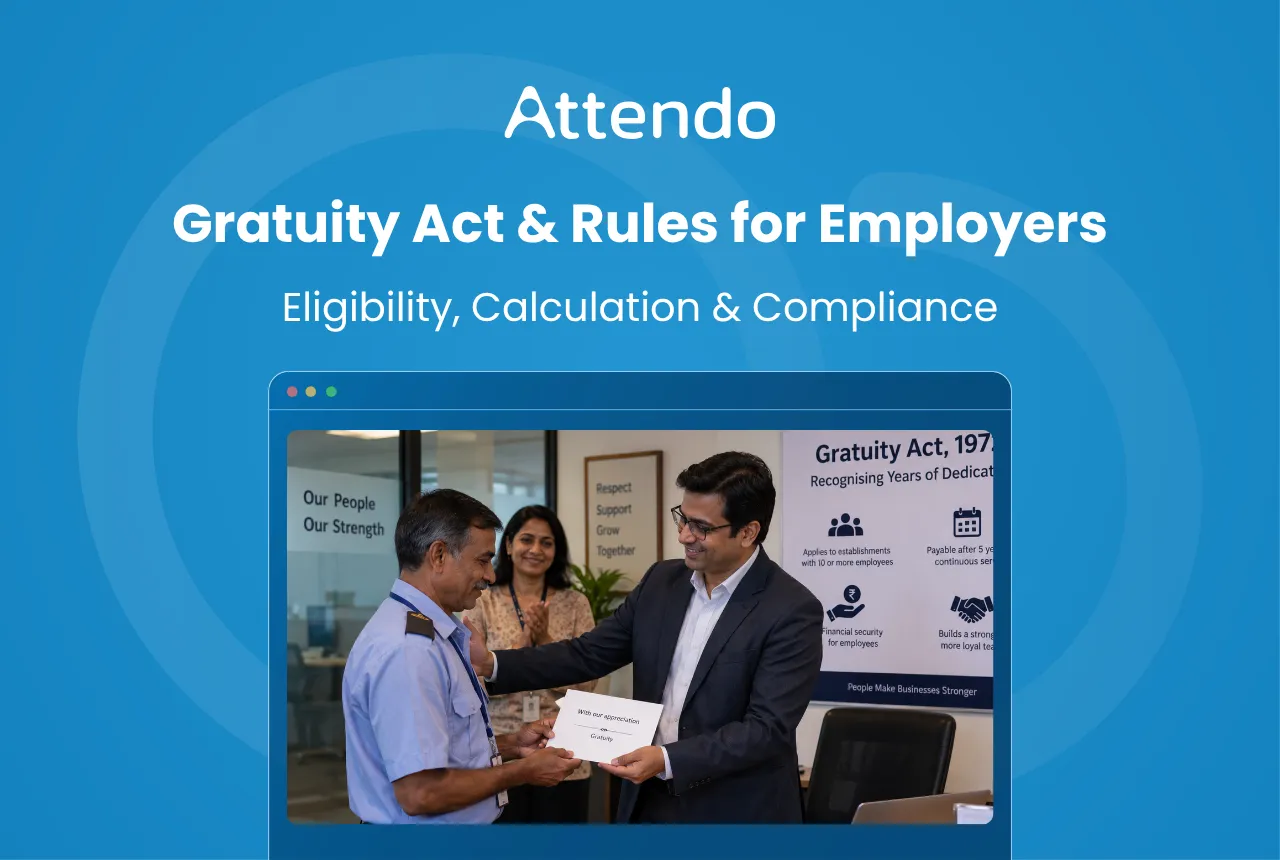
The rules on gratuity changed on 21 November 2025. Most of the change is in the money rather than the rulebook.
The five-year rule still stands for permanent staff. What moved is the wage figure the payment is built from, and how long a fixed-term employee has to serve.
This is a reference for employers. What applies now, what the new wage definition does to the number, and who pays in each case.
Key Takeaways
- What it is: money owed for years of service, paid out when an employ1ee leaves.
- Who qualifies: five years of service for permanent staff. One year for fixed-term employees, paid proportionately.
- How much: 15 days of wages for every completed year, at the employee’s final wage.
- Which law: from 21 November 2025 it is paid under the Code on Social Security, 2020.
- Who pays for contract labour: the Ministry puts the payment on the contractor.
- What to do: check how your salary structure splits basic pay from allowances.
- What changed in 2025: not the formula, but the wage figure it runs on, which is usually larger.
Which Law Applies to Gratuity Now
Gratuity is a payment for long service, made when an employee leaves. It falls due on retirement, resignation or death, and it is worked out on years served.
The four labour codes were made effective on 21 November 2025, replacing 29 older labour laws.
Gratuity moved with them. So the Ministry was asked a direct question. Does service before that date fall under the Payment of Gratuity Act, 1972, and service after it under the codes?
The answer is in the labour codes FAQs of 16 March 2026. Gratuity is paid on the last drawn wages “on and after 21.11.2025 as per the provisions of Code on Social Security, 2020”.
In Simple Words
There is no split calculation here. One payment, under the Code, built on the wage the employee was last drawing.
Who Qualifies for Gratuity
This is where most of the confusion sits. Three kinds of worker, and the rule is not the same for all of them.
The rules below come from the same Ministry FAQs linked above, at entries 10, 14, 16 and 19.
| Type of employee | Service needed | Who pays |
|---|---|---|
| Permanent employee | Five years of continuous service | The employer |
| Fixed-term employee | One year from the start of the contract, paid proportionately | The employer |
| Contract labour through a contractor | Five years of continuous service | The contractor |
The one-year rule is the part that gets misread. It applies to fixed-term employees, and the Ministry defines those as people directly engaged by the employer.
But somebody supplied through a contractor is not a fixed-term employee. For them the five-year rule holds, and the Ministry names the contractor as the one who pays.
Whether a principal employer picks that up when a contractor defaults is a separate question, and not one the FAQs answer.
An eleven-month contract does not qualify either. The Ministry was asked that exact question, and the service has to run a year from the start of the contract.
Proportionate means the payment follows the service actually given. Someone who completes eighteen months is not paid as though that were a full year, nor as though it were two.
How the Wage Definition Changed
This change has the biggest effect on what you pay. It is easy to miss, because the formula itself did not move.
Gratuity is worked out on wages. The codes redefined what wages means, and that new meaning applies to gratuity from 21 November 2025.
If allowances run past half of an employee’s total pay, the excess counts as wages as well.
The government’s own press bureau puts the effect plainly. A wider wage base raises benefits “such as gratuity, pension and leave salary”.
So a small basic with large allowances still keeps an employer’s gratuity cost down, but only up to that half-way line, and above it the saving stops.
Two limits are worth knowing:
- Only what the Code counts as wages goes into the figure. The Ministry says a payment outside those listed components is not counted for gratuity at all.
- Gratuity itself is not counted when working out whether allowances have crossed the half-way mark.
Payments in kind count as wages too. The Ministry gives food coupons, ration items and mobile recharge as examples.
What Did Not Change About Gratuity
Plenty of coverage since November has read as though everything moved. Most of the rules did not, and knowing which saves a lot of unnecessary work.
- The rate. Gratuity is still 15 days of wages for each completed year of service, worked out on the last wage drawn.
- The five-year rule. Still there for permanent staff and for contract labour.
- When it falls due. Retirement, resignation or death, as before.
So the formula your payroll already uses is still the right formula. What moved underneath it is the wage figure it runs on.
Does This Apply to Past Service?
The Ministry puts the change at 21 November 2025, going forward. Nothing in it asks you to redo a settlement already paid.
What the Ministry does not say is whether the years before that date are valued any differently. Instead, its answer describes one payment, worked out on the last wage drawn, under the Code.
On a settlement you run now, the formula uses the last wage drawn, and that wage is set by the Code. So in practice the new base carries the calculation.
Where Employers Get Gratuity Wrong
Everything above is the rule, but this part is what tends to go wrong in practice.
The mistakes split between records and pay structure, and the records ones are the cheapest to fix.
| Type of business | The usual mistake |
|---|---|
| Manufacturing unit using contract labour | Assuming the principal employer owes gratuity when the contractor does |
| IT services firm with fixed-term hires | No gratuity budgeted at all, because a one-year contract used to earn none |
| Retail chain with allowance-heavy pay | A small basic and large allowances, so the new wage base costs the most |
| Hospital or diagnostic chain | Long-serving staff whose last drawn wage jumps in the final year |
| School or coaching institute | Seasonal contracts renewed year on year, with no clear start of contract date |
The record ones are three: whether someone is a fixed-term employee, when their contract started, and what the wage record says.
All three sit in records you already keep.
In Attendo (formerly Petpooja Payroll), contract dates and wage components sit beside the attendance to salary workflow. So the figure a settlement is built on comes out of the system that paid the wages.
The labour codes readiness checklist covers the wider set of changes that arrived with the codes in November 2025.
What to Do About Gratuity This Quarter
Four things worth doing before your next settlement.
- Look at your salary structures. If allowances run past half of total pay, your gratuity liability has already moved.
- Separate your fixed-term employees from contractor-supplied staff on paper. The rules are different and so is who pays.
- Check that every fixed-term contract has a clear start date, because the one-year clock runs from it.
- Keep your wage records straight. A settlement is built on the last drawn wage, and a statutory register is where that gets proved.
Three of those four are records rather than rules, which is also why a correct relieving and experience letter matters when someone leaves.
What to Remember About Gratuity in 2026
The change is smaller than the headlines suggest, and costlier than it first looks.
- Five years still applies to permanent staff. Only fixed-term employees moved to one year.
- The formula did not change. The wage figure it runs on did.
- The Code governs any gratuity paid on or after 21 November 2025.
One caution is worth keeping. The Ministry’s FAQs say that where they and the Code differ, the Code wins. This page rests on those FAQs, which puts it one more step from the Code itself. So check your own position before you commit to a number.
Frequently Asked Questions
1. Is the five-year rule for gratuity still in place?
2. All our staff are permanent. Does any of this reach us?
3. Is a contractor’s worker a fixed-term employee?
4. Why has our gratuity liability gone up without any rule changing the formula?
5. Do we have to recalculate gratuity already paid?
Related Articles You May Like

How to Make a PF Online Payment Under the New ECR
Filing and paying are no longer one action. From wage month September 2025 the return goes up first and the money follows. Here is what to do on the employer portal, and how to correct a return you have already sent.
Ashwiniba Vaghela
HR & Payroll Experts
Conveyance Allowance in Salary: Limits and How to Calculate
For HR and payroll teams: conveyance allowance for duty travel has no maximum, and the ₹1,600 figure everyone quotes was withdrawn in 2018. What rule 280 sets for salary structures now, with three worked examples.
Ashwiniba Vaghela
HR & Payroll Experts
Bonus Act: Who Qualifies and How Much
Two rupee figures decide a statutory bonus, and they do different jobs. One sets who the Act reaches, the other sets what the arithmetic runs on. Here is which is which, and what the deadline is.
Avani Joshi
HR & Payroll Experts

How to Write an Experience Letter: What to Put In and Leave Out
The law names two things an experience letter must carry. Everything else is your choice, including the sentences that come back to bite. Here is what to write, and what to leave alone.
Avani Joshi
HR & Payroll Experts