


How the EPF Interest Rate Works, and When It Arrives
EPFO paid 8.25% to its members this July. Who fixes that figure, what it is worked out on, and why a passbook can sit unchanged for months after the number makes the news.
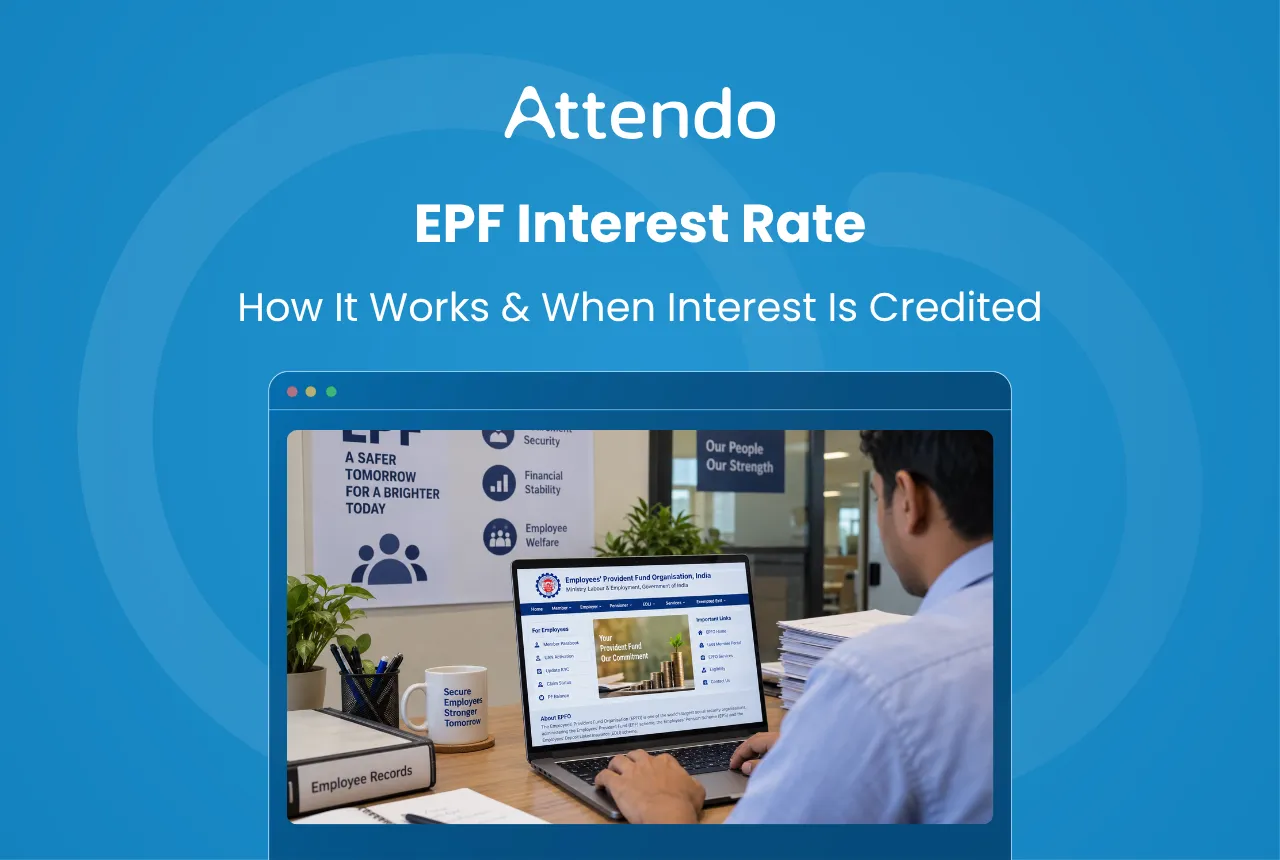
An employee asks in May where their EPF interest is. You open the passbook. The rate was all over the news in March, and the balance has not moved.
Nothing was wrong. The rate for 2025-26 was recommended in March, notified on 1 July and credited by 15 July. Three separate steps, four months apart.
This page sets out what the current EPF interest rate is and who decides it. It also covers when the money lands, and what to check if it has not.
Key Takeaways
- What it is: the yearly rate paid on the money sitting in an EPF account, set by the Government and paid by EPFO.
- The rate now: 8.25% for the financial year 2025-26.
- How it builds: compound interest on the monthly running balance, at the rate declared for that year.
- Who decides: the Central Board of Trustees recommends it, the Government notifies it, EPFO credits it.
- When it arrives: once a year, after the notification, not when the rate is announced.
- When it stops: an account with no contribution for three years after retirement turns inoperative.
- What happened this year: the credit went into nearly 34 crore accounts by 15 July 2026.
The EPF Interest Rate Right Now
8.25% for the financial year 2025-26. The Central Board of Trustees set that figure on 2 March 2026, at its 239th meeting.
But a recommendation is not a payment. The same release says the rate would be notified by the Government first. Only then would EPFO credit it.
That notification came on 1 July 2026. EPFO then directed its regional and zonal offices to credit the approved interest.
One thing to be clear about: 2025-26 is the year that ran from April 2025 to March 2026. The interest paid this July is for money that sat in the account during those twelve months, not for the year now running.
In Simple Words
March gives you the number. July gives you the money. If your balance has not moved yet, check which of the two has happened.
How the Rate Is Decided
Three bodies touch the figure before it reaches anyone, and each does a different job.
| Step | Who | What they do |
|---|---|---|
| 1 | Central Board of Trustees | Recommends a rate for the year |
| 2 | Government of India | Notifies it officially |
| 3 | EPFO | Credits it to member accounts |
Step two is the Ministry of Labour and Employment. For 2025-26 it approved the rate before EPFO could credit anything, which is what the EPF Scheme, 1952 asks for.
When Does EPF Interest Reach You?
Once a year, and only after the notification. For 2025-26 the credit was completed by 15 July 2026 into nearly 34 crore accounts.
Over ₹1.44 lakh crore went out in that round, through EPFO’s new Centralised IT Enabled Services system, or CITES.
EPFO has moved every member record onto one central system. The old setup was split across offices. That is what let a run this big finish in a fortnight.
Two things change for members. Their details, PF balance, claim status and pension service now sit behind one portal, not several.
And a withdrawal request is checked before it reaches an office.
That second one matters at exit. The system checks whether a member qualifies, flags what is missing, and says so if they are asking for too much. Fewer claims should come back rejected.
So the honest answer to “when will my EPF interest come” is this. After the Government notifies the rate, in one go, for the year just ended.
How EPF Interest Is Calculated
Not on your closing balance, and not on your opening one. EPFO states the method as compound interest credited on the monthly running balance, at the statutory rate declared for each year.
So the month a rupee goes in decides how many months it earns for.
In Simple Words
Every month’s balance earns for the months that follow it. Money in early is worth more than the same money in late.
A Worked Example
Take an employee whose account starts the year at ₹1,00,000, with ₹5,000 going in every month. By March the balance is ₹1,60,000, but only the opening ₹1,00,000 was there for the whole of it.
| Month the ₹5,000 went in | Months it earns for |
|---|---|
| April | 12 |
| October | 6 |
| March | 1 |
This is why two employees on identical salaries can see different interest. One joined in April, the other in October, and only the first had a balance earning for the whole year.
What the EPF Interest Rate Covers
It applies to the provident fund balance. It is not the return on every deduction that leaves a salary.
- The employee’s own contribution and the part of the employer’s share that goes to provident fund both sit in the EPF account and earn this rate.
- The pension share is a separate scheme with its own rules, and this rate is not what it pays.
The rate itself does not vary. A member with ₹40,000 in the account and one with ₹4,00,000 earn at the same 8.25%, and no employer can offer more or less. Only the balance differs.
Staff often read the single PF column on a payslip and assume all of it earns 8.25%. Splitting that column into its two parts usually settles the question.
Our guide to EPF forms covers what gets filed against each part.
When an Account Stops Earning
An account does not earn forever after someone leaves. EPFO marks it inoperative once three years pass with nothing paid in. The clock starts at retirement, at a move abroad for good, or at death.
There is a limit alongside that. EPFO’s own FAQ says that at present all accounts earn interest up to the age of 58.
For an employer this matters at exit, not during service. Someone who leaves without moving the money still has a balance. It will not earn forever.
There are two ways to avoid that. The member transfers the balance to the account with their new employer, or they withdraw it.
A transfer is the quieter option, because the balance keeps sitting in an active account instead of going dormant. Worth saying at the exit interview rather than leaving the person to work it out later.
What Should Employers Check?
The interest itself is EPFO’s job. Your side is the money it is worked out on: did it go in, in full, on time.
| Type of business | What tends to go wrong |
|---|---|
| Manufacturing unit with monthly joiners | A late return, so a month of contribution lands in the wrong month |
| IT services firm | Transfers not raised, so a joiner’s old balance sits idle |
| Retail chain across stores | Each store filing separately, so one branch slips and nobody notices |
| School or coaching institute | Staff on contract wrongly left out, so no balance exists to earn on |
| Hospital or diagnostic chain | Wage figure understated, so the balance that earns is smaller than it should be |
Every one of those starts as a payment problem and shows up later as an interest question. The rate is the same for everybody. The balance it runs on is not.
In Attendo (formerly Petpooja Payroll), the wage figure behind the PF share comes from the same attendance record as the salary. So the attendance to salary workflow and the return agree.
The EPF Interest Rate Checklist
If someone asks where their interest is, work through five questions before escalating anything.
- Has the rate for that year been notified yet, or only recommended?
- Is the passbook showing the year just ended, or the current one?
- Were all twelve months’ contributions filed, and filed on time?
- Did a transfer from a previous employer complete?
- Is the account still operative, or has it passed three years since exit?
The short version is this. The rate is 8.25% for 2025-26, it is worked out month by month on whatever is in the account, and it arrives once a year after the Government notifies it.
For the money that arrives before any of this, the ESIC number guide covers the other deduction staff ask about most.
One caution is worth keeping. The rate on this page is the one set for 2025-26. A fresh rate is fixed each year, and it has to be notified before it means anything. Check the year before you quote the figure to anyone.
Frequently Asked Questions
1. What is the EPF interest rate for 2025-26?
2. When will EPF interest be credited to my account?
3. Does it matter which month the money goes in?
4. Why has my EPF balance not changed after the rate was announced?
5. Does an EPF account keep earning interest after someone leaves?
Related Articles You May Like
How to Complete the ESI Registration Process in 8 Steps
Registration is online, real time, and needs no paper at all. The state that wants 20 workers where its neighbour wants 10, what the C-11 letter proves, and why the amnesty no longer helps.
Ashwiniba Vaghela
HR & Payroll Experts
Expected CTC: 7 Ready-to-Use Answers for Your Next Interview
The question asks what you would cost, not what you would receive. Seven lines to use in an interview, the reasoning that backs each of them, and why the law measures a different figure from the one in an offer.
Avani Joshi
HR & Payroll Experts

How the ESIC Claim Process Works for Employees
One form per benefit, one office, and a three-day rule on medical certificates that quietly costs people money. What each claim pays, and how fast ESIC has to pay it.
Avani Joshi
HR & Payroll Experts

How the ESI Salary Limit Works, and Who It Covers
₹21,000 a month, unchanged since 2017. The three routes that bring a workplace into the scheme, why a raise in July does not end cover in July, and the 135 districts still outside it.
Avani Joshi
HR & Payroll Experts