


6 Factories Act Rules Employers Must Follow Now
For HR and plant managers: the six rules that bind a factory employer now that the 1948 Act has gone, including the headcount change that decides whether your unit still counts as a factory at all.
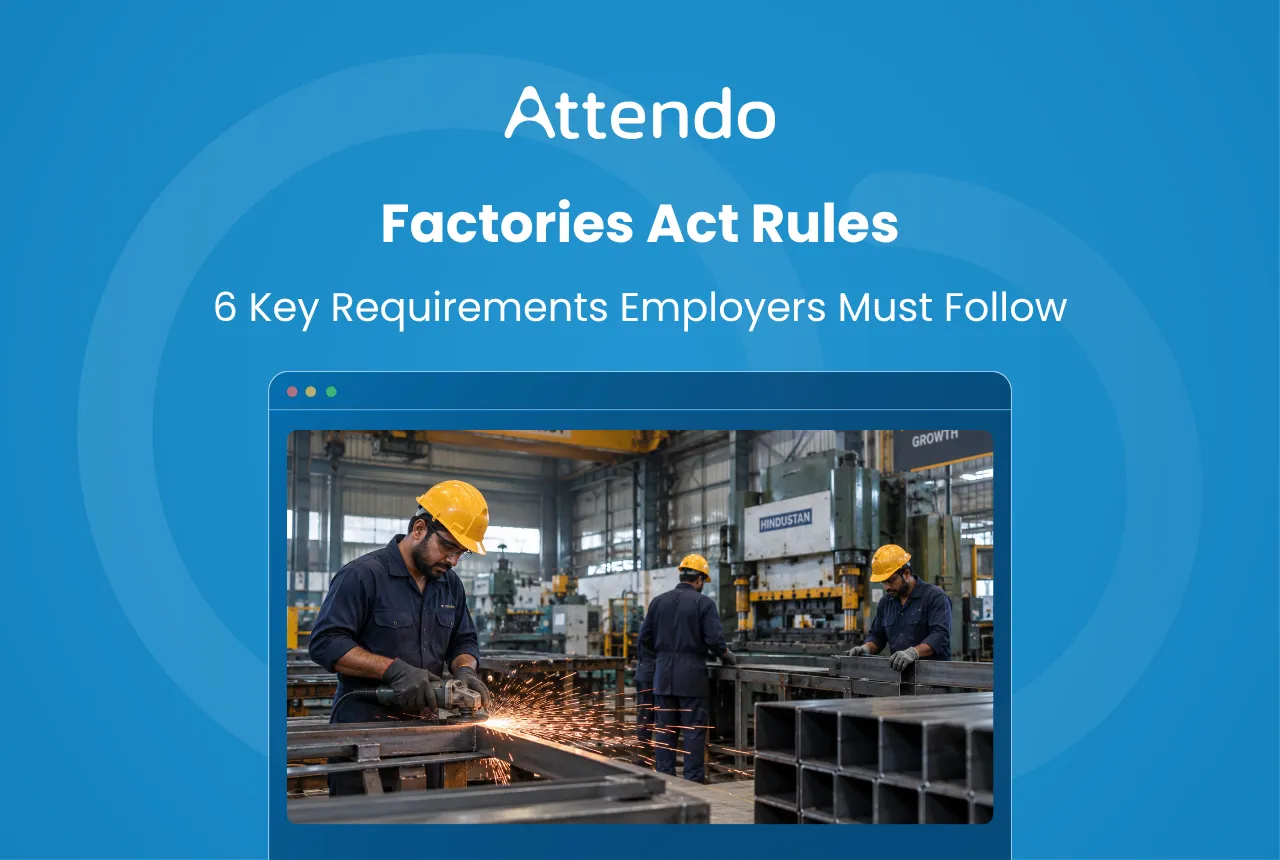
A metal workshop with twenty-six workers has a Factories Act licence on the wall, and a register gets filled in every Friday. The whole system is built around an Act that no longer exists.
None of that is negligence. The law moved underneath the whole sector, and the paperwork did not.
This guide is for whoever keeps a plant legal. An HR manager, an admin head, or the owner doing both jobs. It sets out the six rules a factory employer follows now. It also shows what changed from the Act you may still be working to.
Key Takeaways
- The Factories Act, 1948 was repealed on 21 November 2025.
- Factory rules now sit in the Occupational Safety, Health and Working Conditions Code.
- The headcount that makes you a factory went up, so some units are no longer factories at all.
- An appointment letter for every employee is now a statutory duty, not good practice.
- Annual leave now qualifies at 180 days worked, down from 240.
- Women may work any shift, with consent and prescribed safeguards.
What Replaced the Factories Act
Start here, because the rest of the post depends on it and most compliance calendars have not caught up.
The Ministry of Labour and Employment made the four labour codes live on 21 November 2025. Between them they replace twenty-nine older labour laws.
One of the four is the Occupational Safety, Health and Working Conditions Code, 2020, or OSH Code for short. Section 143(1) of that Code is blunt about the old laws. First on its repeal list is the Factories Act, 1948.
The Act is gone. The duties are not. All the old rules on safety, hours, leave and welfare still apply. They now sit in a different law, under different section numbers, and some of them on different terms.
Did You Know?
The repeal took twelve other Acts with it, including the Mines Act, 1952 and the Contract Labour (Regulation and Abolition) Act, 1970. If your compliance file has a tab for any of those, it is pointing at a repealed statute too.
Rule 1: Factories Act Limit Is Now 20
This one comes first. It decides whether the other five apply to you at all, and the number moved.
Under the OSH Code a factory is premises where twenty or more workers work with the aid of power, or forty or more without it. The test looks at any day of the preceding twelve months.
The Ministry’s own FAQ on the OSH Code puts it plainly. The old limits were ten with power and twenty without. They are now twenty and forty.
| Manufacturing | Factories Act, 1948 | OSH Code, now |
|---|---|---|
| With the aid of power | 10 or more workers | 20 or more workers |
| Without the aid of power | 20 or more workers | 40 or more workers |
Read the right-hand column against your own headcount. A unit of fourteen running machinery was a factory under the old Act and is not one under the Code. That is a genuine reduction in what you have to file.
It is also a trap. Your state licence and registers may still say otherwise, and the proviso preserves a state’s own number where one was already specified.
That change does not switch the duties off. The Ministry answers this directly. Health, safety and welfare rules apply to any workplace with ten or more staff.
So a unit below the factory limit still owes them. What changes is what you register and file as, not whether your workers are covered.
The wording also leaves out a hotel, restaurant or eating place, a railways running shed, and a mobile unit of the armed forces.
Rule 2: Issue Appointment Letters
Most small firms are quietly in breach of this one. It is not a formality.
Section 6(1)(f) of the Code says every employer must give a letter of appointment to every employee. The form is the one the government sets. The Code also dealt with the backlog. Anyone without a letter when it started had to be given one within three months.
On a shop floor that runs on spoken terms and a joining register, this is the biggest day-to-day change. It covers every employee, not just staff on paper. The employee record you create at joining is where the letter should come from. Not typed later from memory.
Rule 3: Pay for the Health Checks
Two clauses of one section work together here, and people miss the second.
- Section 6(1)(c). Give a yearly health check or test free of cost to the groups of workers the government names.
- Section 6(1)(g). Charge no employee for anything done or given to keep the workplace safe and healthy. That includes the medical check for work-related illness.
Together they close the door on deducting the cost of a safety item or a medical from wages. The employer pays. Nothing about safety or health should reach the payslip as a cut.
Rule 4: Everyone on the Premises
The clause is short. Its reach is wider than most employers expect.
For a factory, section 6(1)(h) puts the safety and health of employees and workers on the employer. Then it goes further. It covers other people on the work premises with or without his knowledge.
Those last five words do the work. Think of a contractor’s fitter, a driver waiting by the loading bay, or a supplier’s engineer who walked in through an open gate.
If they are on your premises, their safety is your duty. It does not matter whether anyone signed them in. So a record of who is actually on site stops being an attendance question and becomes a safety one.
Section 6(2) adds the factory detail. Safe plant and safe systems of work. Safe use, handling, storage and transport of articles and substances. And the information, training and instruction to go with them.
Rule 5: Factories Act Leave Is Now 180
The leave maths changed, and it changed in the worker’s favour.
Section 32(1) of the Code sets the entitlement, and the Ministry’s factsheet on the OSH Code states it in plain terms. A worker earns leave with wages once they have worked 180 days in the calendar year.
The rate is one day of leave for every 20 days worked. For an adolescent worker it is one day for every 15.
Under the repealed Act the figure was 240 days. Dropping it to 180 brings seasonal and short-term workers into the leave right for the first time. That is just the group a textile mill takes on for a quarter. Or any manufacturing unit with a seasonal order book.
One detail belongs in your leave policy. Layoff, maternity leave and leave already taken all count toward the 180 days. They are not gaps that reset the clock.
Pro Tip
If your leave rule still says 240 days, look at who it excludes. Workers who joined mid-year, and anyone laid off for part of it. Those are the people most likely to raise it. Change the number before the calendar year closes, not after.
Rule 6: Women May Work Any Shift
This one lifts a limit rather than adding a duty. It still needs handling with care.
Section 43 entitles women to be employed in all establishments for all types of work. They may also work before 6 a.m. and beyond 7 p.m., with their consent.
That consent comes with conditions on safety, holidays and working hours, set by the government. The Ministry states the permission in the same terms: women may work at night, and in all types of work, if they agree and the safety measures are in place.
The reach is wider than a factory. This section covers every workplace. The same consent and safeguards cover a diagnostic lab on nights, or a hotel on split shifts.
That has practical consequences for a plant running shifts. Consent must be real and written down, not assumed from a roster, and the safeguards bind the employer.
So a night shift with women on it is a decision to record, along with the transport, lighting and staffing behind it.
Attendo (formerly Petpooja Payroll) is a complete workforce management system, running everything from attendance at the door through to salary, statutory deductions and payslips in one place.
Headcount, joining dates and leave balances sit beside the attendance to salary workflow, which turns the questions in this post into reports rather than an afternoon with a register.
What This Means for Your Factories File
Five things follow from the six rules, and none of them needs a consultant.
- Count your workers against the new thresholds and establish whether you are still a factory under the Code.
- Check every employee has an appointment letter, and issue the missing ones.
- Change the leave qualifying figure from 240 to 180 in your policy and your payroll settings.
- Stop any deduction connected to safety or health, including medical examinations.
- Retitle the file. A folder marked Factories Act is now a folder marked OSH Code, and the difference is not cosmetic when an inspector asks.
The registers catch people out. The format follows the Code and the rules under it, not the old Act. Keeping the statutory register formats together with the labour codes readiness checklist turns an audit into a lookup instead of a hunt through a drawer.
My Opinion
If I ran a plant today I would start with the headcount, not the paperwork. Most units sit between fourteen and twenty-five workers, and that is the band where the new limits decide whether you file as a factory at all.
Frequently Asked Questions
1. Is the Factories Act still applicable in India?
2. How many workers make a place a factory now?
3. Is an appointment letter compulsory for factory workers?
4. How much annual leave does a factory worker get?
5. Can women work night shifts in a factory?
Related Articles You May Like
Probation Period Rules in India, and the New Six Months
Probation has a stated length again: six months, extendable by three, from 8 May 2026. Who that binds, who still writes their own number, and why PF and ESI never paused for probation at all.
Avani Joshi
HR & Payroll Experts

What Actually Binds: Letter of Intent vs Offer Letter
A letter of intent states an intention. An offer letter is a proposal. Neither creates a contract by itself, and the Contract Act fixes a hard deadline after which you can no longer pull an offer back.
Avani Joshi
HR & Payroll Experts
How to Prepare a Leave Policy Format After the 2025 Update
The qualifying period for earned leave fell from 240 days to 180 on 21 November 2025. What every section of a leave policy has to say now, and the refused-leave rule that has no cap at all.
Ashwiniba Vaghela
HR & Payroll Experts

6 Appointment Letter Formats You Can Copy
The offer letter is the invitation. This one carries the full terms, and since November 2025 it is compulsory. The eight items every version carries, and the clause that changes for six kinds of hire.
Avani Joshi
HR & Payroll Experts