


How to Prepare a Leave Policy Format After the 2025 Update
The qualifying period for earned leave fell from 240 days to 180 on 21 November 2025. What every section of a leave policy has to say now, and the refused-leave rule that has no cap at all.
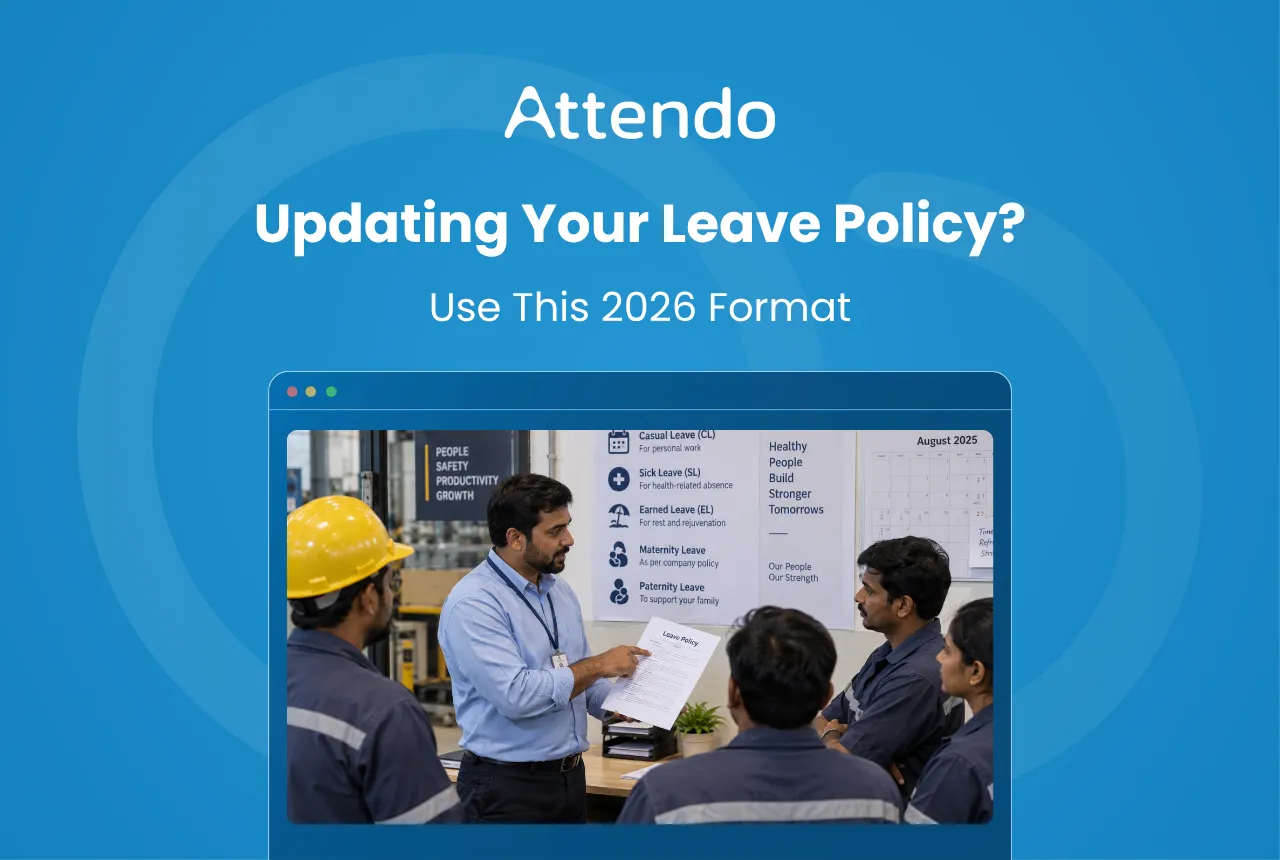
Open the leave policy you are using today and look at one number: the days a worker has to put in before leave is earned. If it says 240, your policy is running on a rule that no longer exists.
The four labour codes took effect on 21 November 2025, and annual leave moved into a new law. That number fell to 180. Most policies in circulation were prepared before the change and have not caught up.
This guide sets out what a leave policy format includes, section by section, and what the updated law now puts inside each one. Work through it against your own document rather than starting a new one.
Key Takeaways
- What it is: a written document that says how much leave staff get, how they ask for it, and what happens to what they do not use.
- The six sections it needs: who it covers, how leave is earned, how it is requested, holidays inside leave, carry forward, and exits.
- What the law fixes for you: one day of leave for every 20 days worked, once a worker has put in 180 days in the year.
- What you fix yourself: casual and sick leave, for almost every kind of staff. The Code does not set them.
- Carry forward: up to 30 days. Leave you refused carries over with no limit at all.
- On exit: unused leave is paid out, and for a resignation it is due by the second working day.
- State law: if your state gives more, the employee keeps the more generous one.
- What changed in 2025: the qualifying period dropped by 60 days, so any policy prepared before November that year carries the wrong number.
What the Law Fixes in Your Policy
A leave policy is your document rather than the government’s. But parts of it are fixed by law, and you cannot go below them.
The four labour codes were made effective on 21 November 2025. Annual leave now sits in section 32 of the Occupational Safety, Health and Working Conditions Code.
Two numbers matter most:
- 180 days. A worker earns leave once they have worked that many days in the calendar year.
- One day for every 20. That is the rate leave builds at. For a young worker under 18, it is one day for every 15.
Some days off still count towards the 180. Layoff, maternity leave and leave already taken are all counted in. What those days do not do is earn any further leave of their own.
Casual and Sick Leave
Mostly it does not, and that surprises people. Section 32 fixes annual leave with wages. That is the leave the Code sets a floor under.
Casual leave appears once in the whole Code, at section 25(3), and only for sales promotion employees and working journalists. Sick leave is not named anywhere in the Code at all.
Those two groups get their own scheme, and it has two parts.
- Earned leave on full wages, at not less than one-eleventh of the time on duty.
- Leave on a medical certificate at half wages, for not less than one-eighteenth of service.
For everybody else, casual and sick leave come from your state rules, your industry or your own contract. The Code does not set them, so your policy has to. Our guide to sick leave in India covers how far the state rules vary.
Keep the two apart in the document. One set of numbers you cannot go below, and one set you decide yourself. The carry forward and exit rules that follow sit in section 32, so they attach to the first set.
What a Leave Policy Format Includes
A policy that works is a policy someone can follow without asking you. These are the parts it needs.
1. Who the Policy Covers
Say plainly which staff it applies to. The Ministry says the leave rules cover workers, and supervisors whose wage is not more than ₹18,000 a month.
Above that line you can still give leave, but you are choosing to rather than being told to. Your policy should say which of the two it is.
2. How Leave Is Earned
State the 180-day qualifying period and the one-day-per-20 rate. Then say what happens to someone who joins in June.
The Code answers that one at section 32(1)(v). Somebody who joins partway through the year earns leave if they work one-fourth of the days left in that year.
3. How Leave Is Requested and Approved
This is the part the law leaves to you, and the part an argument usually starts over.
Set out how much notice you want, who approves, and what happens when a request is turned down.
That last one is expensive to get wrong, because leave you turn down carries forward with no cap at all.
4. Holidays That Fall Inside Leave
If a public holiday lands in the middle of someone’s leave, it does not count as leave. That is section 32(1)(iv), and your policy should repeat it.
5. Carry Forward and Encashment
Say what carries into next year and what gets paid for instead. The Code is firm on both, and the next section sets out the numbers.
6. What Happens When Someone Leaves
Unused leave is paid out when someone goes, and the Code fixes how fast. The deadline is shorter than most settlement cycles.
Carry Forward and Encashment Rules
Three situations decide what happens to unused leave at the end of the year.
| Situation | What the Code says |
|---|---|
| Leave the employee simply did not take | Carries forward, up to 30 days |
| Leave the employee applied for and you refused | Carries forward with no limit |
| Leave left over at the year end, including anything above the 30-day cap | The worker is entitled to encash it on demand |
The second row is the one that costs money. If you turn down a leave request, that leave does not expire. It stacks up, year after year, with nothing capping it.
In Simple Words
There are only two ways that balance ever leaves your books. The person takes the leave, or you pay for it. Refusing the request does neither.
The earned leave calculator will work out a balance, and the leave encashment calculator handles the payout side.
What Happens to Leave on Exit
When someone leaves, unused leave becomes money. The Code sets both the entitlement and the deadline.
The 180 days decides when someone can take leave. It does not decide whether they are paid for what they built up.
So the Code pays out even when the person never reached 180 days. They still get the leave they earned at the one-day-per-20 rate.
| How the person leaves | When the payment is due |
|---|---|
| Resignation, or being let go | Before the end of the second working day |
| Retirement on reaching age, or death in service | Within two months |
Two working days is short. If your full and final settlement runs on a 30-day or 45-day cycle, the leave part cannot wait for it.
Where a Leave Policy Format Fails
A few faults come up more than others, and they differ by how a business runs.
| Type of business | The usual fault |
|---|---|
| Manufacturing unit running shifts | The policy still says 240 days, so staff are told they have not earned leave |
| IT services firm | Leave refused during a delivery crunch, then treated as lapsed |
| Retail chain across stores | Approval left to each store, so the rule is different in every branch |
| Hospital or diagnostic chain | Holidays inside a leave period counted as leave |
| School or coaching institute | Nothing written down for staff who join partway through the year |
Most of these are faults in the document, not in the way leave is tracked. The policy either says the wrong thing or says nothing at all.
You also have to keep a register. The Code says it must cover leave, leave wages, overtime and attendance.
In Attendo (formerly Petpooja Payroll), the leave balance sits next to the attendance to salary workflow. The policy number and the payout number are then the same number.
The statutory register formats cover what the register itself has to hold.
Does State Law Still Matter?
Yes it does, and this is the part of a leave policy that is easiest to leave out.
The Ministry’s FAQ on the labour codes sets two rules, and you have to apply both.
- Where a state law is inconsistent with the Code, the Code wins.
- Where a state benefit is more favourable to the employee than the Code, the employee keeps it.
The Ministry uses carry forward as its own example. The Code caps it at 30 days and Andhra Pradesh allows 60, so an employee there keeps the 60.
So your policy has to clear more than one bar. The Code sets the floor, and your state may set a higher one.
Compare them line by line rather than picking one law and sticking to it. A state rule can be better on one item and worse on the next.
Which set of rules applies depends on whether the Centre or your state is the authority for your kind of establishment. The Ministry draws that line, so confirm which side you sit on before you prepare the policy.
Your Leave Policy Format Checklist
The document has not changed shape. The numbers inside it have, so the quickest way to use this page is to read your existing policy against five questions.
- Does it still say 240 days? Leave is earned after 180 now.
- Does it say what a mid-year joiner gets?
- Does it cap carry forward at 30 days? Refused leave has no cap, and anything above 30 can be encashed.
- Does it pay out unused leave by the second working day after a resignation?
- Does it set your own casual and sick leave, and say whether your state gives more than the Code?
The labour codes readiness checklist covers the other changes that landed on the same day.
One caution is worth keeping. This page sets out the floor the Code puts under your policy. Your state, your industry and your own contracts can all sit above it. So check your own position before you publish a policy.
Frequently Asked Questions
1. Is a written leave policy compulsory for a private company?
2. How many days of leave does the law actually require?
3. Can we cap carry forward at 30 days for everyone?
4. When do we have to pay out unused leave to someone who resigns?
5. Our state law gives more leave than the Code. Which one applies?
Related Articles You May Like
Probation Period Rules in India, and the New Six Months
Probation has a stated length again: six months, extendable by three, from 8 May 2026. Who that binds, who still writes their own number, and why PF and ESI never paused for probation at all.
Avani Joshi
HR & Payroll Experts
What Actually Binds: Letter of Intent vs Offer Letter
A letter of intent states an intention. An offer letter is a proposal. Neither creates a contract by itself, and the Contract Act fixes a hard deadline after which you can no longer pull an offer back.
Avani Joshi
HR & Payroll Experts
6 Factories Act Rules Employers Must Follow Now
For HR and plant managers: the six rules that bind a factory employer now that the 1948 Act has gone, including the headcount change that decides whether your unit still counts as a factory at all.
Avani Joshi
HR & Payroll Experts
6 Appointment Letter Formats You Can Copy
The offer letter is the invitation. This one carries the full terms, and since November 2025 it is compulsory. The eight items every version carries, and the clause that changes for six kinds of hire.
Avani Joshi
HR & Payroll Experts