


Sick Leave in India: Why There Is No Single Rule
No central law sets it, one large state dropped it from its Act, and ESI pays cash rather than days. What applies where, and what your own rules have to cover.
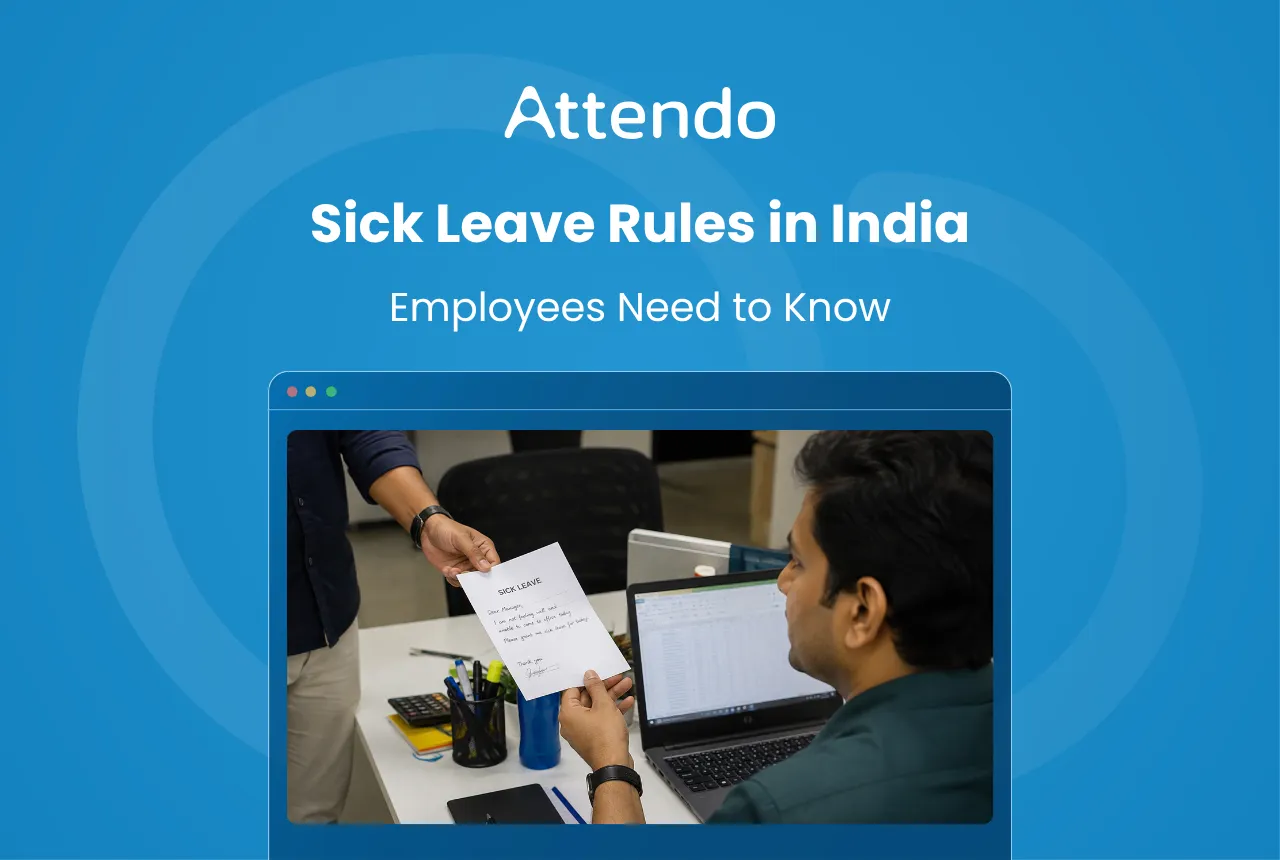
Someone messages at 7am to say they are ill. Is that paid, and for how many days?
Most guides answer with a table of states, along the lines of Maharashtra 15 days, Delhi 12, Karnataka 12. Those numbers are widely repeated, and some of them are out of date.
There is no national sick leave law in India. The rule comes from your state, and states do not agree. One large state removed separate sick leave from its Act altogether.
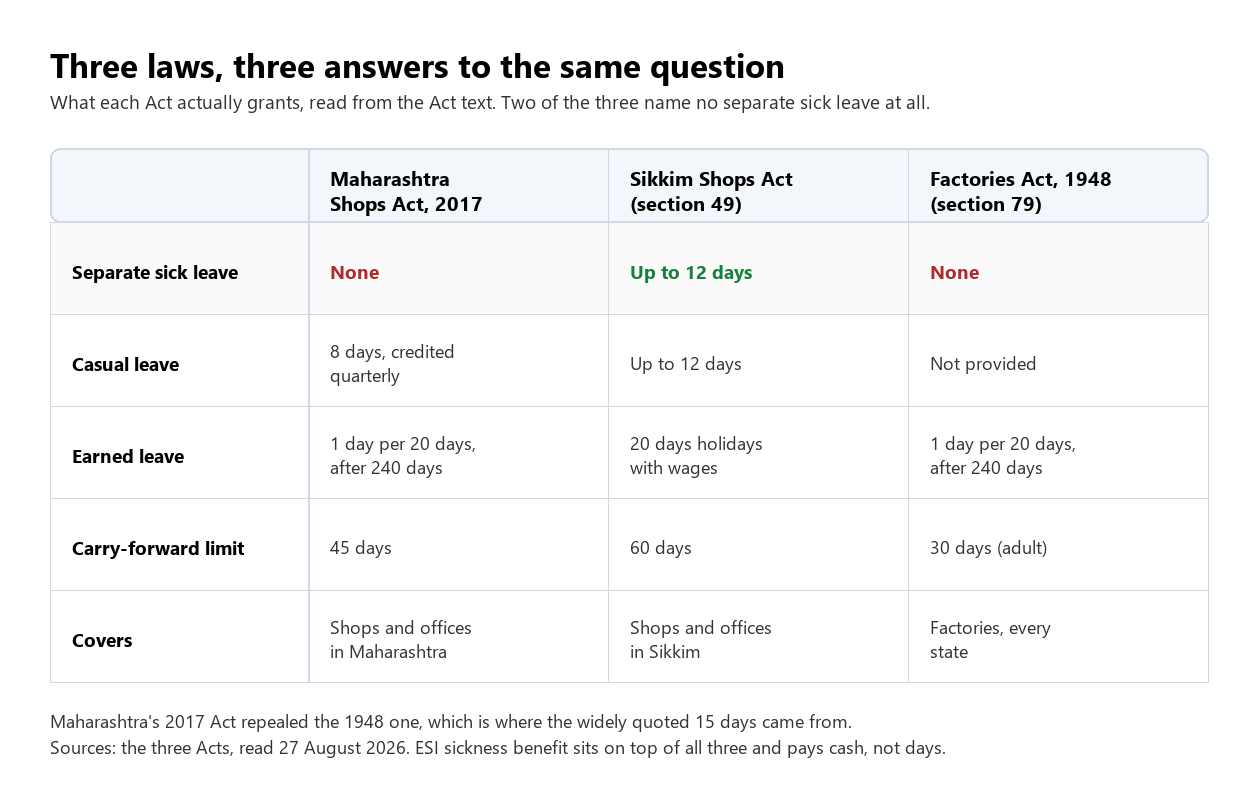
Rather than repeat a state table nobody can source, this guide reads three Acts in full. Maharashtra and Sikkim are the two ends of the range. The central Factories Act is the rule for every plant in the country, whatever that plant’s state does for shops.
So the guide covers where the rule comes from, what changed in Maharashtra, the one benefit that works everywhere, and how to write a policy when your own state says nothing.
Key Takeaways
- Sick leave in India has no central law. Your state Act decides.
- Maharashtra’s 2017 Act has no separate sick leave.
- ESI pays a sickness benefit, but only for covered employees.
- Where the Act is silent, your policy is the rule.
- Check your state’s current Act, not a table you found online.
Where Sick Leave in India Actually Comes From
Start with the source, because it explains why the answers differ so much.
Nothing central sets a single number of sick days for everyone. Which law applies to you depends on what kind of workplace you run:
- Shops, offices, hotels, restaurants and most commercial establishments: your state’s Shops and Establishments Act. Each state writes its own, which is where the variation comes from.
- Factories and manufacturing units: the Factories Act, 1948, which is central and the same everywhere.
- Anyone the ESI scheme covers, in either kind of workplace: ESI sits on top of both, and it pays cash rather than granting days.
So a software firm in Pune, a diagnostic lab in Indore and a garment showroom in Ludhiana can each be on a different rule.
Did You Know?
The state-wise sick leave tables that circulate online rarely say which version of which Act they came from. That is the detail that decides whether the number is still correct.
What Maharashtra’s 2017 Act Changed
This is the change most articles have missed, and Maharashtra is big enough that it matters.
The Maharashtra Shops and Establishments (Regulation of Employment and Conditions of Service) Act, 2017 replaced the 1948 Act. Section 39 repeals the older law outright. Section 18 sets out what leave a worker gets:
- A weekly holiday with wages.
- Eight days of casual leave with wages each calendar year, credited quarterly, lapsing if unused.
- Earned leave at one day for every twenty days worked, after 240 days in the previous year.
- For anyone employed three months or more but short of those 240 days, up to five days for every sixty days worked.
- Accumulation of earned leave up to forty-five days.
- Eight paid festival holidays, four of them fixed and four agreed with the workers.
Notice what is not on that list. There is no separate sick leave, and the words sick leave, sickness, medical certificate and ill health appear nowhere in the Act.
The widely quoted fifteen days comes from the 1948 Act, which no longer applies. An employer following it is following a repealed law, and an employee quoting it is quoting one too.
Pro Tip
If your policy names a state Act, put the year in the sentence. One that says “as per the Shops Act” survives a repeal without anybody noticing.
What a State That Does Grant Sick Leave Looks Like
For contrast, here is a state whose Act still separates the three kinds of leave.
Section 49 of the Sikkim Shops and Commercial Establishments Act is headed Holidays and sick leave, and it grants:
- Holidays with wages, twenty days a year, after twelve months of continuous service. These accumulate up to sixty days.
- Leave on the ground of sickness or accident, up to twelve days a year, with wages.
- Casual leave, up to twelve days a year, with wages, on any reasonable ground.
Only the twenty holiday days wait for a year of service. Sick and casual leave run from the first twelve months, so a new joiner in Gangtok has them from the start.
Sickness is named as its own ground, which is what Maharashtra’s 2017 Act stopped doing. Two states, two structures, and no single national number.
Counting the entitlement is its own small job once accrual is involved. An earned leave calculator settles the earned part faster than a spreadsheet.
What the Factories Act Says, If You Run a Plant
Manufacturing is the one setting where the leave law is central rather than written state by state.
Chapter VIII of the Factories Act, 1948 is titled Annual Leave with Wages, and that is all it grants. Section 79 sets out the whole of it for an adult:
- Earned leave at one day for every twenty days worked, after 240 days in a calendar year, taken the following year.
- Carry-forward of unused days, up to thirty.
- No casual leave and no sick leave. Neither appears in the chapter.
So a plant runs its whole year on earned leave, with no separate bucket for a bad week in February.
Search the Act for the word sick and you will not find it. Medical certificate is not in it either. The word illness appears twice, and only one of those is about leave at all.
That one is section 79(7). Where a worker uses leave already earned to cover illness, the employer must grant it without the usual advance notice. It waives the notice. It does not add a day to anybody’s balance.
Pro Tip
A fabrication unit in Rajkot and a packaging plant in Vapi read the same section 79. Run both a plant and an office and you are running two rule sets, so the leave register has to know which staff sit under which.
ESI Sickness Benefit, the One Rule That Crosses States
There is one sickness entitlement that does not change at a state border, and it is often confused with sick leave.
A covered employee gets an ESI sickness benefit worth 70% of average daily wages. It runs for up to 91 days across two benefit periods, and ESIC pays it, not the employer.
Two things follow from that, and both get missed.
- It is a cash benefit, not leave. It does not add days to anybody’s leave balance.
- It only reaches employees ESI covers. The wage ceiling has stood at ₹21,000 a month since January 2017, and ₹25,000 for an employee with a disability. Anyone paid above that ceiling is outside the scheme.
So two people can be off sick in the same week on different terms, one drawing an ESI benefit and the other drawing whatever the company policy gives. Both are correct.
What a Benefit Period Is, and Why It Delays Cover
The 91 days come with a timing rule that catches new joiners out.
ESI runs on two contribution periods of six months each. Each one has a matching benefit period, and it starts later:
| Contribution period | The benefit period it pays for |
|---|---|
| 1 April to 30 September | 1 January to 30 June the following year |
| 1 October to 31 March | 1 July to 31 December |
So somebody joining in October contributes from day one but cannot draw cash sickness benefit until the following July. Medical care starts immediately, which is the part that gets confused with the cash.
The rates have been 0.75% from the employee and 3.25% from the employer since July 2019, when they were reduced. An older and higher pair still circulates in notes and templates, so it is worth checking which one your payroll is using. Anyone on a daily average wage of ₹176 or less pays no employee share, though the employer still pays its own.
A new joiner at a Nashik packaging unit and one at a Kochi clinic are in the same spot: treatment from day one, cash not for months. Say so at onboarding, not while they are already unwell.
How to Write a Sick Leave Policy When Your State Is Silent
This is the part that applies to most readers, because in many states the Act now says little or nothing about sickness.
Where the statute is silent, your policy becomes the rule and is enforceable as a term of employment, so it is worth writing deliberately rather than inheriting from a template.
1. Say how many days, and over what period
A calendar year, a financial year or a rolling twelve months. Name it in the policy. Most disputes about leave balances are really disputes about which twelve months were being counted.
2. Say when a medical certificate is required
Pick a threshold and apply it evenly. Two or three consecutive days is common. A supervisor at a Coimbatore textile unit and a manager at a Gurugram office should be asked for the same thing.
3. Say what happens to unused days
They can lapse, carry forward, or carry forward up to a set number of days. Sick leave is usually not encashed, which is where it differs from earned leave. If you do encash anything, the leave encashment calculator shows what the arithmetic looks like before you write the clause.
4. Say how it is applied for, and by when
Illness rarely gives notice, so demanding prior approval sets up a rule nobody can follow. Say instead how soon the person must inform someone, and who.
What to Check in Your Own Policy This Week
Four checks, and none of them takes long.
- Find the Act that applies in your state, and its year. Not a summary of it.
- Compare your policy against that Act, not against the policy you copied it from.
- Confirm your ESI coverage list matches who is actually on the payroll.
- Check the leave register shows a balance somebody could defend in an inspection.
The register is the one that gets left until an inspector asks. Keeping it with your other statutory registers turns a scramble into a lookup.
Balances also drift when leave lives in one system and attendance in another. Where absence already feeds the attendance to salary workflow, the payslip and the register show the same number, because both read the same record.
Attendo (formerly Petpooja Payroll) is a complete workforce management system. It runs everything from attendance at the door through to salary, in one place. The leave balance and the register behind it stop being two numbers to reconcile.
My Opinion
The number of sick days matters far less than whether the rule is written down and applied the same way twice. Most of the trouble I would expect here comes from a policy nobody can find, not from a policy that is too thin.
Frequently Asked Questions
1. How many days of sick leave are employees entitled to in India?
2. Does Maharashtra still give 15 days of sick leave?
3. Is sick leave the same as ESI sickness benefit?
4. Can an employer ask for a medical certificate for one day of sick leave?
5. Does unused sick leave get encashed or carried forward?
Related Articles You May Like
Probation Period Rules in India, and the New Six Months
Probation has a stated length again: six months, extendable by three, from 8 May 2026. Who that binds, who still writes their own number, and why PF and ESI never paused for probation at all.
Avani Joshi
HR & Payroll Experts
What Actually Binds: Letter of Intent vs Offer Letter
A letter of intent states an intention. An offer letter is a proposal. Neither creates a contract by itself, and the Contract Act fixes a hard deadline after which you can no longer pull an offer back.
Avani Joshi
HR & Payroll Experts
How to Prepare a Leave Policy Format After the 2025 Update
The qualifying period for earned leave fell from 240 days to 180 on 21 November 2025. What every section of a leave policy has to say now, and the refused-leave rule that has no cap at all.
Ashwiniba Vaghela
HR & Payroll Experts
6 Factories Act Rules Employers Must Follow Now
For HR and plant managers: the six rules that bind a factory employer now that the 1948 Act has gone, including the headcount change that decides whether your unit still counts as a factory at all.
Avani Joshi
HR & Payroll Experts