


Probation Period Rules in India, and the New Six Months
Probation has a stated length again: six months, extendable by three, from 8 May 2026. Who that binds, who still writes their own number, and why PF and ESI never paused for probation at all.
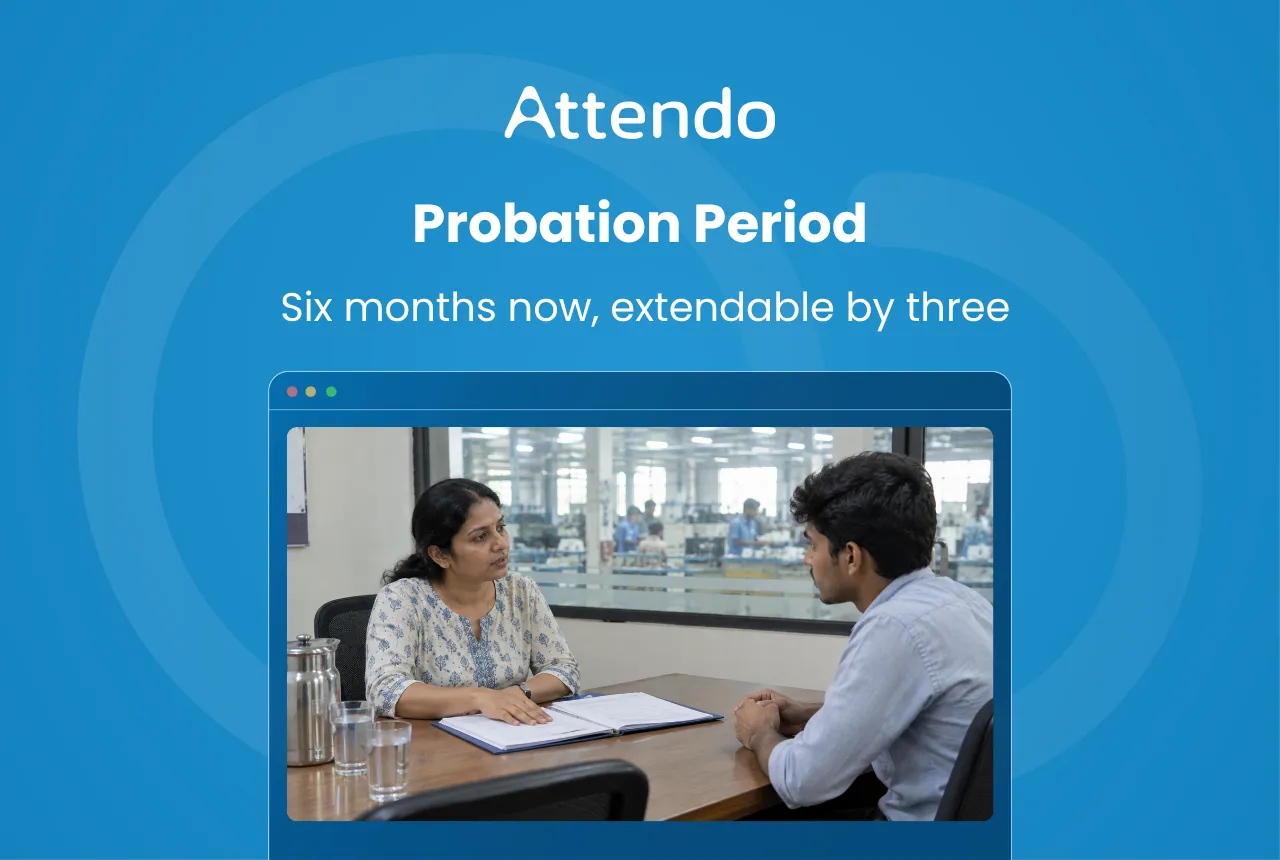
A probation period in India now has a stated length for the first time under the labour codes. It is six months, and it can be extended by three more (explained in detail below).
That applies to industrial establishments with three hundred or more workers. Below that line, probation is still whatever the appointment letter says, because no code fixes a length for a smaller employer.
The number arrived on 8 May 2026, in the Model Standing Orders, 2026, which superseded the 1946 rules most articles are still describing.
This page sets out who the six months binds, how long probation can run for everyone else, and what probation never affected either way.
Key Takeaways
- How long: six months under the 2026 standing orders, extendable by up to three more on an assessment of performance.
- Who that binds: industrial establishments with 300 or more workers, and only for staff who count as workers under the Code.
- Everyone below that line: no code sets a length, so the appointment letter decides it.
- When it changed: 8 May 2026, when the new orders superseded the 1946 rules that carried the figure people still quote.
- Confirmation: above that threshold it is now a duty rather than a courtesy. The employer issues a confirmation letter and records it within thirty days.
- What it does not change: PF, ESI and gratuity, none of which the Code on Social Security ties to probation.
What Is a Probation Period?
This section covers what probation is in law: a class of worker the Code names, with a length that comes from the orders made under it.
Probation is the opening stretch of a job, when the employer is still deciding whether to confirm the person and the person is still deciding whether to stay.
The Industrial Relations Code, 2020 names it once. Its First Schedule, listing what standing orders must cover, opens with the classification of workers as permanent, temporary, apprentices, probationers, badlis or fixed term.
Read that carefully. Probationers are a category an employer has to classify people into. The Code itself does not say how long the category lasts, what it entitles anybody to, or what it takes away.
The orders made under it do, and that is the next section.
Size is one limit. Who counts is the other. Standing orders govern only people the Code calls workers, and that definition carves several groups out.
Two of them matter in an ordinary workplace: anyone employed mainly in a managerial or administrative capacity, and anyone in a supervisory role on wages above ₹18,000 a month, or such other figure as the Central Government notifies.
So a manager on probation sits outside standing orders whatever the size of the business. For them, probation is a contract term and nothing more.
In Simple Words
If your firm has 300 workers or more, probation starts at six months. It can go up by three more. If your firm is smaller, your job letter sets the time.
What Changed for Probation in 2026?
This section covers the change that put a number back on probation, on 8 May 2026.
The four labour codes were made effective on 21 November 2025. One of them, the Industrial Relations Code, absorbed three older laws, including the Industrial Employment (Standing Orders) Act, 1946.
The Act went, but the rules made under it did not go with it. The 1946 Central Rules stayed on as the model standing orders, so for a while the Code named probationers without saying how long anybody stayed one.
That gap closed on 8 May 2026, when the Central Government notified the Model Standing Orders, 2026, S.O. 2312(E), under section 29(1) of the Industrial Relations Code, expressly in supersession of the Industrial Employment (Standing Orders) Central Rules, 1946.
They run to three schedules, for the mining, manufacturing and service sectors.
All three carry the same definition. A probationer is a worker provisionally employed to fill a permanent vacancy who has not completed six months service in the post, and that period may be extended by up to three further months on an assessment of performance.
Six months is also what makes somebody permanent. The same orders define a permanent worker as one who has satisfactorily completed the six-month probationary period.
So the three months still widely quoted is out of date, and not by a little. The figure that applies now is twice as long.
How Long Can a Probation Period Be?
Six months if the standing orders reach you, and whatever your appointment letter says if they do not. Which of those you are is the rest of this section.
The standing-orders chapter of the Code applies to an industrial establishment that employs three hundred or more workers, or employed that many on any day in the preceding twelve months.
Below that line, the Code does not require standing orders.
Do not read industrial too narrowly, though. The Code defines an industrial establishment as one where any industry is carried on, which reaches well past factories into offices, shops, hospitals and schools.
For establishments above that threshold, the Ministry’s compliance handbook for employers sets out two routes. An employer can adopt the model standing orders for its sector and tell the certifying officer it has done so, or draft its own.
Either way the six months is the starting point. An employer that adopts the model takes it as written; an employer drafting its own has to build on the model rather than ignore it.
What This Means in Practice
Most Indian employers are nowhere near three hundred workers. For them nothing changed on 8 May 2026, and probation length stays a commercial decision written into the appointment letter.
Six months is still worth treating as the reference point, because it is now the number the law uses when it uses one at all.
Did You Know?
A business with 280 workers and one with 2,800 sit in different positions here. The first picks its own probation length. The second starts from six months.
What Probation Does Not Change
This section covers the part employers get wrong most often: the statutory deductions do not pause during probation.
Search the Code on Social Security, 2020 for the word probation and you will not find it. Provident fund, state insurance, gratuity and maternity benefit all turn on the establishment, the wages and the length of service instead.
None of those tests asks whether somebody has been confirmed.
| What people assume | What actually decides it |
|---|---|
| PF starts after confirmation | Whether the establishment is covered and the person is an employee on its rolls |
| ESI starts after confirmation | Entry into insurable employment, which is the first day of work |
| Gratuity service counts from confirmation | Continuous service, counted from the joining date, with the usual five-year qualifying period on top |
| Leave accrues only once confirmed | Whatever the contract and the applicable state Act provide |
ESI is the clearest illustration. The scheme pays disablement benefit from day one of insurable employment, with no contribution condition attached to it. Somebody hurt at work in their first week is entitled to that benefit whether or not they have been confirmed.
What Must the Appointment Letter Carry?
Four things, whichever side of the threshold you are on: the length, whether it can be extended, what confirmation requires, and the notice.
The model orders lean on it directly. Confirmation is to be done in accordance with the terms and conditions stipulated in the letter of appointment, and the employer then has to issue a letter of confirmation and record it in the service card within thirty days.
So a letter saying nothing more than “six months probation” leaves every practical question open. Above the threshold it also leaves that confirmation duty resting on terms nobody wrote down.
- The length, stated in months from the date of joining.
- Whether it can be extended, by how long, and who decides.
- What confirmation requires, and whether it happens automatically if nobody writes.
- The notice each side owes during probation, if it differs from the notice after it.
Our guide to appointment letter formats covers how those clauses sit alongside the rest of the letter, and the labour codes readiness checklist covers what else the codes moved.
Where Probation Period Rules Trip You
The faults repeat, and they change with how the business is set up.
| Type of business | What goes wrong |
|---|---|
| Manufacturing unit near the threshold | Crossing three hundred workers without realising standing orders now apply |
| Retail chain | Probation written into offer letters at one length and into the HR policy at another |
| Hospital or diagnostic lab | PF and ESI started from the confirmation date rather than the joining date |
| School or coaching institute | Probation extended with nothing in writing, leaving the original term as the only one on record |
| Hotel or restaurant group | Confirmation letters never issued, so nobody can say who is still on probation |
Above the threshold the last of those is a breach of the model orders rather than untidiness, because the confirmation letter is a duty there. The rest are paperwork, and they end the same way: nobody can produce the document that settles it.
One pattern is worth naming, as judgement rather than data. Probation arguments tend not to turn on the length somebody agreed. They turn on nobody being able to show when the person joined, whether the term was extended, or whether a confirmation letter ever went out.
So even where the law now fixes the length, the argument is usually about records. The joining date is the one fixed point every other answer hangs off.
Attendo (formerly Petpooja Payroll) is a complete workforce management system for every kind of business, running attendance, shifts, leaves, approvals, payroll and statutory compliance in one place.
Because the joining date drives the attendance to salary workflow from the first day, the PF and ESI months line up with the date the person actually started rather than the date somebody signed a confirmation.
Your Probation Period Checklist
Run your own position past six questions.
- Does the appointment letter state a probation length, in writing?
- Does it say whether probation can be extended, and by how much?
- Does confirmation need a letter, or does it happen by default?
- Are PF and ESI running from the joining date rather than the confirmation date?
- Are you an industrial establishment with three hundred or more workers, which would bring standing orders into it?
- If somebody is past their probation end date with no letter either way, do you know what their status is?
That last one causes the most trouble. Somebody past their end date with no letter either way is, on the paperwork, still on probation, and the joining date is the only fixed point anybody can argue from.
Getting Probation Right
Probation has a number again, and most employers are not covered by it.
If you are at three hundred workers or more, six months is your starting point and the orders expect a confirmation letter at the end of it. If you are below that, nothing obliges you to use six months, and nothing stops you either.
Either way the work is the same. Write the length, the extension terms and the notice into the appointment letter, run PF and ESI from the joining date, and issue the confirmation letter when the time comes.
Frequently Asked Questions
Q1. What is a probation period in a job?
Q2. What are the probation period rules in India now?
Q3. How long can a probation period be?
Q4. Is PF deducted during the probation period?
Q5. Can a probation period be extended?
Related Articles You May Like

What Actually Binds: Letter of Intent vs Offer Letter
A letter of intent states an intention. An offer letter is a proposal. Neither creates a contract by itself, and the Contract Act fixes a hard deadline after which you can no longer pull an offer back.
Avani Joshi
HR & Payroll Experts
How to Prepare a Leave Policy Format After the 2025 Update
The qualifying period for earned leave fell from 240 days to 180 on 21 November 2025. What every section of a leave policy has to say now, and the refused-leave rule that has no cap at all.
Ashwiniba Vaghela
HR & Payroll Experts

6 Factories Act Rules Employers Must Follow Now
For HR and plant managers: the six rules that bind a factory employer now that the 1948 Act has gone, including the headcount change that decides whether your unit still counts as a factory at all.
Avani Joshi
HR & Payroll Experts

6 Appointment Letter Formats You Can Copy
The offer letter is the invitation. This one carries the full terms, and since November 2025 it is compulsory. The eight items every version carries, and the clause that changes for six kinds of hire.
Avani Joshi
HR & Payroll Experts