


How to Find Minimum Wages by State in India
Minimum wages by state come down to four inputs. One is in the Code, two are in a notification, and the last one is sitting in your own employee records.
Listen to this article
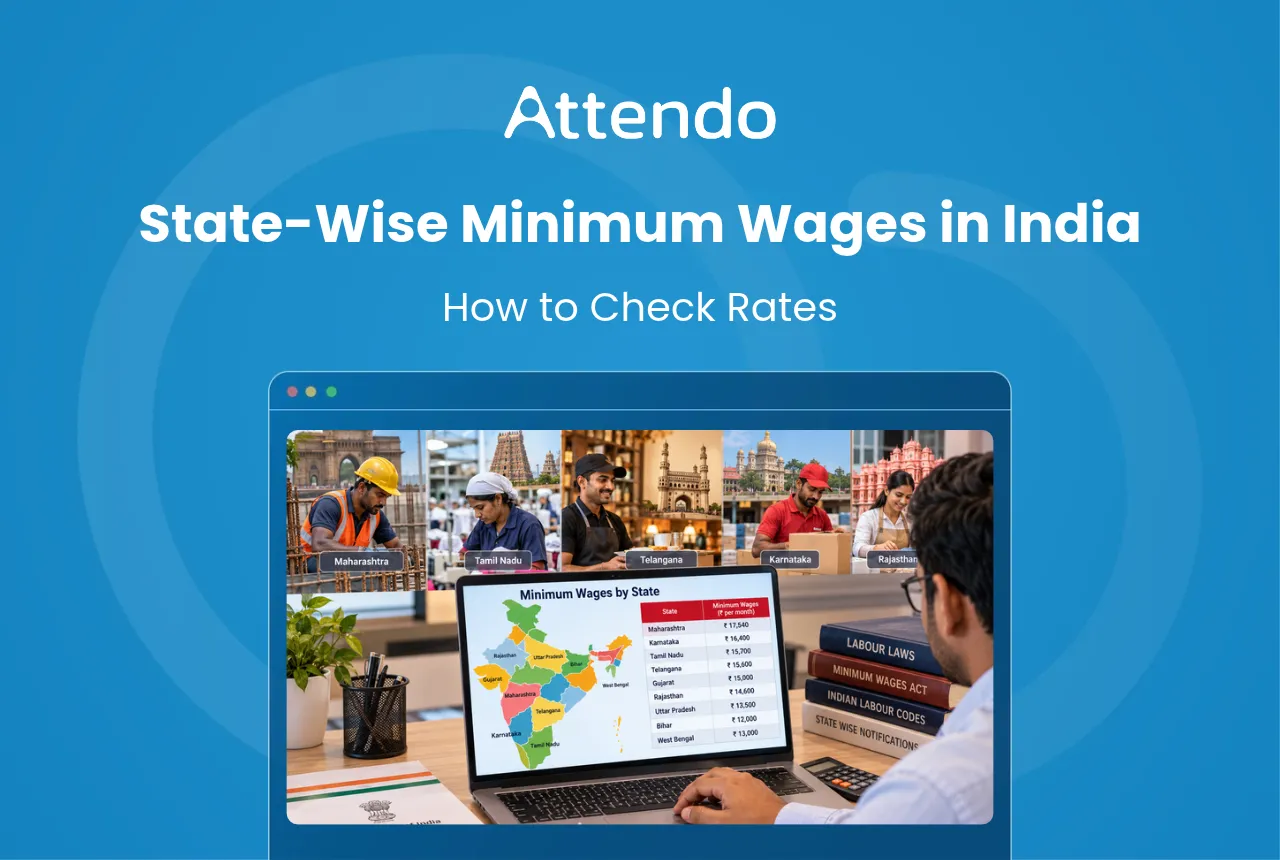
The central government’s wage order runs from ₹478 a day, for an unskilled farm worker in a Class C area, to ₹1,094, for an armed security guard in a Class A city.
Both come from the central government’s wage order of 1 April 2026. Neither is necessarily yours: those rates bind railways, mines, ports, banks and a short list of other employers. Everyone else reads a rate their own state sets.
This page shows you how to find the minimum wages by state rate that applies to your staff. It also shows you how to check that the one you already have is still live.
Key Takeaways
- The central rates today: ₹478 a day at the bottom, ₹1,094 at the top, set on 1 April 2026.
- They may not be yours: the job, the skill grade, the area and whoever notifies you all feed into the rate you owe.
- Two governments, not one: section 2(d) puts a short list of establishments under the Centre and everyone else under their state.
- Four skill grades: the Code names them, and your state decides which of your roles belongs in each one.
- Zones are real: the same state can notify different rates for different areas, so your branch address matters.
- A new rate is not instant: the default gap between issue and effect is three months, so read the date of effect.
- No rate may sit under the floor: a government may fix above the central floor wage, never below it.
What Are the Current Rates?
Below are the rates the central government set from 1 April 2026, in full, from the Chief Labour Commissioner’s wage order. Each figure is a basic rate plus a living-cost allowance, added together.
| Farm work, per day | Class A area | Class B area | Class C area |
|---|---|---|---|
| Unskilled | ₹528 | ₹483 | ₹478 |
| Semi-skilled | ₹578 | ₹530 | ₹488 |
| Skilled or clerical | ₹627 | ₹578 | ₹529 |
| Highly skilled | ₹694 | ₹645 | ₹578 |
| Other work, per day | Class A area | Class B area | Class C area |
|---|---|---|---|
| Sweeping and cleaning | ₹827 | ₹693 | ₹556 |
| Loading and unloading | ₹827 | ₹693 | ₹556 |
| Security, unarmed | ₹1,008 | ₹918 | ₹781 |
| Security, armed | ₹1,094 | ₹1,008 | ₹918 |
| Mining, per day | Above ground | Below ground |
|---|---|---|
| Unskilled | ₹556 | ₹693 |
| Semi-skilled | ₹693 | ₹827 |
| Skilled or clerical | ₹827 | ₹964 |
| Highly skilled | ₹964 | ₹1,078 |
These rates moved because the consumer price index for industrial workers rose from 413.52 to 424.80 over 2025. They are revised twice a year, on 1 April and 1 October, so the next set lands on 1 October.
In Simple Words
These are the rates the central government sets. Most businesses do not follow them. Your state sets your rate, and the rest of this page shows you how to find it.
If your business is not on the central list, and most are not, the shape above is still what you are looking for: a job, a skill grade, an area, and a basic rate with an allowance on top.
Why Minimum Wages by State Differ
Because the Code on Wages never asks for a single national rate. It asks each government to fix its own, and tells them what to base it on.
Section 6(6)(a) of the Code on Wages, 2019 says a government fixing a rate shall primarily take into account the skill of workers required, or the geographical area, or both.
So the law itself builds in variation. A textile mill and a supermarket chain in the same state are not reading the same notification, and two branches of that supermarket in different zones may not be reading the same line of it.
The Code does set one boundary underneath all of it. Section 9 gives the Central Government a duty to fix a floor wage, and says minimum rates fixed by any government shall not be less than it. A state may sit above the floor. It may not go below.
In Simple Words
There is no one rate for all of India. Your rate depends on the job, the skill level, the place, and who makes the rules for you. The law sets a bottom line that no state can go under.
Attendo (formerly Petpooja Payroll) is a complete workforce management system for every kind of business, running attendance, shifts, leaves, payroll and statutory filings in one place. It is built by Petpooja, serving Indian businesses since 2011, and used by 40,000+ businesses today.
Which Government Notifies You?
Either the Centre or your state, and section 2(d) of the Code decides which. It calls whichever applies to you the appropriate government, and getting this wrong means reading the wrong notification all year.
| Your establishment is | You read |
|---|---|
| Railways, mines, an oil field or a major port | Central Government notifications |
| Air transport, telecommunication, banking or insurance | Central Government notifications |
| An establishment of the Central Government, a body set up by a Central Act, or an autonomous body the Centre owns or controls | Central Government notifications |
| A central public sector undertaking or its subsidiary | Central Government notifications |
| A contractor working for any establishment in the rows above | Central Government notifications |
| Anything else, which covers most businesses | Your State Government’s notifications |
A hotel in Jaipur, an engineering workshop in Pune, a diagnostic lab chain in Hyderabad, a school, a supermarket and a coaching institute all sit in the last row, reading their own state. A contractor supplying staff to any of them reads the same one.
Our guide to the Code on Wages rules covers what the central rules themselves require and how the daily rate turns into a monthly one. This page picks up where that one stops, at your state’s own notification.
Which Four Things Set Your Rate?
Four, and you need all of them before a rupee figure means anything.
Which government notifies you is settled above. The three below come from the notification that government issues, read against what your own records say about each employee and each branch.
The Employment Category
The employment category is not in the Code at all. The old Minimum Wages Act carried a schedule of employments; the Code carries none, and the phrase “scheduled employment” does not appear in it.
States still notify in that shape, because the notifications saved by section 69(2) were written that way. Shops and establishments, hotels and restaurants, engineering, textiles, construction and private security are commonly listed on their own.
If you run a printing unit inside a hospital, ask your state labour department which category you fall under rather than guessing. The answer decides which notification covers the unit. The grade then decides each person’s rate inside it.
The Skill Grade
Section 6(6)(a) names four: unskilled, skilled, semi-skilled and highly-skilled. States define which roles sit in which grade, inside the notification itself.
This is where underpayment tends to start, and rarely on purpose. A welder in a Chennai fabrication unit whose record says unskilled gets paid the unskilled rate, which may sit below the grade their state puts welding in.
The record is what an inspector reads, and the wage and payroll register is where they read it.
Section 6(6)(b) lets a government take account of arduous work on top of the skill grade, such as heat, humidity, hazardous processes or underground work, in the way its own rules prescribe. Where your state has done that, the uplift sits in the same notification.
The Zone
Many states divide themselves into zones or areas, and notify a different rate for each. A metro corporation area, a municipal area and a rural area can be three different figures for identical work.
For a single-branch business this is a one-time lookup. For a pharmacy chain with thirty outlets it is thirty lookups, and the branch address on your records is what settles each one.
Zones are drawn by the state, not by distance. Two outlets twenty minutes apart can sit in different ones if a municipal boundary runs between them, and neither the pin code nor the city name is the test.
The notification names its own areas, usually by corporation, municipality or panchayat. Match your branch to the name the notification uses, and keep that mapping where payroll can see it, because a branch that relocates can change zone without changing city.
How to Read a Wage Notification
Read it as two parts that move at different speeds. Where a notification splits the rate that way, one part holds between revisions and the other is adjusted on its own rhythm. The two together are the figure you owe.
Everything else on the page tells you whether that figure is yours: the employment it covers, the area it applies to, and the grade it is set against.
The Two Parts of a Rate
Section 7(1) says a minimum rate may be made up of a basic rate of wages and an allowance adjusted to the cost of living index, which the Code calls the cost of living allowance. Most people know it as the variable dearness allowance, or VDA.
Section 7(1) allows three shapes. A basic rate plus that allowance, a basic rate plus the cash value of any concessions, or one all-inclusive figure. Your notification will say which it uses.
The labour ministry’s compliance handbook for employers sets out what employers are expected to hold on file.
Which Part Moves, and How Often
The basic part sits still between full revisions. The living-cost part is the one that moves.
Section 7(2) leaves both the computing authority and the interval to the government that notified the rate. That is why your state may revise twice a year while the Code never names a month.
| What you see on the notification | What it is doing |
|---|---|
| The employment category | Tells you whether this notification covers your business at all |
| Zone, area or class of town | Narrows it to your branch address |
| Unskilled, skilled, semi-skilled, highly-skilled | The four grades from section 6(6)(a) |
| Basic rate | The part that holds until the next full revision |
| VDA or cost of living allowance | The part that moves with the cost of living index |
| Per day and per month columns | Section 6(4) allows rates by the hour, the day or the month |
| Date of issue and date of effect | Not the same date. Section 8(3) explains the gap |
Our salary per day calculator converts between the daily and monthly views once you have the right figure.
Finding the figure is the one-off part. Holding it correctly every month, for each grade and each branch, is what the payroll run has to do without being reminded.
Where Attendo Fits
Payroll runs per Payroll Group, and a group is a set of people sharing one salary structure and one pay frequency. Skill grades that are paid differently can sit in different groups.
Three groups ship ready to use, including an Hourly Payroll group for staff paid by the hour rather than the month, which is the shape section 6(4) allows.
Each branch carries its own configuration, so a chain with branches in two zones or two states is one account rather than two, with branch-wise reporting alongside the organisation-wide view.
When you move people between Payroll Groups you set the date it applies from, past or future. A revision that lands mid-cycle can be back-dated so the run recalculates, or queued for the date the notification names.
If you want wage structures handled this way, you can take a look at Attendo, or read how it works end to end first.
When Do Minimum Wages by State Change?
On the date the notification names, which is often not the date on top of it.
Section 8(3) sets the default. A fixed or revised rate comes into force on the expiry of three months from the date of its issue, unless the notification provides otherwise.
Plenty of notifications do provide otherwise, which is why the date of effect is its own line on the document, and why it is worth reading rather than assuming.
Section 8(4) sets the outer limit. A government shall review or revise ordinarily at an interval not exceeding five years. That is a deadline, not a rhythm, and plenty of states move sooner.
How a Revision Is Made
Section 8(1) gives a government two routes to a revision. It appoints committees to hold enquiries and recommend, or it publishes its proposals and names a date, at least two months away, on which it will consider them.
Employers get a hearing either way. Section 8(2) puts employer representatives on any committee, matched by an equal number for employees and independent members capped at a third.
Both routes leave a paper trail before the rate lands. If you want warning of a revision rather than a surprise on the payroll run, the place to watch is your state labour department’s notification page, not a news report about it.
Do Old Notifications Still Count?
The Code repealed the Minimum Wages Act, 1948 when the four labour codes took effect on 21 November 2025. That did not wipe the slate.
Section 69(2) saves what came before. A notification made under the old Act is deemed to have been made under this Code, and it stays in force so far as it does not conflict with the Code.
That saving ends only when the Code itself, or a central notification, repeals the old notification.
So the rate binding you today may well be one issued years ago.
In Simple Words
A new rate does not start the day it is signed. Unless the paper says so, it starts three months later. Look for the line that says when it begins.
Your Minimum Wages by State Checklist
Trouble with minimum wages by state is rarely a decision to underpay. It is usually a figure looked up once, for one branch, and then left alone.
If I had to pick one line to check before a payroll run, it would be the skill grade on the employee record. It is the one input nobody re-reads, and the one your own system gets wrong most quietly.
- Confirm whether you are on the central list in section 2(d) or read your state, and write the answer down where payroll can see it.
- Find the employment category that covers your business, by name, not by what feels closest.
- Record a skill grade against every employee, and check it against what they actually do rather than what they were hired as.
- Map each branch to its zone, and re-check it when a branch moves.
- Note the date of effect from the notification, not the date of issue.
- Diarise the living-cost revision your state actually runs, because the Code does not name one.
If you are auditing state-level obligations anyway, professional tax and the labour welfare fund change by state too. The attendance to salary run is where all three land.
Frequently Asked Questions
1. What is the minimum wage in India in 2026?
2. Who decides my minimum wage, the Centre or my state?
3. What are the four skill categories?
4. Why do minimum wages differ between two cities in one state?
5. How often do minimum wages change?
6. When does a revised rate take effect?
Listen to this article
Related Articles You May Like

Why Dearness Allowance Keeps Rising and Who Actually Gets It
Does dearness allowance reach private pay as well? See the current central DA rate, how it is set, VDA in minimum wages, and how DA is taxed.
Avani Joshi
HR & Payroll Experts

Retention Bonus Means Extra Pay for Staying, Taxed as Salary
Offered money to stay on? A retention bonus falls due on the agreed date, is taxed as salary, and is hard to claw back once paid.
Avani Joshi
HR & Payroll Experts
5 Examples to Calculate Bonus for Employees
The statutory bonus follows the Code on Wages, while performance and festival bonuses follow policy. Five worked examples show how each is calculated.
Avani Joshi
HR & Payroll Experts

Is a Diwali Bonus Taxable? What TDS You Must Deduct
Tax on a festival payout is not a flat percentage, and the money does not always move in the same tax year the charge lands. Both catch payroll teams out.
Ashwiniba Vaghela
HR & Payroll Experts