


Attendo (formerly Petpooja Payroll) vs Tankhwa Patra
Per-employee billing looks cheap at ten staff and stops looking cheap at a hundred. A side-by-side on cost, salary setup and attendance control.
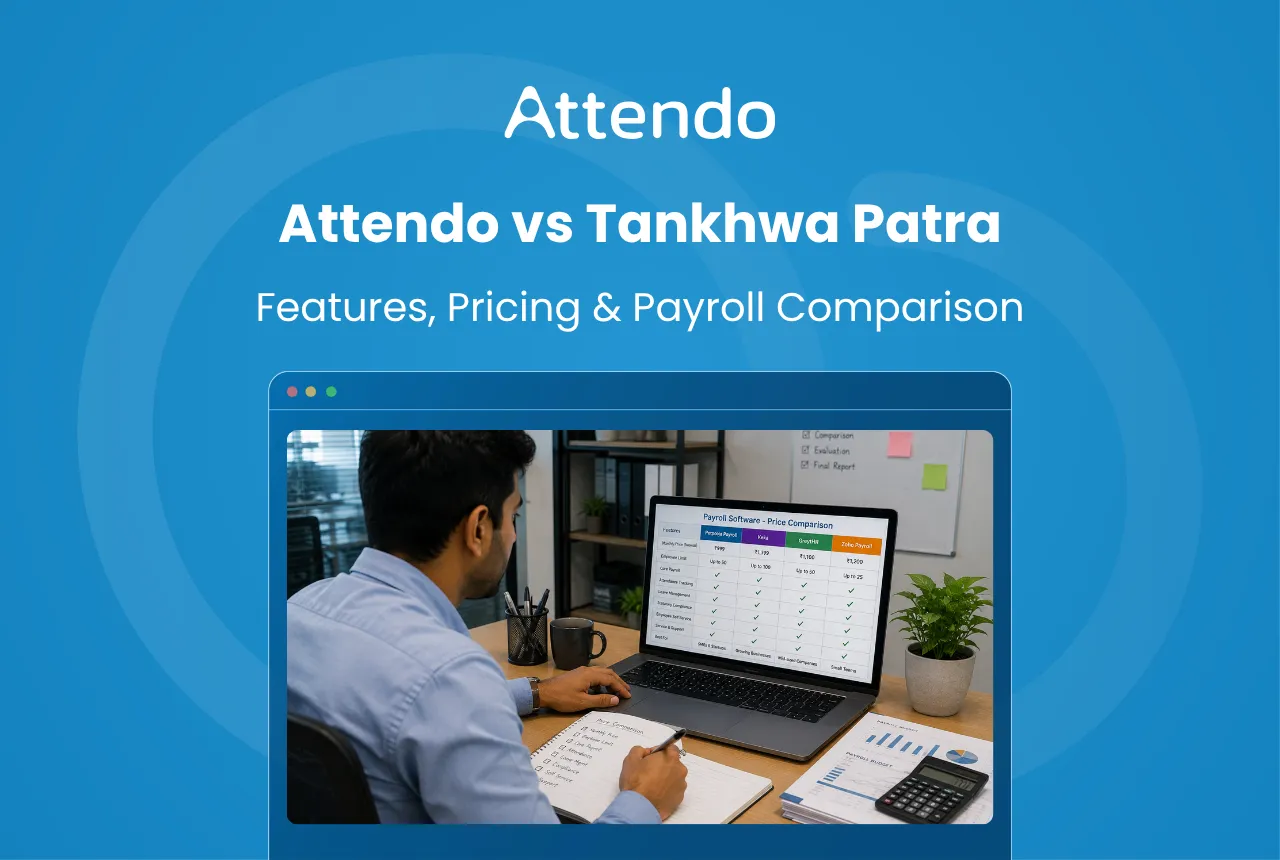
Choosing payroll software is a long-term financial decision. Beyond features, businesses must consider compliance requirements, the complexity of salary structuring, and how software costs evolve as their workforce grows. A system that works well for a 10-employee team may become expensive or operationally restrictive at 100 employees.
In the Indian market, payroll software companies use different pricing models: some use fixed subscription pricing, while others scale costs based on the number of employees. Attendo and Tankhwa Patra represent two such approaches. One combines attendance-linked payroll control with fixed annual pricing, while the other focuses on structured payroll configuration with per-employee billing.
Understanding these structural differences is essential before selecting a payroll management software solution that aligns with your long-term growth plans.
Pricing Structure and Long-Term Cost Implications
When evaluating payroll software, the pricing structure matters as much as the feature list. Many payroll software companies in India adopt different billing models; some offer fixed annual subscriptions, while others charge per employee.
The real consideration is not just the starting cost, but how the payroll software price in India scales as the workforce expands. A system that looks affordable at a smaller team size can climb sharply as headcount grows under a per-employee model.
Attendo uses a fixed annual subscription model, so the cost remains stable regardless of team size. Tankhwa Patra, by contrast, uses a per-employee annual pricing structure that increases in proportion to the number of employees.
Understanding these pricing mechanics helps you avoid common payroll mistakes and assess the long-term sustainability of payroll management software.
| Criteria | Attendo | Tankhwa Patra |
| Pricing model | Flat annual subscription, no per-employee charge | Per user per year, across three tiers |
| Feature tiers | No tier-gating, every feature in one package | Features vary by tier (Dreamer, Performer, Achiever) |
| Statutory compliance | PF, ESIC, PT, TDS and LWF | PF, ESIC and PT |
| Attendance hardware | Device included in the package, lifetime warranty, on-site installation | Devices sold separately |
| Support | 24×7×365, including salary-processing days | Not publicly disclosed |
| Cost as the team grows | Stays fixed | Rises with each user added |
For Attendo, the package and the device are settled on a call. Talk to the Attendo team about which one suits the site. Tankhwa Patra publishes its tiers on its own site, and rates change, so check there rather than relying on a figure quoted in an article.
The Role of Compliance and Payroll Structure
For most Indian businesses, payroll is not simply about issuing salaries each month. Recent payroll trend analysis highlights how automation, cloud systems, and compliance readiness are reshaping payroll operations for growing businesses. It involves ensuring statutory compliance, maintaining accurate salary structures, and generating clear reports for financial and regulatory purposes.
At the same time, effective attendance and payroll software must rely on accurate attendance inputs, particularly in businesses where working hours directly affect earnings. Whether a payroll management software solution focuses more on attendance validation or structured salary configuration can influence how efficiently payroll is processed.
Attendo
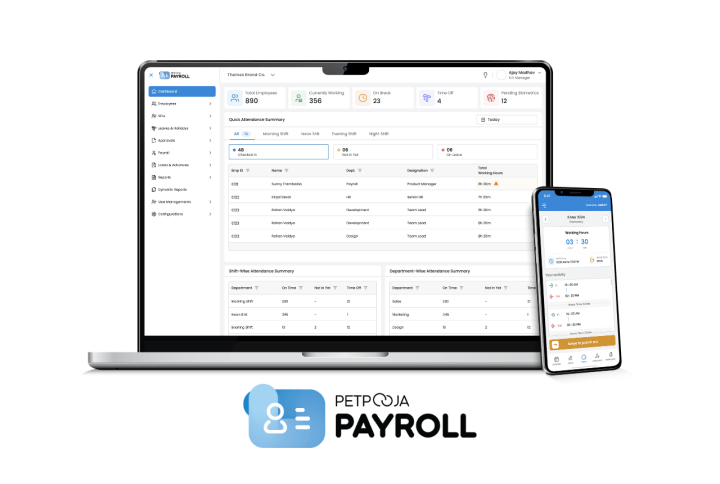
Attendo is a complete workforce management system for every kind of business, running attendance, shifts, leaves, approvals, payroll and statutory compliance in one place. It is built by Petpooja, which has been serving Indian businesses since 2011, and more than 40,000 businesses run on it today. It suits businesses where shift accuracy and working-hour discipline feed straight into pay, particularly where shift management & attendance tracking play a central role.
Key Strengths
- An attendance-linked payroll system, ensuring salary calculations are directly tied to shift attendance
- Automatic statutory compliance: PF, ESIC, PT, TDS and LWF
- Advanced shift scheduling and rules enforcement for accurate payroll
- Multi-location support, helping businesses with operations in multiple locations manage payroll centrally
- Employee loan and advance management features to track employee loans and deductions
Best For
- Indian businesses of any size that want a price-effective way to run attendance and payroll
- Multi-location businesses that require centralised payroll and accurate attendance management
- Businesses needing automated compliance for statutory deductions like PF and ESI
Tankhwa Patra
Structured payroll management with compliance at the core.
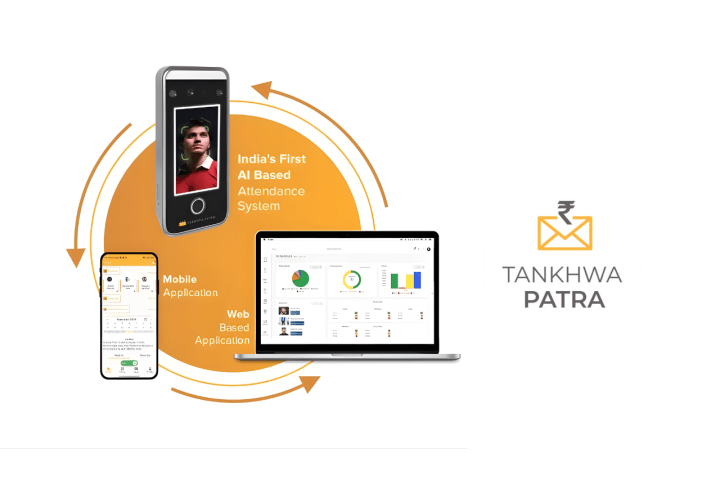
Tankhwa Patra focuses primarily on payroll structuring and statutory compliance. It emphasises payhead configuration, salary breakdown clarity, and reporting accuracy.
Attendance, shifts, leave and overtime are all in the entry tier; the emphasis sits on payroll structuring rather than attendance control.
Key strengths
- Strong salary structure configuration
- Detailed payroll reports
- Compliance-oriented calculations
- Loan and advance deduction support
Best for: compliance-focused businesses with structured salary systems and stable attendance processes.
Conclusion: Choosing the Right Payroll Solution
Selecting between Attendo and Tankhwa Patra depends on your business model, growth plans, and operational priorities.
If cost predictability and attendance-linked processing are central to your organisation, a flat annual fee gives you one number to plan around. If structured payroll configuration and compliance-focused reporting are your primary concerns, a per-employee payroll management software model may suit your needs.
Both platforms combine attendance with payroll. The right choice is not about identifying the best payroll software in India overall, but about selecting the system that aligns with how your business operates today and how you expect it to grow.
Balancing the pricing structure against how you actually operate remains the most practical way to choose.
Frequently Asked Questions
1. What is the main difference between Attendo and Tankhwa Patra?
2. Which payroll software is more cost-effective for a growing team?
3. When should a business prioritise attendance-linked payroll over compliance-led payroll structuring?
4. How does Tankhwa Patra handle payroll management?
5. What should a business look for in payroll management software in India?
6. Do both systems function as attendance and payroll software?
Related Articles You May Like
What a Day of Leave Without Pay Actually Costs
Leave without pay does more than dock a day’s salary. It reaches your provident fund, your ESI, the service behind a gratuity payment and the balance you build for the year ahead.
Ashwiniba Vaghela
HR & Payroll Experts
How to Complete the ESI Registration Process in 8 Steps
Registration is online, real time, and needs no paper at all. The state that wants 20 workers where its neighbour wants 10, what the C-11 letter proves, and why the amnesty no longer helps.
Ashwiniba Vaghela
HR & Payroll Experts
Expected CTC: 7 Ready-to-Use Answers for Your Next Interview
The question asks what you would cost, not what you would receive. Seven lines to use in an interview, the reasoning that backs each of them, and why the law measures a different figure from the one in an offer.
Avani Joshi
HR & Payroll Experts
How the ESIC Claim Process Works for Employees
One form per benefit, one office, and a three-day rule on medical certificates that quietly costs people money. What each claim pays, and how fast ESIC has to pay it.
Avani Joshi
HR & Payroll Experts