


Attendo (formerly Petpooja Payroll) vs SalaryBox: Pricing
Attendo bundles the attendance device, installation and support into one flat annual fee. SalaryBox charges a monthly base fee plus a rate for each employee, and sells the device separately. The gap shows up as the team grows.
Managing your team’s attendance and running payroll can be a real challenge, especially as you grow. Manually tracking hours, handling shift changes, and calculating wages, overtime, and deductions takes time and can lead to mistakes, especially in businesses that rely on hour-based payroll structures. Inaccurate payroll not only affects staff morale but can also cause compliance issues.
That’s why many businesses are now choosing dedicated attendance and payroll software to simplify workforce management. Investing in reliable payroll management software helps reduce errors, improve compliance and save administrative time. Two options you might be considering are Attendo & SalaryBox. Both tools aim to take the stress out of workforce management by automating key processes, but they do things in slightly different ways and may suit different business needs.
In this blog, we’ll compare Attendo and SalaryBox in a simple, easy-to-understand way. We’ll look at their key features, how they handle attendance and payroll, and which one suits which kind of business.
What to Look for in Attendance & Payroll Software
Before choosing any attendance and payroll solution, look for simplicity and accuracy, as compliance complexities and manual payroll challenges push businesses toward automation. The right attendance and payroll software should make it easy to track working hours, shifts, overtime, and leave while reducing manual effort.
At the same time, payroll features should save time rather than add complexity. Automatic salary calculations, clear payslips, and basic compliance support are essential. Affordability and ease of use matter just as much, because many businesses have no dedicated HR team. With these key factors in mind, let’s compare Attendo and SalaryBox in more detail.
Attendo
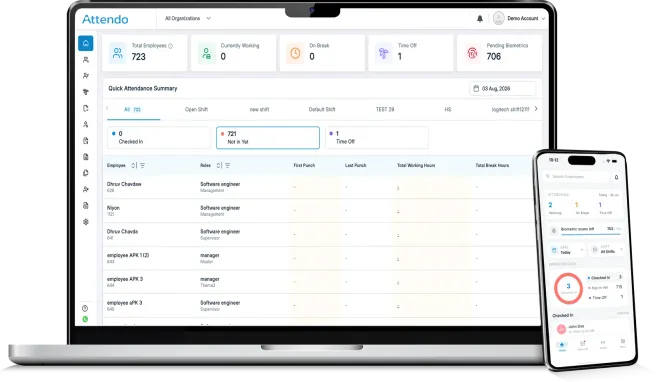
Attendo is a complete workforce management system for every kind of business, running attendance, shifts, leaves, approvals, payroll and statutory compliance in one place. It is built by Petpooja, which has been serving Indian businesses since 2011, and more than 40,000 businesses run on it today across manufacturing, corporate offices, retail, healthcare, hospitality and education.
Key Strengths
- Attendance flows straight into payroll, so salaries are calculated from the hours actually recorded
- Automatic statutory compliance: PF, ESIC, PT, TDS and LWF
- Mobile-accessible payroll for remote access, allowing employees to view their payslips and attendance
- Attendance can be corrected in bulk before payroll is finalised, and finalising locks the period so the numbers behind a payslip cannot drift
- Simplified reporting and salary breakdowns for easy understanding and transparency
Best For
- Indian businesses of any size that want a price-effective way to run attendance and payroll
- Businesses that prefer a fixed annual cost for payroll, providing predictable expenses year-round
- Companies seeking automated compliance management without the need for complex configurations
SalaryBox
Payroll and HR management combined into a single system.
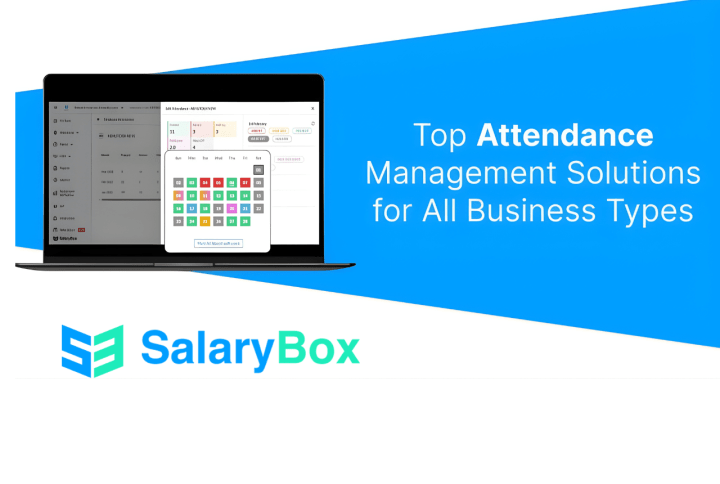
SalaryBox integrates attendance, payroll, and HR workflows into a unified platform. It supports mobile-based attendance and automates salary processing, including statutory deductions.
It is structured more as a people-management system than as a purely attendance-control engine.
Key strengths:
- Mobile attendance with GPS and selfie verification
- Integrated payroll and statutory compliance
- Employee self-service and document storage
- Expense and reimbursement workflows
- Suitable for growing teams
Best for: Growing teams that want payroll integrated with HR processes.
Price Comparison
While both platforms function as attendance and payroll software, their pricing structures and operational priorities differ sharply.
The real question is: How does pricing behave as the team grows?
Some tools charge per employee, some charge a monthly fee, and some stay fixed however many people you hire. That third model is the one that stops surprising you in year two.
Here is how the two compare on the things that actually move the bill.
| Criteria | Attendo | SalaryBox |
| Pricing model | Flat annual subscription, no per-employee charge | Monthly base fee plus a per-employee charge, billed quarterly |
| Feature tiers | No tier-gating, every feature in one package | Payroll and payslips start on the Business tier |
| Attendance hardware | Device included in the package, lifetime warranty, on-site installation | Biometric device bought separately as an in-app add-on |
| Statutory compliance | PF, ESIC, PT, TDS and LWF | “Statutory compliances” stated; individual deductions not itemised |
| Support | 24×7×365, including salary-processing days | Not publicly disclosed |
| Cost as the team grows | Stays fixed | Rises with headcount |
For Attendo, the package and the device are settled on a call. Talk to the Attendo team about which one suits the site. SalaryBox publishes its tiers and add-ons on its own pricing page, and rates change, so check there for the current numbers rather than relying on a figure quoted in an article.
P.S.: With Attendo’s fixed pricing model, the software cost stays the same even as your team grows. That lets a business scale headcount without the software bill moving.
Conclusion: Making the Right Choice
The difference between Attendo and SalaryBox is less about what they do than how they are sold. Attendo runs attendance, shifts, leaves, payroll and all five statutory deductions on one flat annual fee, with every feature in the box and the attendance device included. SalaryBox tiers its features and bills a monthly base fee plus a charge for each employee, with the device bought separately.
Both automate attendance and payroll, but they differ on how features are packaged and how the bill behaves. It is worth weighing how much attendance drives payroll in your organisation, how quickly you expect to grow, and whether you need the wider HR workflows.
If you would rather budget once a year and have whoever supplies the device also answer for it, Attendo is the more predictable choice. see how it works end to end.
Frequently Asked Questions
1. What should a business evaluate before choosing payroll management software?
– Pricing structure (fixed vs per employee)
– Attendance control requirements
– Need for integrated HR workflows
– Expected team growth
– Long-term cost implications
2. Do both platforms support statutory compliance?
3. Which platform is better for shift-based businesses?
4. What makes Attendo different from other payroll management software?
5. Is SalaryBox suitable for a growing team?
Related Articles You May Like
What a Day of Leave Without Pay Actually Costs
Leave without pay does more than dock a day’s salary. It reaches your provident fund, your ESI, the service behind a gratuity payment and the balance you build for the year ahead.
Ashwiniba Vaghela
HR & Payroll Experts
How to Complete the ESI Registration Process in 8 Steps
Registration is online, real time, and needs no paper at all. The state that wants 20 workers where its neighbour wants 10, what the C-11 letter proves, and why the amnesty no longer helps.
Ashwiniba Vaghela
HR & Payroll Experts
Expected CTC: 7 Ready-to-Use Answers for Your Next Interview
The question asks what you would cost, not what you would receive. Seven lines to use in an interview, the reasoning that backs each of them, and why the law measures a different figure from the one in an offer.
Avani Joshi
HR & Payroll Experts

How the ESIC Claim Process Works for Employees
One form per benefit, one office, and a three-day rule on medical certificates that quietly costs people money. What each claim pays, and how fast ESIC has to pay it.
Avani Joshi
HR & Payroll Experts