


8 Advance Salary Policy Rules (+ Template and Request Format)
Eight rules for advance salary, a copy-paste policy template and ready request formats, with the legal limit on recovering it from pay.
Listen to this article
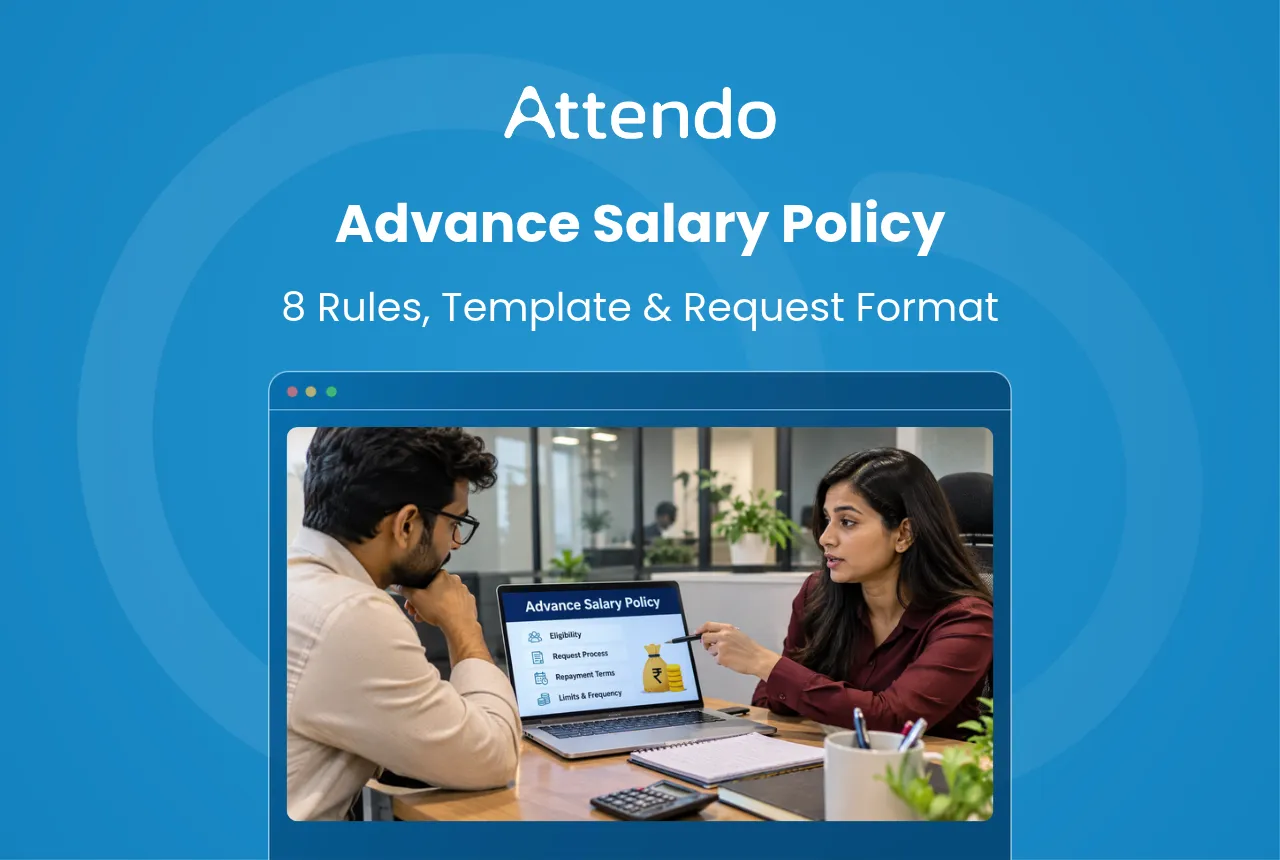
An advance salary, also called a salary advance, is part of an employee’s salary paid before payday and taken back from later pay.
A written advance salary policy helps prevent favouritism, disputes over who got what, and money that is never recovered.
Below are 8 rules for your policy, a copy-paste template, and an application format employees can use. In my view, the rules matter most on the day someone leaves, so write the exit rule (rule 8) with care.
Key Takeaways
- An advance salary policy needs 8 rules: who is eligible, how much, how often, valid reasons, how to apply, repayment, interest and tax, and recovery on exit.
- Recovery has a legal ceiling. The instalment and all other deductions together cannot cross half the wages for that month.
- Every request needs a written application and a signed repayment plan, so there is no dispute later.
- An advance counts as income in the year it is paid, not the year the salary would have fallen due.
What Is an Advance Salary?
An advance salary is salary paid before the employee has earned it. Advance salary, salary advance and advance against salary all mean the same thing.
It is different from an employee loan, which is compared further down. This advance salary glossary entry gives the short definition.
Take an example: a ₹15,000 advance is paid in month 1 and recovered as ₹5,000 in each of the next three months. Show the instalment and the balance on every payslip.
8 Advance Salary Policy Rules Every Company Should Set
These eight rules settle the questions that otherwise turn into arguments at month end. Set each one in writing before the first request comes in.
1. Who Is Eligible
Limit advances to confirmed employees who have completed a minimum tenure, such as six months, and who are not serving notice. Say whether trainees and contract staff can apply.
2. How Much Can Be Advanced
Set a ceiling, for example up to one month’s net pay. A garment showroom in Surat might allow half a month, a software firm in Gurugram a full month, and a hotel in Jaipur a fixed rupee amount.
3. How Often
Allow one advance in 12 months, for example, and no new advance until the last one is fully repaid. A factory in Pune that gets many requests before Diwali can use this rule to keep things fair.
4. Valid Reasons
List the reasons you accept, such as a medical bill, a family emergency, education fees or a wedding. Keep the details private: only the people who approve the request need to see them.
5. How to Apply: Form, Request Letter and Approval Flow
Ask employees to apply in writing, using an advance salary form, a request letter or an email. Name who approves it, such as the manager and then HR, and how quickly they must reply. All three formats are below.
For advances taken before a festival, this festival advance application form has the request, the approval and the repayment plan ready to fill in.
6. Repayment and Salary Deduction Limits
Write the instalments and the start month into a repayment plan the employee signs.
Under the Code on Wages, 2019, all deductions in a month, the advance included, cannot cross half of that month’s wages. The Labour Ministry’s Code on Wages FAQ confirms this cap. The Code replaced the Payment of Wages Act.
In this example, the employee’s wages, as the Code counts them, are ₹24,000, so deductions cannot cross ₹12,000. With ₹2,500 already deducted, there is room for ₹9,500, and the ₹5,000 instalment fits inside the limit.
For paying wages, the Code counts house rent allowance, conveyance and overtime as wages, but leaves out items such as statutory bonus and commission. This per-day salary calculation template has the half-of-wages check built in.
Where the central government sets the wage rules, such as in banks, mines and central public sector units, the Code on Wages (Central) Rules, 2026 require advances to be recorded in the Form IV register. State rules set their own registers, and these statutory register formats include Form IV.
Pro Tip
I’d suggest taking the first instalment from the very next payroll after the advance is paid, not a month or two later. If the employee resigns early, a smaller balance is left to adjust in the full and final settlement.
7. Interest and Tax Treatment
Say whether the advance is interest-free. Since it is the employee’s own salary paid early, many policies keep it free of interest; if you do charge interest, write the rate down.
For tax, an advance salary is income in the year it is paid. Under the Income-tax Act, 2025, salary paid before it is due is taxed in that year and not taxed again later.
If your policy treats the money as a loan repaid from salary instead, the tax treatment differs, so confirm it with your chartered accountant.
If the advance pushes the employee into a higher tax rate, they can ask for relief under section 157 of the 2025 Act, which replaces section 89 of the 1961 Act. Older guides mention Form 10E from the old law; file the form the current rules prescribe.
8. Recovery on Resignation or Exit
Any unpaid balance is adjusted in the full and final settlement. The Code on Wages requires a leaver’s wages within two working days. Treat the half-of-wages limit as applying to the wages in that final payment.
If the balance could be bigger than the limit allows, agree in the signed plan how the rest would be repaid. This notice period recovery template helps with the wording, and these notice period rules explain the exit timeline.
Free Advance Salary Policy Template (Copy-Paste)
Copy this advance salary policy template and fill in the parts in square brackets. It follows the 8 rules above.
Advance Salary Policy of [Company Name]
1. Eligibility. Confirmed employees with at least [6 months] of service, who are not serving notice. Trainees and contract staff are [eligible / not eligible].
2. Amount. Up to [one month’s] net salary.
3. Frequency. One advance in [12] months. No new advance until the last one is repaid.
4. Reasons. Medical needs, family emergencies, education fees, weddings or other reasons the approver accepts. The reason is seen only by the people who approve the request.
5. Application. Submit the advance salary form, a request letter or an email to [the manager], who forwards it to [HR]. A reply is given within [3] working days.
6. Repayment. Repaid in up to [3] monthly instalments, starting in [month], as set out in a repayment plan the employee signs. Total deductions in any month will not cross half of that month’s wages, so more instalments are allowed where that limit requires it.
7. Interest and tax. The advance is [interest-free / charged at __% a year]. It is treated as salary for tax in the year it is paid.
8. Exit. Any balance is adjusted in the full and final settlement, within the legal limit. Any amount above that is repaid as set out in the signed repayment plan.
Approved by: [Name, Designation], [date].
Add the policy to your employee handbook, and mention it in your appointment letter so new joiners know it exists.
In Simple Words
An advance salary is an employee’s own pay, given early. The policy says who can get it, how much, and how it is paid back.
Attendo (formerly Petpooja Payroll) is a complete workforce management system for every kind of business, running attendance, shifts, leaves, payroll and statutory filings in one place. Attendo has more than 40,000 users today. It is Software By Petpooja, building helpful products for Indian businesses since 2011.
With the policy in place, employees need a simple way to ask.
Advance Salary Application Format (With Samples)
Pick whichever advance salary format suits your workplace. The letter and the email are ready to send, and the form section lists the fields to build into your own form.
Advance Salary Request Letter Format
Subject: Request for advance salary
To,
[Manager’s name]
[Designation, Department]
[Company name]Dear [Sir / Madam],
I request an advance salary of ₹[amount] because of [reason, for example a medical bill]. I have worked here since [joining date] as [designation].
I agree to repay it in [number] monthly instalments of ₹[amount] from my salary, starting in [month].
Thank you for considering my request.
Yours sincerely,
[Name]
[Employee code]
[Date]
Advance Salary Application by Email
Subject: Advance salary request, [Name], [Employee code]
Dear [Manager’s name],
I would like to request an advance of ₹[amount] against my salary for [reason]. I can repay it in [number] instalments from [month]. Please let me know if you need any documents.
Regards,
[Name]
Advance Salary Form: Fields to Include
An advance salary form should have these fields:
- Employee name, employee code, department and date of joining.
- Amount requested and the reason.
- Number of instalments and the month repayment starts.
- The employee’s signature agreeing to recovery from salary.
- Approvals: manager, HR and, if needed, finance, with dates.
- For office use: amount sanctioned, payment date and instalment schedule.
Salary Advance vs Employee Loan: What’s the Difference?
A salary advance is part of the employee’s own salary paid early and taken back over the next few salaries. An employee loan is a separate sum on its own terms, often larger and repaid over months or years. Here is how they differ:
| Salary advance | Employee loan | |
|---|---|---|
| Amount | Part of future salary | Set by the loan terms, often larger |
| Tenure | The next few salaries | Many months or years |
| Interest | Usually none | As agreed in the loan terms |
| Deduction | From salary, within half of wages | Only where the Code allows, within the same half-of-wages limit |
| Tax | Taxed as salary in the year paid | Not salary; check interest-free loans with a CA |
A salary advance is also not a Provident Fund (PF) advance, which comes from the employee’s own PF savings. This guide to PF advance withdrawals explains how that works.
How Attendo Handles Salary Advances
In Attendo’s Settlements module, a Loan and an Advance are separate types. The words in bold are the screen labels.
The Advance type is taken back in one payroll. For an advance you recover over a few months, use the instalments of the Loan type, which you can schedule and edit if the employee wants to skip a month or pay early. Your policy still calls it an advance.
The View Logs button shows every debit and credit, with the date, the amount and the admin who recorded it.
Once a payroll is finalised, that month’s advances are locked and can change only if the support team unlocks the period.
If you want advance salary tracked this way, attendohr.com shows how it works.
A written advance salary policy, a simple application format and payroll that tracks each instalment keep advances fair and easier to recover. For owners and HR teams who want this in one place, see how Attendo handles it.
Frequently Asked Questions
1. What is advance salary?
2. Is salary in advance taxable?
3. How much advance salary can an employee ask for?
4. Can the full advance be deducted from one month’s salary?
5. How do I write an advance salary request letter?
6. Can a company refuse an advance salary request?
Listen to this article
Related Articles You May Like

4 New Labour Codes Explained, and What Each Changes at Work
The Code on Wages, IR Code, Social Security Code and OSH Code replaced 29 labour laws in November 2025. Here is what each changes for salary, hours, leave and gratuity.
Ashwiniba Vaghela
HR & Payroll Experts
6 RazorpayX Payroll Alternatives I’d Shortlist in 2026
RazorpayX Payroll’s published pricing, and six payroll tools compared on how attendance reaches the payslip.
Nisarg
Nisarg Kansara is Senior Marketing Manager at Petpooja. What he brings to table is the tactical layer, meaning the features most users never find, the automations that remove a daily chore, and the exact fix for a workflow that keeps breaking. He spends his weeks with Indian business owners working out where billing, purchase entries and task follow-ups fall apart in practice, and that input shapes how the products change. India has over 1.5 crore active GST registrations, and most of those businesses still handle compliance by hand. Nisarg writes for the owners trying to change that, with a focus on where AI removes manual work rather than adding another button.
6 Zoho People Alternatives I’d Pick for Payroll in 2026
Zoho People’s prices from India, and six HR tools that keep attendance, leave and payroll in one product.
Avani Joshi
HR & Payroll Experts
6 Keka Alternatives You Should Try in 2026
Weighing Keka against other HR and payroll tools? See which one fits your team by device, billing and the HR tools you need.
Nisarg
Nisarg Kansara is Senior Marketing Manager at Petpooja. What he brings to table is the tactical layer, meaning the features most users never find, the automations that remove a daily chore, and the exact fix for a workflow that keeps breaking. He spends his weeks with Indian business owners working out where billing, purchase entries and task follow-ups fall apart in practice, and that input shapes how the products change. India has over 1.5 crore active GST registrations, and most of those businesses still handle compliance by hand. Nisarg writes for the owners trying to change that, with a focus on where AI removes manual work rather than adding another button.