


12 HR Roles and Responsibilities, From Hiring to Exit
From workforce planning to full and final settlement: the HR tasks every business has, and the job titles that do them.
Listen to this article
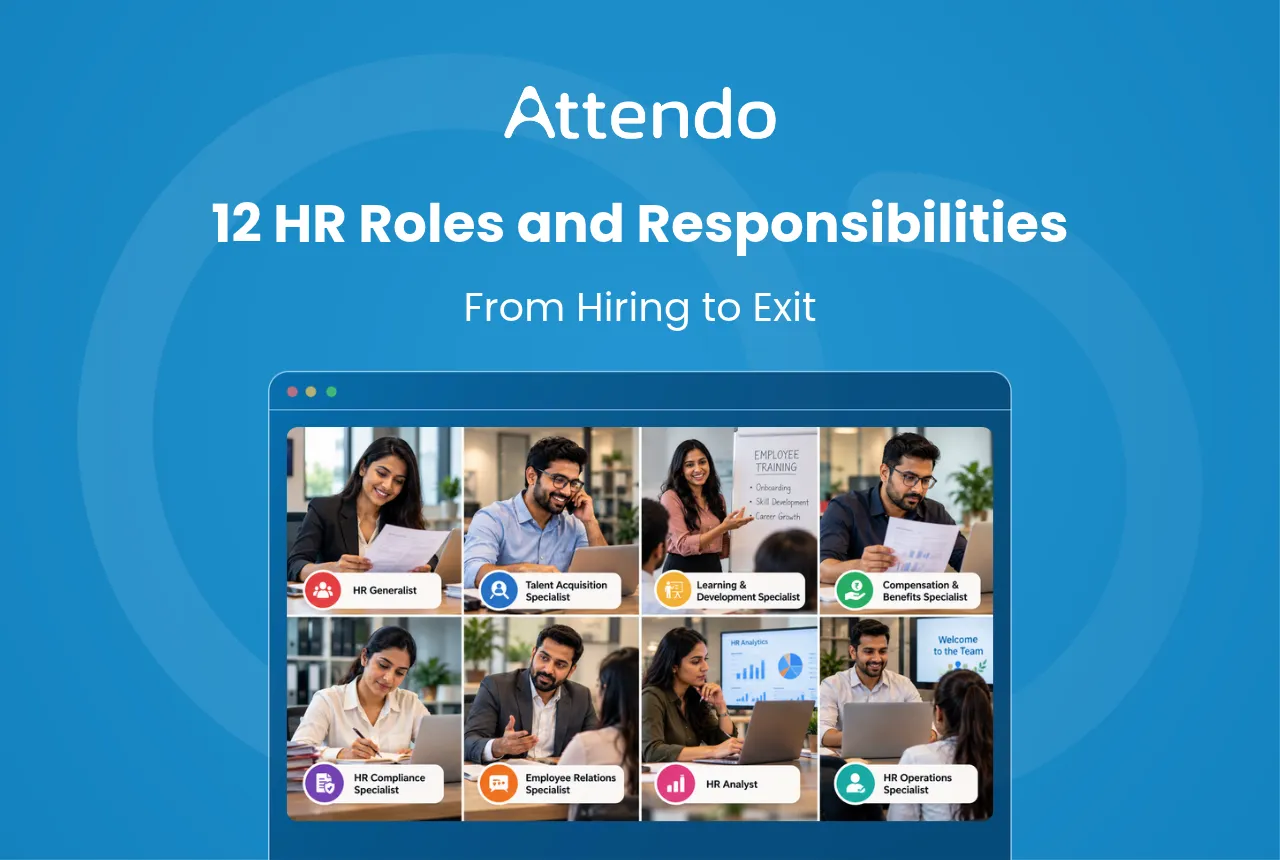
Human resources (HR) roles and responsibilities cover everything a business does for its people. HR hires them, pays them right, treats them fairly and lets them go properly.
Below are the 12 core HR responsibilities, what each one involves, and what the common HR job titles do day to day.
In my view, the HR job that gets noticed least is the one that matters most every month: getting attendance and pay right.
Key Takeaways
- HR’s main roles fall into four groups: hiring, pay and attendance, growing and keeping staff, and rules and exits.
- Attendance and leave come first, because payroll and its legal deadlines depend on them.
- Job titles split the work. An HR executive runs the daily tasks; an HR manager owns policies and decisions.
- Exits have a deadline too. A leaver’s unpaid wages must reach them within two working days.
HR Roles and Responsibilities in Brief
Here are the 12 responsibilities, grouped into four parts:
| Group | Responsibilities | How often |
|---|---|---|
| Hiring | 1. Workforce planning, 2. Recruitment, 3. Onboarding | When a role opens |
| Attendance and payroll | 4. Attendance and leave, 5. Payroll, 6. Statutory compliance | Every month |
| Growing and keeping staff | 7. Training, 8. Performance reviews, 9. Engagement and retention | Monthly to yearly |
| Rules, complaints and exits | 10. Policies, 11. Grievances and discipline, 12. Exits | As needed |
In a typical month, last month’s wages are due by the 7th under the Code on Wages, 2019. Where Employees’ State Insurance (ESI) applies, last month’s contribution is due by the 15th, as the Employees’ State Insurance Corporation (ESIC) rules set out.
Provident Fund (PF), Tax Deducted at Source (TDS) and Professional Tax (PT) have their own due dates too. The middle of the month suits hiring and training. In the last week, check attendance and approve leave before payroll.
HR Roles and Responsibilities in Hiring
HR work starts with deciding who you need, finding them, and getting them ready for day one.
1. Workforce Planning
HR works out how many people each team needs, and when. A factory in Coimbatore plans for the festival rush; a school in Indore plans before the new term.
2. Recruitment
HR prepares the job description, posts the opening, screens candidates and arranges interviews. A clear job description makes every later step easier.
3. Onboarding and Documents
HR collects documents, runs checks and issues the offer and appointment letters. The Occupational Safety, Health and Working Conditions (OSH) Code, 2020 requires covered establishments to give every employee a letter of appointment.
A ready appointment letter format saves time here. On day one, HR also sets up the employee’s code, bank details and attendance access, so the first salary is right.
HR Roles in Attendance and Payroll
This is the monthly heart of HR, and the part with legal deadlines.
4. Attendance and Leave
HR records who worked, who was late and who was on leave. It also makes sure every leave request is approved or rejected before payroll. A hotel in Jaipur with three shifts needs this record every day.
5. Payroll
HR turns attendance into salary: working days, overtime, deductions and the final payslip. It also answers staff questions about salary at month end. A salary sheet template keeps the month’s numbers in one place.
6. Statutory Compliance
HR deducts and pays the amounts the law asks for, where each one applies. These are PF, ESI, PT, TDS and the Labour Welfare Fund (LWF).
HR also keeps the registers the labour codes ask for, such as the employee register, the attendance register and the wage register.
HR Roles in Growing and Keeping Staff
Once people join, HR helps them get better at the job and want to stay.
7. Training
HR plans induction for new joiners and skills training for others. That can mean safety drills on a shop floor or software training in an office. Keeping a simple record of who was trained, and when, helps at review time.
8. Performance Reviews
HR sets up how and when managers review work, and turns the results into raises and promotions. An appraisal letter template records the outcome. A short review every six months can be easier on managers than one long review a year. It also gives staff feedback while it still helps.
9. Engagement and Retention
HR runs recognition, festival celebrations and team activities, and watches why people leave. A retail chain with stores in Andheri and Thane can compare branches to see where staff stay longer.
HR Roles in Rules, Complaints and Exits
The last group keeps the workplace fair, and makes sure people leave on good terms.
10. Policies and the Employee Handbook
HR sets the rules on leave, attendance, conduct and benefits, and makes sure every employee can read them. A leave policy is a good first one to prepare.
11. Grievances and Discipline
HR gives staff a fair way to raise complaints and handles warnings properly.
Under the Industrial Relations Code, 2020, an industrial establishment with 20 or more workers must have a grievance redressal committee.
The Code counts only workers, which leaves out people employed mainly in a managerial or administrative capacity, supervisors earning more than ₹18,000 a month (or a higher figure the Centre notifies), and apprentices.
This grievance redressal policy template sets up the process.
For sexual harassment complaints, the Sexual Harassment of Women at Workplace (Prevention, Prohibition and Redressal) Act, 2013, known as the POSH Act, requires an Internal Committee at the workplace. Workplaces too small to have one use the Local Committee in their district.
Women employees can also complain on the government’s SHe-Box portal.
12. Exits and Full and Final Settlement
When someone resigns, HR runs the notice period, the final pay and the experience letter. Under the Code on Wages, wages still owed are due within two working days; other dues, such as gratuity, follow their own timelines.
HR also collects company property and closes system access on the last day. A short exit interview records why people leave.
In Simple Words
HR looks after the people in a business. It hires them, pays them on time, and treats them fairly. It also helps them leave well.
Attendo (formerly Petpooja Payroll) is a complete workforce management system for every kind of business, running attendance, shifts, leaves, payroll and statutory filings in one place. Attendo has more than 40,000 users today. It is Software By Petpooja, building helpful products for Indian businesses since 2011.
That covers the 12 tasks. In a growing business, they are split across a few HR job titles.
HR Job Roles and Responsibilities
Here is what the common HR job titles do, and which business usually needs each one:
| Job title | Main responsibilities | Usually needed when |
|---|---|---|
| HR executive | Attendance, leave, records, joining papers | You have a steady team to look after |
| HR manager | Policies, reviews, complaints, compliance | Several teams or branches |
| HR recruiter | Sourcing, screening, interviews | You hire often |
| HR generalist | A bit of every HR task | One person covers all of HR |
| HR admin and operations | Records, office needs, HR systems | Paperwork is piling up |
| HR payroll executive | Salary, deductions, payslips, filings | Payroll takes days each month |
A small team may have one person in two or three of these roles. Each title is explained below. This job description template pack includes a ready HR executive format.
HR Executive Roles and Responsibilities
HR executive roles and responsibilities are daily and hands-on. They cover attendance, leave balances, staff files and joining papers. In a factory of 60 people, the HR executive closes the attendance sheet each month and chases missing punches.
HR Manager Roles and Responsibilities
An HR manager owns the policies and the hard conversations: reviews, complaints, warnings and compliance. In a hospital in Pune, the HR manager also plans staffing across wards.
HR Recruiter Roles and Responsibilities
HR recruiter roles and responsibilities centre on hiring. A recruiter finds and screens candidates, schedules interviews and keeps hiring managers updated. Firms that hire in volume, such as a BPO in Noida, often have several.
HR Generalist Roles and Responsibilities
HR generalist roles and responsibilities cover a little of everything on this list. The role suits a business with one HR person and many different needs. In a clinic chain, a generalist might hire nurses on Monday and check payroll inputs on Friday.
HR Admin and Operations Roles
HR admin staff keep records and handle office needs such as ID cards and seating. HR operations staff run the HR software and keep the system tidy so others can rely on it.
HR Payroll Roles and Responsibilities
HR payroll roles and responsibilities sit with a payroll executive, who runs salary, statutory deductions and payslips. The work runs to fixed dates every month, and they answer staff questions about deductions.
Pro Tip
I’d suggest a one-page HR calendar listing each task, who owns it and its due date. Add a backup name to every line, so salary week still runs when the HR person is on leave.
Whoever does the work, it is easier to run attendance, leave and payroll from one system than from three spreadsheets.
Where Attendo Fits
HR’s monthly cycle starts with attendance and ends with a payslip.
Attendo records attendance from biometric or face devices and the Employee App. It sends leave requests to managers for approval, and calculates PF, ESI, PT, TDS and LWF in payroll.
Payroll runs in three steps, Finalize, Mark as Paid and Release Payslip, and employees see their payslips in the Employee App.
Access Templates let you give an HR executive and an HR manager different rights, such as viewing payroll without editing it. The words in bold are the screen labels.
If you want attendance, leave and payroll run this way, attendohr.com shows how it works.
Which HR Responsibilities Come First?
HR roles and responsibilities run from hiring to exit, but they do not all start at once. Take them in this order:
- Attendance and leave, because payroll depends on these records.
- Payroll, statutory deposits and leavers’ final pay, which carry legal dates.
- Complaint committees the law requires, such as the POSH Internal Committee, set up alongside the first two, not later.
- Hiring and onboarding, as the team grows.
- Policies and reviews, once the monthly basics run smoothly.
- Training and engagement, to help good people stay.
For owners and HR teams who want attendance, leave and payroll in one place, see how Attendo handles them.
Frequently Asked Questions
1. What are the main roles and responsibilities of HR?
2. What does an HR executive do?
3. What are the roles and responsibilities of HR manager and HR executive?
4. Does a small business need an HR person?
5. What are the different roles in HR?
6. What are HR admin roles and responsibilities?
7. Which HR responsibilities have legal deadlines?
Listen to this article
Related Articles You May Like
40 Fun Friday Activities and Games for Office Teams
Fresh ideas, themed days, office games, weekly rituals and virtual games, plus a Fun Friday email format to copy.
Avani Joshi
HR & Payroll Experts

30 Team Building Games and 50 Icebreaker Questions for Work
Short games for meetings, shift changes and team days, and ready questions to open any session, with tips to keep it fair.
Avani Joshi
HR & Payroll Experts

25 Diwali Office Decoration Ideas for Every Budget
Torans, rangoli, LED diyas and lanterns: ideas to decorate the office, factory, shop or clinic for Diwali, with low-cost options and safety rules.
Avani Joshi
HR & Payroll Experts
12 Employee Retention Strategies That Work on a Small Budget
Most people leave a small business over small things. Twelve low-cost ways to keep good staff in a factory, shop, clinic or office.
rakshit
Rakshit Acharya is Head of Growth at Petpooja, where he has spent roughly four years moving from growth manager to running acquisition across the entire product suite. He owns the demand side of a company serving 1,50,000+ Indian businesses: paid campaigns across Google, Meta and LinkedIn, marketing automation, and the push into markets outside India. He also built the team that does it, hiring the performance marketers. That gives him a view most growth writing lacks he can see what a business owner searched, what they clicked, where they dropped off, and whether any of it turned into a paying customer. Outside Petpooja he ran a research project with GrowthX mapping how Indian founders and operators actually use AI at work, rather than how vendors claim they do. He writes about growth for people who have to justify a budget: what channels cost in India, what payback looks like, and which tactics survive contact with a real funnel.