


12 Employee Retention Strategies That Work on a Small Budget
Most people leave a small business over small things. Twelve low-cost ways to keep good staff in a factory, shop, clinic or office.
Listen to this article
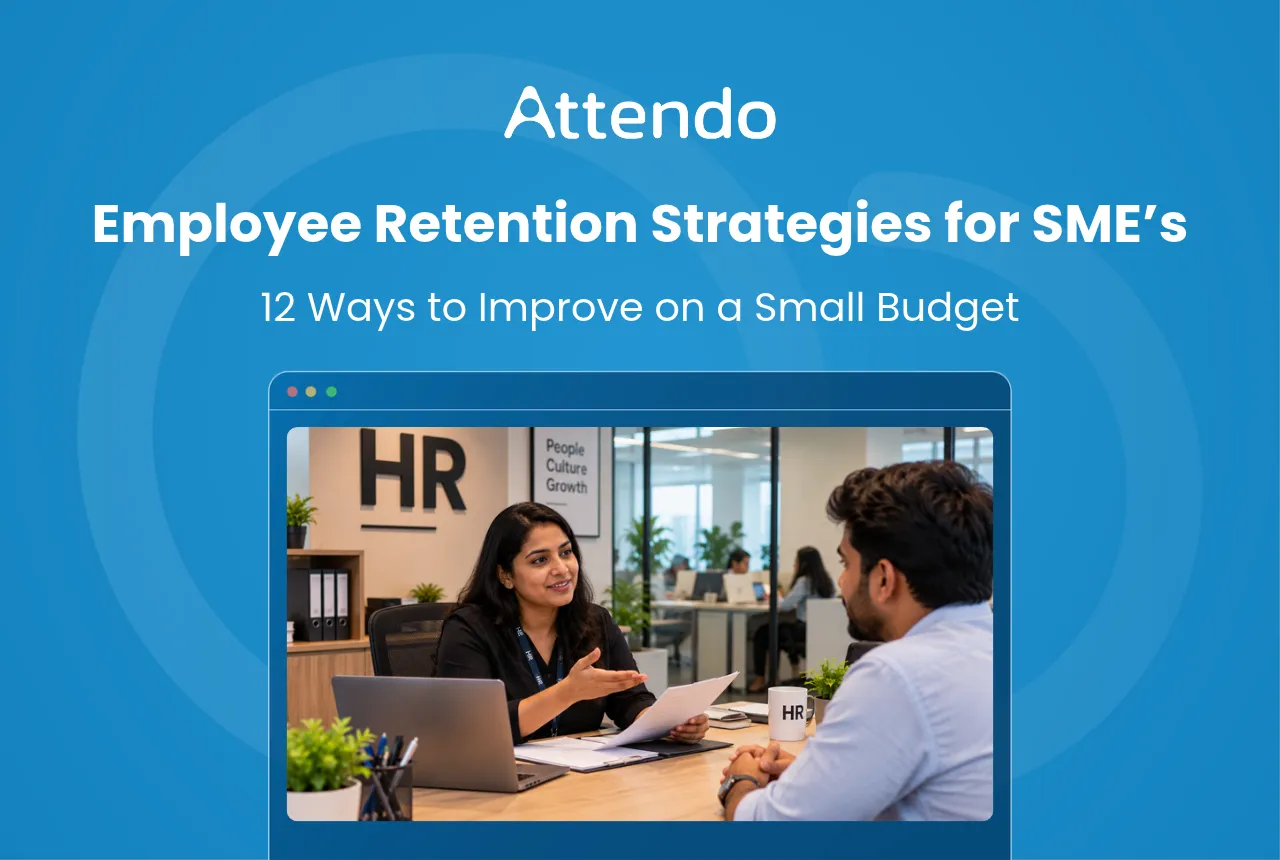
Losing a good employee costs a small business more than a salary. You lose their skill, the time spent training them, and the time it takes to hire again. Here are 12 employee retention strategies, most of which cost little or nothing.
They suit a factory, a shop, a clinic or an office, and several are things the labour codes already ask employers to do.
In my view, most people do not leave over one big thing. They leave after many small things, such as late pay, unclear rules or a request nobody answered.
Key Takeaways
- Good employee retention strategies build trust. Pay on time, put promises in writing and answer requests fast.
- Most cost nothing. Eight need only time and habits.
- Some are law. On-time pay always; appointment letters, a grievance committee and a creche from set headcounts.
- Measure the result. Track your attrition rate, the share of staff who leave, before and after.
Why Employees Leave Small Businesses
The reasons are often ordinary, and most can be fixed. These are common in factories, shops, clinics and offices alike:
- Pay arrives late or is hard to understand. People cannot plan their month.
- Rules change without notice. Shifts, leave and deductions feel random.
- Requests go unanswered. A leave request sits for days, or a complaint goes nowhere.
- There is no next step. The job looks the same in three years as it does today.
To see whether this is happening to you, start with your numbers. The attrition rate calculator shows what share of your team left in a year.
In Simple Words
Retention means keeping your good people. Pay them on time and be fair with them. Listen when they have a problem, and help them grow in the job.
Most of the strategies below answer one of these reasons. Here is what they cost:
Each strategy below says how to put it into practice.
12 Employee Retention Strategies
These 12 employee retention strategies suit small and mid-sized businesses. Strategy 1 applies to every employer, and strategies 3, 9 and 11 become legal duties from a set headcount.
1. Pay on Time, Every Month
Late pay breaks trust fast. Under the Code on Wages, monthly wages must be paid before the end of the seventh day of the next month. Pick a pay date and keep it.
If something might delay pay, tell the team before the date, not after. A warning keeps trust, but it does not move the legal deadline.
Once a year, review pay and check that every wage meets your state’s minimum wage. A small, fair raise on time often counts for more than a big one that comes late.
2. Make Every Payslip Easy to Read
Employees should be able to see how their pay was worked out: days present, overtime, deductions and advances. A clear payslip stops many pay arguments before they start.
In a retail chain with many part-time staff, the payslip may be the only place an employee sees why this month’s pay is different.
3. Put the Job in Writing
The Occupational Safety, Health and Working Conditions (OSH) Code requires an appointment letter for every employee in an establishment it covers, generally one with 10 or more workers.
Worker is the Code’s own term and can leave out managerial and some supervisory staff, so check its definition before you count heads.
Smaller teams benefit too. Write down the pay, hours, leave and notice period, using appointment letter formats that match the OSH Code. Then use the first week to walk new joiners through pay, leave and who to ask for help.
4. Share Shifts Early and Fairly
Publish the roster at least a week ahead, and share night and weekend shifts fairly. In a hospital, a hotel or a factory, a fair roster makes a real difference.
Women can work night shifts only with their consent and the safety arrangements the OSH Code sets.
The Code also caps work at six days a week, so when someone works their weekly day off, give a day off in its place, and record it so the same person is not always the one who gives up a Sunday.
5. Approve Leave Without Delay
Set a rule that every leave request gets an answer within a day or two. A late “no” is often worse than a fast one.
Publish the leave rules once, in writing, so a team lead in one branch does not say yes to what another branch refuses.
6. Thank People in Public
Name good work in the team meeting or the team group. Mark birthdays and work anniversaries too. Recognition costs nothing and is easy to forget.
Be specific: “Ramesh cleared the dispatch backlog before the audit” means more than “great work, team”.
7. Help in a Cash Crunch
A small advance before a festival, a wedding or a medical bill can keep a good employee from looking elsewhere. Use a festival advance application form and agree the repayment in writing.
Recover a small advance from the next salary, or a larger loan in instalments. Total deductions from wages cannot exceed half of the wages, under the Code on Wages.
8. Train People for the Next Role
Teach a helper to run a machine, a cashier to manage a shift, or an assistant to handle billing. People are more likely to stay where they can see a next step.
Tell people what the next role pays and what it needs, so the path is real and not a vague promise. Train your team leads too; for many employees, the supervisor is the company.
9. Give Complaints Somewhere to Go
The Industrial Relations Code requires a grievance redressal committee in every industrial establishment with 20 or more workers. A grievance committee policy shows how to set one up.
If you are not sure the rule covers your business, ask your state labour office. A simple complaint route helps either way.
10. Hold Short One-on-Ones
Spend ten minutes a month with each employee, or with each team lead in a bigger team. Ask what would make the job easier, fix one small thing, and say you fixed it.
These talks are sometimes called stay interviews. They catch problems while the person is still working for you, not on their last day.
11. Support Working Parents
Flexible start times can help working parents, and people with long commutes, stay on, whether in a school, a clinic or an office. They cost nothing.
Once you have 50 or more employees, or another number the government sets, the Social Security Code requires a creche, either your own or one shared with other employers.
12. Ask Leavers Why
Every resignation is information. Use an exit interview form to find the reason, then fix the one that comes up most.
Employee Retention Strategies Compared
Here are all 12 in one view, by cost and whether the law requires them:
| Strategy | Cost | Legal duty? |
|---|---|---|
| 1. Pay on time | Free | Yes, for every employer |
| 2. Clear payslips | Free | No |
| 3. Job in writing | Free | Yes, from 10 workers |
| 4. Fair shifts | Free | No |
| 5. Fast leave approvals | Free | No |
| 6. Public thanks | Free | No |
| 7. Advances | Low cost | No |
| 8. Training | Low cost | No |
| 9. Grievance committee | Low cost | Yes, from 20 workers |
| 10. One-on-ones | Free | No |
| 11. Flexibility and creche | Varies | Creche from 50 employees |
| 12. Exit interviews | Free | No |
Eight are free, and four are also legal duties.
Attendo (formerly Petpooja Payroll) is a complete workforce management system for every kind of business, running attendance, shifts, leaves, payroll and statutory filings in one place. Attendo has more than 40,000 users today. It is Software By Petpooja, building helpful products for Indian businesses since 2011.
Mistakes That Push Good Employees Out
Some habits undo every employee retention strategy above. Watch for these:
- Promises made but not written. A raise promised at Diwali and forgotten by March often costs more trust than no promise. Put raises in an increment letter.
- Favourites on the roster. If the same people always get day shifts, everyone else notices.
- Deductions nobody explains. Any cut from pay must follow the Code on Wages rules, and the employee should see why.
- Ignoring the reason people give. If three leavers mention the same supervisor, that is the problem to fix.
Fixing one of these is often worth more than adding a new perk.
Employee Retention Strategies for HR
For human resources (HR) teams and owners, the hard part is choosing where to start. Here is a simple order:
- Measure your attrition rate. Use the attrition rate calculator mentioned earlier to get a starting number.
- Fix the basics first. On-time pay, clear payslips and written letters (strategies 1 to 3).
- Add two habits. Fast leave approvals and public thanks (strategies 5 and 6).
- Check again in three months. Compare the rate, and read the exit interviews for the main reason.
Pro Tip
I’d suggest asking three long-serving employees why they stay. Their answers show what to protect while you fix the rest.
Several of these strategies depend on accurate records: pay dates, leave requests and payslips. That is where software helps.
Where Attendo Fits
Retention starts with getting pay and leave right, every month.
In Attendo, employees use the Employee App to see their attendance, leave history and payslips, and to apply for leave, in 11 Indian languages.
Leave requests follow the approval chain you set, such as reporting manager then HR, and each approver sees them in the Approval Requests queue.
Advances and loans are recorded on the Settlements screen, and the Announcements module can send birthday and work anniversary wishes automatically.
If you want pay, leave and recognition handled this way, attendohr.com shows how it works.
Keeping Good Employees on a Small Budget
The cheapest way to keep good people is to make work predictable: pay, rules, shifts and answers they can count on. The table above shows which strategies are free.
Start this month with strategies 1 to 3, which cost nothing, and add the rest as you go.
For HR teams and owners who want payslips, leave approvals and employee wishes in one system, see how Attendo handles them.
Frequently Asked Questions
1. What are the top 5 employee retention strategies?
2. How to retain employees without raising salaries?
3. How do I reduce attrition in a factory?
4. Is a grievance committee required for a small business?
5. How do I retain employees in a retail store or hotel?
6. How do I know if my retention strategies are working?
Listen to this article
Related Articles You May Like

25 Diwali Office Decoration Ideas for Every Budget
Torans, rangoli, LED diyas and lanterns: ideas to decorate the office, factory, shop or clinic for Diwali, with low-cost options and safety rules.
Avani Joshi
HR & Payroll Experts

30 Secret Santa Gift Ideas for the Office, Most Under ₹500
Useful, kind gifts for colleagues at three budgets, plus how to run a fair office gift swap that includes every shift.
Ashwiniba Vaghela
HR & Payroll Experts
Garden Leave Means Full Pay at Home Until Your Notice Ends
Garden leave lets you send a leaving employee home on full pay in India until the job ends. Stopping them working elsewhere after that cannot be enforced.
Avani Joshi
HR & Payroll Experts
6 Employee Background Verification Checks Before You Hire
Hiring someone, or being checked yourself? Here are the six background verification checks, what each one proves, and the data rules that apply from May 2027.
Ashwiniba Vaghela
HR & Payroll Experts