


4 New Labour Codes Explained, and What Each Changes at Work
The Code on Wages, IR Code, Social Security Code and OSH Code replaced 29 labour laws in November 2025. Here is what each changes for salary, hours, leave and gratuity.
Listen to this article
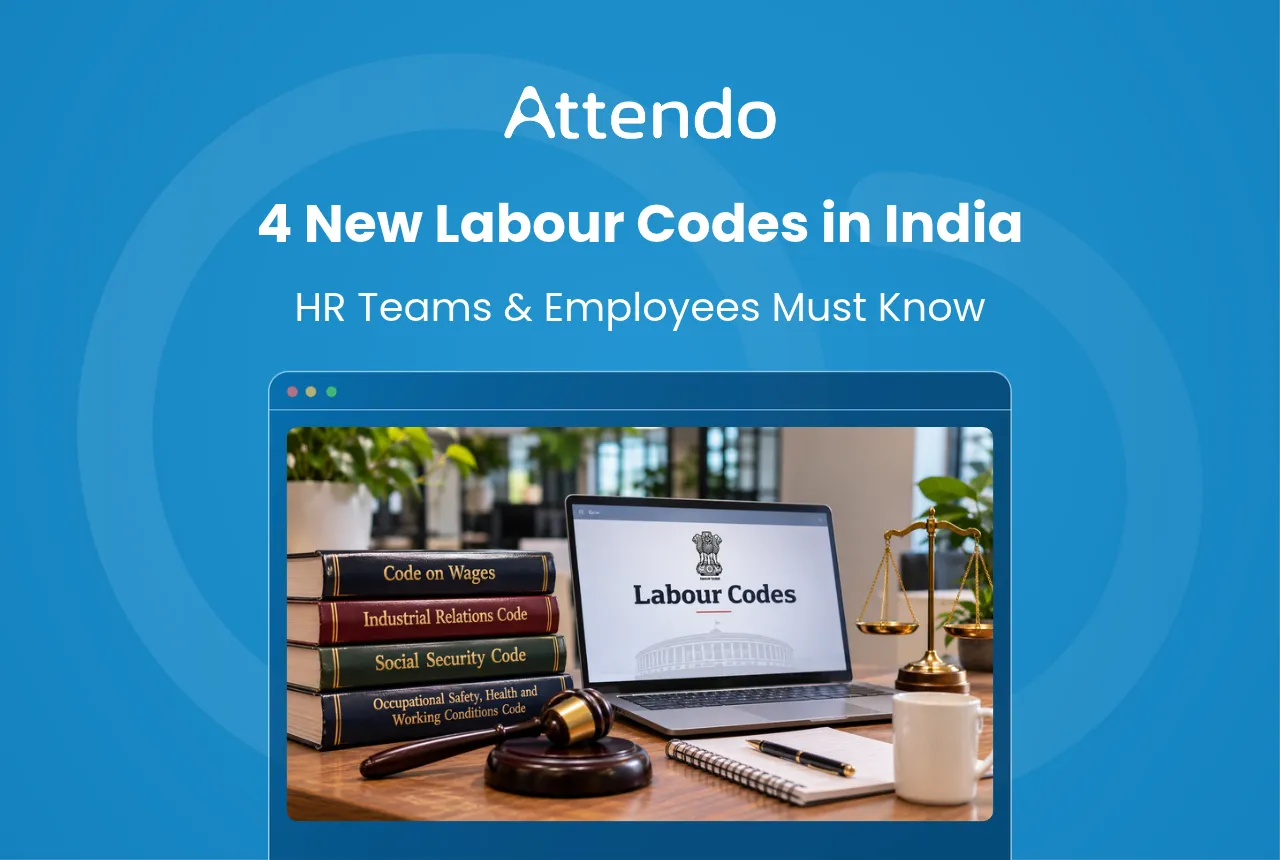
India’s labour laws changed in November 2025. Here are the 4 new labour codes, what each one replaced, and what each changes for employees, human resources (HR) teams and owners.
The four codes cover wages, industrial relations, social security and workplace safety. They have been in force since 21 November 2025, as the government’s announcement says, and they replaced 29 central labour laws.
I expected the new codes to mean more forms to fill in. The Labour Ministry’s handbook says the opposite: forms fell from 181 to 73, and registers from 84 to 8.
Key Takeaways
- The four codes are the Code on Wages, the Industrial Relations Code, the Social Security Code and the workplace safety code, known as the OSH Code. Each one took over a group of older laws.
- They have applied since 21 November 2025. Where new rules are not out yet, old ones still count where they match the codes.
- The biggest salary change is how wages are counted. Allowances above half of total pay now count towards Provident Fund (PF), gratuity and bonus.
- Fixed-term employees no longer wait five years for gratuity. A contract of one year can now earn it. Permanent employees still need five years.
What are the New Labour Codes?
The new labour codes are four laws that combine 29 older central labour laws into one set of rules. Each code covers one area of work:
| Code | What it covers | Laws it replaced |
|---|---|---|
| Code on Wages, 2019 | Minimum wages, pay dates, bonus, equal pay | 4 |
| Industrial Relations Code, 2020 | Unions, standing orders, disputes, lay-offs | 3 |
| Code on Social Security, 2020 | PF, ESIC, gratuity, maternity, gig workers | 9 |
| OSH Code, 2020 | Working hours, leave, safety, contract labour | 13 |
For an ordinary workplace, the changes people notice most are in pay, working hours, leave and gratuity.
In Simple Words
India had many old work laws. Now it has four. They say how you get paid, how long you work and what help you get.
When Did the New Labour Codes Start?
All four codes came into force on 21 November 2025. Their detailed rules came later. Until new rules are officially published, the Labour Ministry’s FAQs on the codes say the old rules stay in force, as long as they are in line with the codes.
The central government published its Code on Wages rules and its social security rules on 8 May 2026. These cover businesses the central government regulates directly, such as banks, insurance companies, major ports and central public sector companies.
Most private businesses follow their state’s rules instead, and each state publishes its own. So check your state labour department’s website before you change a policy.
Attendo (formerly Petpooja Payroll) is a complete workforce management system for every kind of business, running attendance, shifts, leaves, payroll and statutory filings in one place. Attendo has more than 40,000 users today. It is Software By Petpooja, building helpful products for Indian businesses since 2011.
The 4 New Labour Codes One by One
Each code replaced a group of older laws. Here is what each one covers, and its best-known change.
1. Code on Wages, 2019
The Code on Wages replaced the Payment of Wages Act, the Minimum Wages Act, the Payment of Bonus Act and the Equal Remuneration Act.
Its best-known change is one definition of wages for all four codes. It also gives every employee a minimum wage, not just people in jobs on a government list.
2. Industrial Relations Code, 2020
The Industrial Relations Code replaced the Trade Unions Act, the Standing Orders Act and the Industrial Disputes Act.
It covers unions, strikes, lay-offs and complaints. Its best-known change is that two duties start only at 300 workers. One is written service rules, called standing orders. The other is government permission before laying off staff or closing.
3. Code on Social Security, 2020
The Social Security Code replaced nine laws, including the Employees’ Provident Funds Act, the ESI Act, the Payment of Gratuity Act and the Maternity Benefit Act.
It covers Provident Fund (PF), the Employees’ State Insurance Corporation (ESIC), gratuity and maternity benefit. Gratuity still needs five years of service, except for fixed-term employees.
It also covers gig and platform workers, such as delivery partners, for the first time. Platform companies will pay 1% to 2% of their yearly turnover towards these workers’ social security, at a rate the government notifies.
4. OSH Code, 2020
The Occupational Safety, Health and Working Conditions Code, or OSH Code, replaced 13 laws. They include the Factories Act and the Contract Labour Act.
It sets working hours, overtime, annual leave and safety duties. Its best-known change is a written appointment letter for every employee. The contract labour rules now sit inside it too.
New Labour Codes and Your Salary
The new labour codes change how your salary is counted, when it is paid and what can be deducted from it.
The 50% Rule
Under the Code on Wages, wages means basic pay and dearness allowance (DA). If your other allowances add up to more than half of total pay, that extra part is counted as wages too.
Take a monthly salary of ₹30,000, with ₹12,000 as basic and DA and ₹18,000 as allowances (an example). Half of ₹30,000 is ₹15,000, so ₹3,000 of the allowances is over the limit.
That ₹3,000 is counted with basic and DA, so wages for PF, and gratuity become ₹15,000 instead of ₹12,000. Your total pay stays ₹30,000; only the wage used for PF and gratuity changes.
Performance incentives, employee stock options (ESOPs) and reimbursements are not counted as wages, the Labour Ministry’s FAQs say. Statutory bonus under the new code uses this definition of wages too, within its own limits.
Pay Dates and Deductions
- Monthly salary by the 7th. It must be paid by the end of the seventh day of the next month.
- Wages within two working days of leaving. This applies whether you resign, are let go or are removed.
- Deductions capped at half. All deductions together cannot be more than half of wages.
- Equal pay. No pay difference is allowed on the ground of gender for the same or similar work.
These pay rules apply the same way in a garment unit, an IT services firm or a hospital.
New Labour Codes for Employees
Beyond salary, the new labour codes give these rights. The hours, overtime and leave rights are for workers, as the OSH Code calls them:
- An appointment letter. In an establishment the OSH Code covers, every employee must get one.
- Eight hours a day, six days a week. Work beyond eight hours a day or 48 hours a week is overtime.
- Overtime at double pay, with consent. It is paid at twice the normal rate, and only if the employee agrees.
- Annual leave after 180 days of work in a year. One day of leave is earned for every 20 days worked, and up to 30 days can be carried forward.
- A free annual health check-up. The government’s announcement says this is for employees above 40; state rules can set a different age.
- Night shifts for women, by choice. Women can work before 6 a.m. or after 7 p.m. only with their consent.
Worker is a legal term that covers most staff, but not everyone. People in managerial or administrative roles are outside it, and so are supervisors earning above ₹18,000 a month, the Ministry’s additional FAQs confirm for leave.
Fixed-Term Employees
A fixed-term employee must get the same pay and benefits as a permanent employee doing the same work. Gratuity is paid in proportion to the time worked, and the Labour Ministry says one year of service is enough.
New Labour Codes for HR and Owners
For HR and owners, the new labour codes mean a list of checks. Most apply to every business; a few depend on headcount:
- Check every salary structure against the wage rule. It can raise the wage base for PF, gratuity and bonus.
- Fix your pay date. Monthly salaries go out by the 7th, and wages due on an exit within two working days.
- Issue appointment letters. Existing staff without one were due a letter within three months of 21 November 2025, so issue any still missing now. Use appointment letter formats that match the code.
- Count overtime by the day and by the week. Pay whichever total gives the employee more, and record their consent.
- Register for PF and ESIC on time. PF applies from 20 employees, and ESIC from 10.
- Set up a grievance committee at 20 workers. It must include women in proportion to the workforce.
- Arrange safety for women’s night shifts. The government lists written consent, safe transport and CCTV.
- Plan the yearly health check-ups. Book them for eligible employees each year.
The new labour codes readiness checklist puts these checks in one place.
Pro Tip
I’d suggest starting with the wage rule. It is the change most likely to move PF and gratuity, and you can check it on one salary sheet.
Any business that pays large allowances, whether a retail chain, a hotel or an IT firm, will see the biggest change. Getting the wage base right every month is payroll work.
Where Attendo Fits
The new wage definition changes the wage that PF, gratuity and bonus are worked out on, so the payroll has to follow it.
In Attendo, each Payroll Group carries its own salary structure. With compliance switched on, PF, ESIC, professional tax, tax deducted at source (TDS) and labour welfare fund are calculated in every payroll run.
ESIC, professional tax and the employer’s PF share also support a Custom Formula, which can use basic, gross, house rent allowance and attendance.
Overtime is worked out from the hours beyond each shift, and the Overtime Report shows it by employee, department and period, so weekly totals can be checked too.
If you want payroll set up around the new labour codes, attendohr.com shows how it works.
So, What Do the New Labour Codes Change?
The new labour codes bring wages, industrial relations, social security and safety under one set of rules. For employees, the biggest changes are how wages are counted, faster pay on leaving and gratuity for fixed-term staff.
For employers, start with salary structures, pay dates and appointment letters, and watch for your state’s final rules.
For HR teams and owners who want PF, ESIC and overtime worked out in every payroll run, see how Attendo handles them.
Frequently Asked Questions
1. What are the 4 new labour codes?
2. When were the new labour codes implemented?
3. Is a 9-hour working day allowed under the new labour codes?
4. Will my take-home salary fall under the new labour codes?
5. Do the new labour codes apply to small businesses?
6. Where can I read the new labour codes?
Listen to this article
Related Articles You May Like
8 Advance Salary Policy Rules (+ Template and Request Format)
Eight rules for advance salary, a copy-paste policy template and ready request formats, with the legal limit on recovering it from pay.
Ashwiniba Vaghela
HR & Payroll Experts
6 RazorpayX Payroll Alternatives I’d Shortlist in 2026
RazorpayX Payroll’s published pricing, and six payroll tools compared on how attendance reaches the payslip.
Nisarg
Nisarg Kansara is Senior Marketing Manager at Petpooja. What he brings to table is the tactical layer, meaning the features most users never find, the automations that remove a daily chore, and the exact fix for a workflow that keeps breaking. He spends his weeks with Indian business owners working out where billing, purchase entries and task follow-ups fall apart in practice, and that input shapes how the products change. India has over 1.5 crore active GST registrations, and most of those businesses still handle compliance by hand. Nisarg writes for the owners trying to change that, with a focus on where AI removes manual work rather than adding another button.
6 Zoho People Alternatives I’d Pick for Payroll in 2026
Zoho People’s prices from India, and six HR tools that keep attendance, leave and payroll in one product.
Avani Joshi
HR & Payroll Experts
6 Keka Alternatives You Should Try in 2026
Weighing Keka against other HR and payroll tools? See which one fits your team by device, billing and the HR tools you need.
Nisarg
Nisarg Kansara is Senior Marketing Manager at Petpooja. What he brings to table is the tactical layer, meaning the features most users never find, the automations that remove a daily chore, and the exact fix for a workflow that keeps breaking. He spends his weeks with Indian business owners working out where billing, purchase entries and task follow-ups fall apart in practice, and that input shapes how the products change. India has over 1.5 crore active GST registrations, and most of those businesses still handle compliance by hand. Nisarg writes for the owners trying to change that, with a focus on where AI removes manual work rather than adding another button.