


15 HR Policies Every Indian Company Should Have
A list of 15 HR policies for Indian businesses, the labour code rules behind them, a blank policy format and an employee handbook outline.
Listen to this article
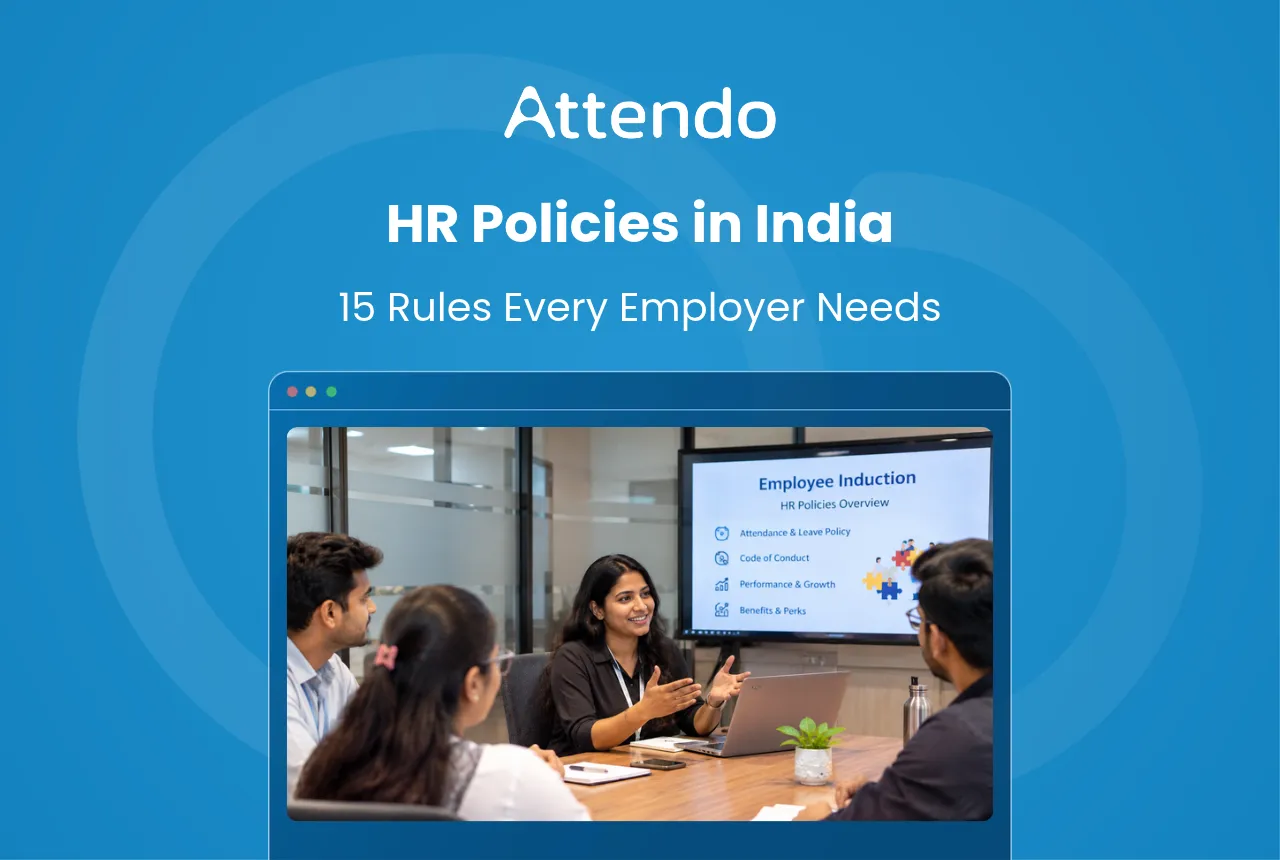
HR (human resources) policies are the written rules a company sets for its people: how attendance, leave, pay, conduct and complaints work. They answer the everyday questions before they turn into arguments.
Owners and HR teams need them in every kind of business, from a ten-person shop to a factory or an office, and many of them must follow rules set by Indian labour law.
Below are 15 HR policies every Indian company should have, with a sample line for each and the law behind many of them. In my view, the attendance and leave policies come first, because staff use them every single month.
Key Takeaways
- HR policies are a company’s written people rules, covering time, pay, conduct and complaints.
- The law sets the rules behind many of them, such as leave, pay dates and overtime, and a few are legal documents.
- Keep each policy short and in plain words, with a named owner, a version and a review date.
- Share every policy and get it acknowledged, so no one can say they were never told.
What HR Policies Should Include
Every HR policy in this guide, from leave to conduct, works best with the same simple structure. With it, staff can find an answer quickly, and managers apply the rule the same way for everyone.
Parts of an HR Policy
Start with the purpose in one line, and say who the policy covers: all staff, or named groups such as shift workers or field sales. Then set out the rules as short numbered points, in plain words that a new joiner can follow.
Add the process: who to ask, who approves, and by when. End with the policy owner (the person responsible for it), its version number, the date it took effect and the date of the next review, so everyone knows which version is current.
In the chart, parts 1 to 4 carry the policy itself, and part 5 keeps it current.
A Blank HR Policy Sample
Use this HR policy sample as the base for every policy below. Copy it into Word on your letterhead, fill in the square brackets, and keep each policy to one or two pages, so that staff will read it through and follow it.
Write down the rules your business actually follows, not a copy of another company’s handbook found online. A policy that matches daily practice is easier for managers to apply fairly, and easier to keep up to date.
[Policy Name] Policy of [Company Name]
1. Purpose. [One line on why the policy exists.]
2. Who it covers. [All employees / named groups.]
3. Rules. [Short numbered rules.]
4. Process. [Who to ask, who approves, time limits.]
5. Owner and version. [Name, Designation]; version [Number], in effect from [Date]; next review [Date].
A policy is only as useful as the records behind it, from attendance to leave balances.
Attendo (formerly Petpooja Payroll) is a complete workforce management system for every kind of business, running attendance, shifts, leaves, payroll and statutory filings in one place. Attendo has more than 40,000 users today. It is Software By Petpooja, building helpful products for Indian businesses since 2011.
15 HR Policies Every Company Needs
This list of HR policies runs from everyday rules to the ones that protect and support staff. Each section gives a sample line you can adapt as a starting point.
The numbers in the chart match the numbered policies below.
1. Attendance and Working Hours Policy
Set the start and end time of each shift, the grace period, the weekly off, and how attendance is recorded, such as a biometric device or an app. For workers, normal hours are 8 a day and 48 a week. Worker is the labour codes’ word for most staff.
That limit is in the Labour Ministry’s additional FAQs. Under section 26 of the OSH Code, no worker may work more than six days a week. Small shops and offices should also check their state’s shops and establishments rules on hours and opening times.
Sample line: “Work runs from 9:30 am to 6:30 pm, including a one-hour lunch break, with 10 minutes’ grace. A punch after 9:40 am is a late mark. Sunday is the weekly off.”
2. Leave Policy
List each kind of leave, such as earned, casual and sick leave, how it builds up, and how to apply. Under section 32 of the OSH Code, 2020, a worker with 180 days’ work in a calendar year earns one day of paid leave for every 20 days.
Say how much leave can be carried forward or paid out as cash, and who approves it. This guide to preparing a leave policy format covers each part, and this sandwich leave policy guide explains how weekends between leave days are counted.
Sample line: “Apply for earned leave in the app at least 3 working days ahead. Your manager will approve or reject it within 2 working days.”
3. Holiday Policy
Publish the year’s holiday list in advance: national holidays, festival holidays and any optional holidays staff can choose. A school, a hospital and a retail chain will each need a different list, so write your own.
Festival holidays depend on the state, so check your state’s rules before you fix the list. This guide to festival holidays by state shows how many each state requires and how businesses usually pick them from the state list.
Sample line: “The holiday list for the year is shared in December. Each employee may also choose 2 days from the optional holiday list.”
4. Overtime Policy
Say when work counts as overtime, who must approve it in advance, and how it is paid. For workers covered by the labour codes, the Ministry’s FAQs say work beyond 8 hours a day or 48 a week is paid at twice the normal rate.
Record overtime hours from attendance, not from memory, so the payslip matches the hours worked. These overtime rules explain how the labour codes changed overtime, and how to work out the amount on each worker’s payslip.
Sample line: “Overtime must be approved by your manager before it starts, and is paid with the same month’s salary.”
5. Payroll and Salary Policy
State the pay date, how pay is calculated, and what is deducted. Under section 17 of the Code on Wages, 2019, monthly wages are due by the seventh day of the next month, so set your own pay date on or before that day.
Explain how salary changes are made, how advances work, and who to ask about a mistake. A clear payroll policy cuts down the month-end questions, because staff can check the rule themselves before they raise a query with HR.
Sample line: “Salary is credited to your bank account by the 5th of each month. Report any payslip error to HR within 7 days.”
6. Travel and Expense Policy
Set what the company pays for on work trips, such as travel class, hotel limits and daily meal allowances, and how staff claim it. Field sales teams and branch managers use this policy far more often than office staff.
Ask for bills with every claim, set a deadline to submit them, and name the person who approves each claim. Paying claims through payroll on a fixed date each month keeps reimbursements easy to check when the accounts are closed.
Sample line: “Submit travel claims with bills within 15 days of the trip. Approved claims are paid with the next salary.”
7. Employee Code of Conduct
An employee code of conduct sets the behaviour the company expects, such as honesty, respect, punctuality and keeping company information private. It is the policy other rules point back to when something goes wrong.
Code of conduct examples include no gifts from suppliers, no harassment and no sharing of confidential data. The 2026 Model Standing Orders treat sharing confidential information as misconduct. To get confidentiality in writing, use this non-disclosure agreement (NDA) template.
Sample line: “Do not accept cash or gifts from any supplier or customer. Report any offer to your manager.”
8. Probation and Confirmation Policy
Set the probation period for new joiners, how they are reviewed, and how confirmation is given in writing. In industrial units that must keep standing orders (written service rules required by law), probation is six months.
The 2026 Model Standing Orders let it be extended by up to three more months after a performance review. These probation period rules explain the notice during probation, and how probation works in smaller businesses.
Sample line: “Probation is six months, and may be extended by up to three months after a review. If the review is positive, you get a confirmation letter.”
9. Disciplinary Policy
Set out what counts as misconduct, the steps the company will take, and the employee’s right to reply. A fair process usually starts with a quiet word, then a written warning, then a proper inquiry for serious matters.
Write the steps down before you need them, so every manager applies them in the same way to every employee. These warning letter formats help with the first written step, long before any suspension or formal inquiry.
Sample line: “No suspension or major penalty will be given without a written charge and a chance for you to reply.”
10. Notice Period and Exit Policy
State the notice each side must give, how leave and dues are settled, and what the employee must return, such as a laptop or ID card. Under the Code on Wages, final wages are due within two working days of employment ending, by resignation or removal.
List the exit documents the employee will receive, and when they will get them. These notice period rules explain what applies under the labour codes, and how a notice period can be served in full, waived or bought out.
Sample line: “Confirmed employees and the company each give 30 days’ notice. Final wages are paid within two working days of your last working day.”
11. POSH Policy Against Sexual Harassment
A POSH policy, named after the Sexual Harassment of Women at Workplace (Prevention, Prohibition and Redressal) Act, 2013, explains what sexual harassment at work is, how to complain, and how each complaint is handled and closed.
Whether you need your own Internal Committee, the panel that hears complaints, depends on headcount under the Act. If you have one, name its members. Sexual harassment is also misconduct under the 2026 Model Standing Orders. Display the policy where staff can see it, and train staff on it regularly.
Sample line: “Any employee can report harassment to the Internal Committee in writing. Every complaint is kept confidential.”
12. Equal Employment Opportunity Policy
An equal employment opportunity policy commits the business to fair treatment in hiring, pay and promotion, whatever a person’s gender, religion, caste or disability. It sets out how the company will make work accessible for everyone.
For disability, it is also a legal duty: the Rights of Persons with Disabilities Act, 2016 requires every establishment to publish such a policy. This equal opportunity policy template explains that duty, with a free Word file to fill in.
Sample line: “Hiring, pay and promotion are decided on skills and work alone, never on gender, religion, caste or disability.”
13. Grievance Redressal Policy
A grievance policy tells staff how to raise a complaint about pay, leave, a manager or working conditions, and how quickly it will be answered. Complaints handled early are less likely to grow into disputes, strikes or legal notices.
Under the Industrial Relations Code, an industrial establishment, such as a factory or workshop, with 20 or more workers must have a Grievance Redressal Committee. Businesses outside this rule can name one person instead. This grievance committee template shows how to set one up.
Sample line: “Raise a complaint with [Name] by email or in person. You will get a written reply within 7 working days.”
14. Maternity Leave Policy in India
Set out maternity leave, any paternity or adoption leave the company offers, and how to apply. The Code on Social Security, 2020 allows up to 26 weeks of maternity benefit for the first two children, no more than 8 of them before delivery.
A woman qualifies after working at least 80 days in the 12 months before the expected delivery. This maternity leave policy template has the full rules, including the shorter period for a woman with two or more children.
Sample line: “Tell HR about your expected delivery date at least 12 weeks ahead, so your leave and pay can be planned.”
15. Work From Home Policy
If staff work from home, set who can, how often, and the hours they must be online. Many offices and IT services firms allow a few remote days a week, while factories and stores rarely can, so write rules that fit the role.
Say how attendance is marked for a remote day, which equipment the company provides, and how data must be kept safe at home. No law requires a written work from home policy, but it prevents arguments about who was working when.
Sample line: “Remote days need your manager’s approval a day ahead. Mark attendance in the app by 9:40 am.”
Latest Update on HR Policies
The four labour codes took effect on 21 November 2025. Policies still written around the old Acts, such as the Factories Act or Payment of Wages Act, need updating to the codes.
Employee Handbook Template
An employee handbook brings all your HR policies together in one document. New joiners read it in their first week, and managers use it to answer questions without having to guess the rule.
What Goes in an Employee Handbook
Open with a short welcome and the company’s values, then add each policy as its own section, in the order staff need them: joining first, then attendance, leave and pay, then conduct, complaints and remote work, and exit last. Add a contents page.
Keep the employee handbook template in Word or as a PDF, with page numbers and a version date on every page. Short day-to-day rules, such as dress code and phone use, can go in a final section. Item 10 of the outline below holds that workplace rules sample wording.
Employee Handbook of [Company Name]
1. Welcome and our values
2. Joining, probation and confirmation
3. Working hours, attendance and weekly off
4. Leave, holidays, maternity and parental leave
5. Pay, overtime, travel and expenses
6. Code of conduct and discipline
7. POSH, equal opportunity and grievances
8. Remote work
9. Notice and exit
10. Workplace rules: dress code, phones, safety
Version [Number], in effect from [Date]
How to Roll Out HR Policies
Share the handbook with every employee, explain the main changes in a team meeting or at each branch, and ask each person to sign an acknowledgement. Give new joiners time in their first week to read it and ask their questions.
Section 33 of the Industrial Relations Code, 2020 already makes industrial units with standing orders keep their certified text in a prescribed language for workers to read. That is a good model for any handbook.
Store the signed acknowledgements safely, and repeat the whole process whenever a policy changes. A new joiner should sign within their first week. Name the handbook in their joining letter too, and these appointment letter formats have space for that line.
Policy Acknowledgement
I, [Name], [Employee Code], confirm that I have received and read the [Policy Name / Employee Handbook], version [Number], dated [Date], and agree to follow it.
[Signature]
[Date]
Pro Tip
I’d suggest translating a one-page summary of hours, leave, pay date and how to complain into Hindi, Marathi, Tamil or whatever your staff speak. A single page in their own language gets read far more readily than a long translated handbook.
HR Policy Checks for Owners
Policies go out of date as laws and the business change. Run these checks once a year, or whenever the business grows past a new size, such as 20 or 300 workers.
Check HR Policies Against the Labour Codes
Many policies still quote the Factories Act, the Payment of Wages Act or the Industrial Employment (Standing Orders) Act, all repealed by the labour codes. Replace those references, and check each number, such as leave and overtime rates.
This labour codes readiness checklist walks through the changes one area at a time. Where an industrial establishment has 300 or more workers, this standing orders template covers the rules it must have certified by the authorities.
Review HR Policies Every Year
Set one month each year to read every policy against how the business works today. Remove rules nobody follows, add the ones managers keep making up, and check that each policy’s owner and the review date are current.
Ask managers and a few staff what confuses them, because that is where a policy needs plainer words. Record what changed and when, so the version history is clear if a dispute ever reaches a labour officer or a court.
In Simple Words
HR policies are the rules for work. They tell staff when to come in and how leave and pay work. They also say how to complain about a problem. Everyone should read and sign them.
How Attendo Helps Share HR Policies
Attendo’s Announcements screen can post a policy to everyone or to chosen departments, under the built-in category labelled Policy Update, with the policy attached as a PDF.
Switch on the Acknowledgement required setting, and each employee taps the Acknowledge button in the Employee App. The admin sees who has acknowledged, who has only read it, and who has not opened it yet.
If you want policies shared and acknowledged this way, attendohr.com shows how it works.
Which HR Policies to Prepare First
If you have no HR policies yet, start with the ones the law touches and staff use most. This table sets out a sensible order, from the rules used every month to those added later.
| Priority | HR policies | Why |
|---|---|---|
| First | Attendance, leave, holidays, overtime, payroll | Staff use them every month, and the law sets their rules |
| Also from day one | POSH, equal opportunity, a grievance contact | They protect every employee; POSH and equal opportunity carry legal duties |
| Next | Probation, code of conduct, disciplinary, notice and exit, maternity | They matter from the first hire, and when something goes wrong |
| As needed | Travel, remote work | Add them when the business starts using them |
Together, these 15 HR policies cover a company’s people rules from the first day to the last. Once each is ready, put them all into one employee handbook. For owners and HR teams who want policies, attendance and payroll in one place, see how Attendo handles them.
Frequently Asked Questions
1. What are HR policies?
2. Which HR policies are mandatory in India?
3. What is a company code of conduct?
4. How often should HR policies be updated?
5. Do small businesses need HR policies?
6. What is the difference between an HR policy and an employee handbook?
Listen to this article
Related Articles You May Like

25 Christmas Decoration Ideas for the Office on Any Budget
Wreaths, trees, garlands and star lanterns: 25 ideas to decorate the office, factory, shop or clinic for Christmas, with DIY ideas and safety tips.
Ashwiniba Vaghela
HR & Payroll Experts

60 New Year Wishes for Boss, From Formal to Heartfelt
Professional, short, heartfelt, Gen Z and Ugadi or Vishu wishes for your boss, plus family and sir or madam wishes, an email format and when to send each.
Avani Joshi
HR & Payroll Experts

60 Birthday Wishes for Boss, From Formal to Heart Touching
Professional, short, heart touching, funny and Gen Z birthday wishes for your boss, plus wishes for sir and madam, an ex boss, and office birthday tips.
Avani Joshi
HR & Payroll Experts
7 Salary Increment Request Letter Samples for Employees
Seven samples for asking your employer for a raise, a blank template, tips on the figure, and how HR should reply.
Ashwiniba Vaghela
HR & Payroll Experts