


How Many Festival Holidays Must You Give in Your State?
Seven paid days a year in one state, thirteen in another. Here is what nine states and Delhi put in writing, and how to find the rule for anywhere else.
Listen to this article
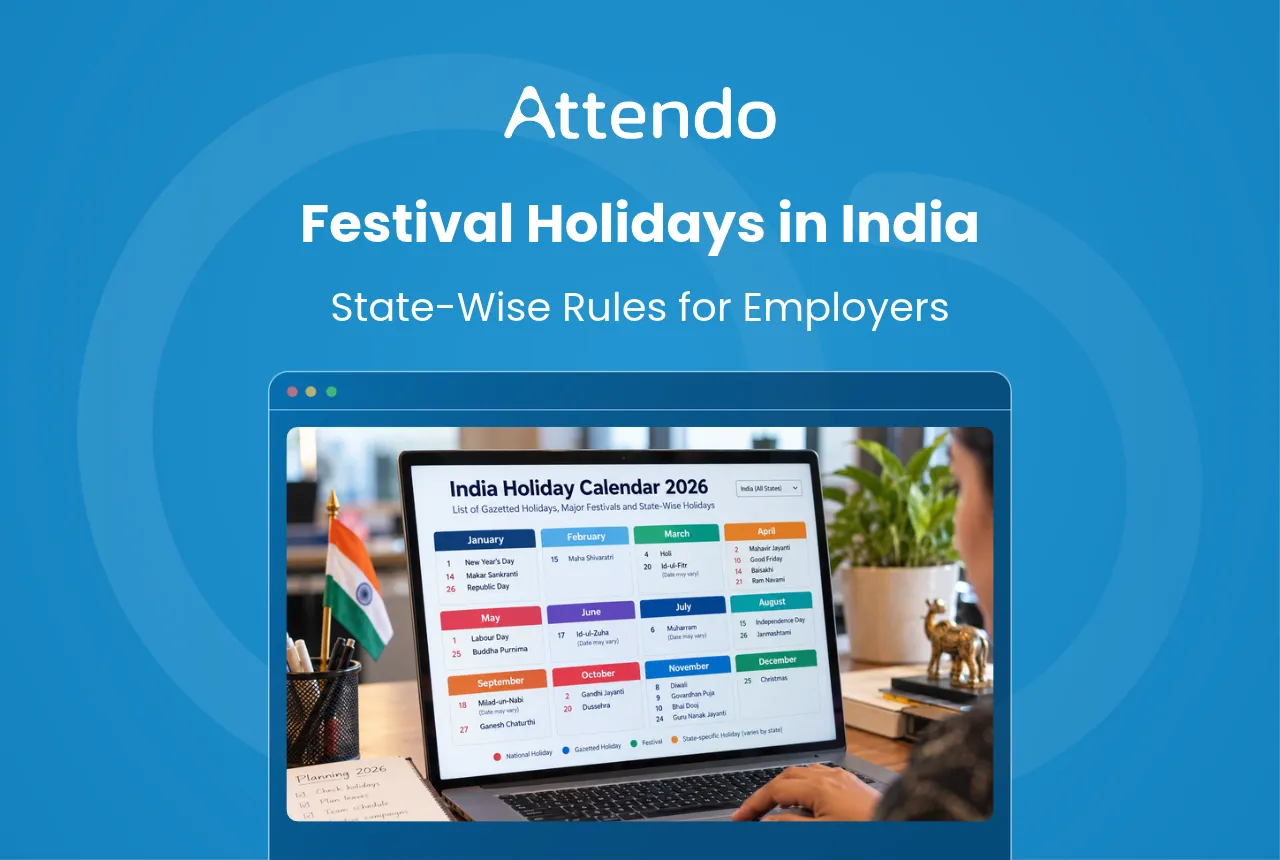
The number of festival holidays you must give depends on your state. Across India’s states and union territories, it runs from none at all to nine a year.
Those come on top of the national holidays, which usually number three or four. So the paid days run from none in a few states to thirteen in Kerala.
No central law sets the number. The four labour codes cover hours, rest days and leave, and they do not mention festival holidays at all.
In many states the holiday law reaches only factories, so the tables also say which businesses it covers.
Key Takeaways
- Your state sets the number. A few laws have no festival days at all; Kerala’s has nine, plus the national ones.
- National holidays are not always four. 1 May is the usual difference.
- No law here makes Diwali a fixed holiday. Each says who chooses the festival days.
- A holiday worked costs double pay, or pay plus a day off. Several ask for both.
How Many Festival Holidays per State?
Each state sets its own figure, from none to nine festival holidays a year. Some states have a holidays Act of their own. Others put the rule inside the shops law, and a few give no festival holidays at all.
Each figure below was read on 12 or 13 October 2026 from the copy of the law the government itself publishes. Check for a later amendment before you rely on any one of them.
States With Their Own Holidays Act
These states and union territories have a separate Act for national and festival holidays.
In the south, Tamil Nadu’s Act and Karnataka’s Act reach shops and offices as well as factories.
So does Kerala’s Act, though only where twenty or more people are employed.
Telangana’s Act and Andhra Pradesh’s Act use the same wording on holidays. Each one covers factories, shops and offices, and so do Odisha’s Act and Puducherry’s.
In the north, the Punjab Act serves Punjab and Haryana, and Delhi applies it too. It reaches factories and plantations only, so a shop or an office is outside it. Chandigarh uses it as well.
Himachal Pradesh, Bihar, Jharkhand, Jammu and Kashmir and Ladakh have Acts of the same kind, also for factories. Uttar Pradesh’s and Uttarakhand’s factory law gives national holidays only.
| State | National + festival | Paid days | Which businesses |
|---|---|---|---|
| Tamil Nadu | 4 + 5 | 9 | Shops, offices and factories |
| Karnataka | 3 + 7, with 1 May and 1 November fixed | 10 | Shops, offices and factories |
| Kerala | 4 + 9 | 13 | Any business with 20 or more people |
| Telangana | 4 + 4 | 8 | Shops, offices and factories |
| Andhra Pradesh | 4 + 4 | 8 | Shops, offices and factories |
| Odisha | 4 + 4 | 8 | Shops, offices and factories |
| Puducherry | 5 + 3 | 8 | Shops, offices and factories |
| Punjab | 3 + 4 | 7 | Factories and plantations |
| Haryana | 3 + 5 | 8 | Factories and plantations |
| Delhi | 3 + at least 4 | At least 7 | Factories and plantations |
| Chandigarh | 3 + 4 | 7 | Factories and plantations |
| Himachal Pradesh | 3 + 5 | 8 | Factories and plantations |
| Bihar | 4, with 1 May, + 4 | 8 | Factories and plantations |
| Jharkhand | 4, with 1 May, + 4 | 8 | Factories and plantations |
| Jammu and Kashmir | 3 + 4, and 13 July in the Act’s text | 7 or 8 | Factories |
| Ladakh | 3 + 4 | 7 | Factories |
| Uttar Pradesh | 3 + none | 3 | Factories |
| Uttarakhand | 3 + none | 3 | Factories |
Karnataka has two numbers: five festival holidays for establishments the central government owns or controls, and seven for everybody else. So a private business owes ten paid days.
A 1963 Karnataka notification exempts some trades from giving these holidays on the set dates, among them hotels, restaurants, hospitals and chemists. They must give paid holidays on other days instead.
States That Use the Shops Law
Many states, and the shops in some of those above, use the shops law. Maharashtra’s shops law and Gujarat’s shops law each give eight paid holidays a year, national days included. So does Assam’s new shops law, and Goa’s gives seven.
| State | National + festival | Paid days | Which businesses |
|---|---|---|---|
| Maharashtra | 4 + 4 | 8 | Above a size limit |
| Gujarat | 3 + 5 | 8 | Above a size limit |
| Goa | 5, with 1 May and 19 December, + 2 | 7 | Shops and establishments |
| Assam | 3 + 5 | 8 | Shops and establishments |
| Manipur | 3 + 5 | 8 | Ten or more workers |
| Chhattisgarh | 3 + 5 | 8 | Twenty or more workers |
| Uttarakhand | 4, with 1 May, + 5 agreed | 8 or 9 | Twenty or more employees |
| Uttar Pradesh | 3 + 5 named in the rules | 8 | Twenty or more employees; shops close |
| Himachal Pradesh | 3 + 3 | 6 | Shops in towns and notified areas |
| Jharkhand | 3 + up to 5 | Up to 8 | Shops and establishments |
| Andaman and Nicobar | 3 + 5 | 8 | Shops close; twenty or more, once notified |
| Dadra and Nagar Haveli and Daman and Diu | 3 + 5 | 8 | Ten or more workers |
| Meghalaya | 4 + days the state notifies | 4 or more | Five or more employees |
Maharashtra’s and Gujarat’s laws apply these holidays only above a size limit. The published copies of both Acts set it at ten employees.
That is changing. Maharashtra raised the figure to twenty by an ordinance of 1 October 2025, and Bill 89 of 2025 followed to confirm it. Gujarat’s amendment bill makes the same change, back-dated to 16 December 2025.
Neither bill touches the holiday rule itself. So a business with ten to nineteen employees in either state should confirm where it now stands.
A factory in Maharashtra or Gujarat is a separate question, and it is not covered here.
States With No Festival Holiday Rule
In five states the shops law gives a weekly holiday but no festival holiday list: Rajasthan, Madhya Pradesh, West Bengal, Nagaland and Tripura. See Rajasthan’s shops law and West Bengal’s shops law for two examples.
West Bengal and Tripura still pay work on a day the state notifies as a national holiday at twice the ordinary rate, as overtime. Nagaland, and Meghalaya above, let an employee take up to three days a year for religious ceremonies.
In those five states, any festival holiday comes from your own policy.
For Sikkim, Arunachal Pradesh, Mizoram and Lakshadweep, and for shops in Bihar, ask the state labour department which rule applies now.
What Changed Recently
Maharashtra and Gujarat are lifting their shops law size limit from 10 employees to 20. Maharashtra’s change runs from 1 October 2025 and Gujarat’s from 16 December 2025. The eight paid holidays stay the same.
In Simple Words
Each state has its own list. First find your state. Then check that its law covers your kind of business. A factory and a shop in one city can get two different answers.
Find your state in both tables before you settle the list.
Attendo (formerly Petpooja Payroll) is a complete workforce management system for every kind of business, running attendance, shifts, leaves, payroll and statutory filings in one place. Attendo has more than 40,000 users today. It is Software By Petpooja, building helpful products for Indian businesses since 2011.
Who Picks the Festival Holidays?
It depends on the state: an inspector, the government, the employer after consulting staff, employer and employees together, or each employee. The national days are named in the law itself.
| How festival holidays are chosen | Where that applies |
|---|---|
| An inspector specifies them, after consulting the employer and the employees | Tamil Nadu, Kerala, Odisha, Puducherry, Jammu and Kashmir, Ladakh |
| The employer picks from a list in the Act, after consulting the union or the employees | Karnataka |
| The government, or an authority it names, notifies them | Telangana, Andhra Pradesh, Andaman and Nicobar, Meghalaya, and the shops laws of Himachal Pradesh and Jharkhand |
| The days are named in the rules themselves | Uttar Pradesh shops |
| Each establishment fixes and declares them in January | Goa |
| The employer and the employees settle them, from a list of festivals in the Act | Punjab, Haryana, Delhi, Chandigarh, Himachal Pradesh factories |
| Each employee chooses from a list in the Act | Bihar, Jharkhand |
| The employer and the employees agree them ahead of each year | Maharashtra, Gujarat, Assam, Manipur, Chhattisgarh, Uttarakhand shops, Dadra and Nagar Haveli and Daman and Diu |
None of these laws in force fixes Diwali as a named holiday. It comes in as one of the chosen festival days. In most states, that is why two firms in one city can close on different dates.
Uttar Pradesh comes closest. Its shop rules close shops on Diwali Parewa, the day after Diwali.
The national days differ as well. Among them, Tamil Nadu, Kerala, Telangana, Andhra Pradesh, Odisha and Maharashtra name four: Republic Day, 1 May, Independence Day and Gandhi Jayanti. Goa adds 19 December, Liberation Day, and Puducherry adds 16 August.
Most other states, among them Gujarat, Punjab, Haryana and Delhi, name three, without 1 May. Karnataka names three as well, then fixes 1 May among its seven festival days.
Did You Know?
Goa’s new shops Act of 2025 names Diwali among nine fixed paid holidays. It takes effect only once the state notifies a start date; until then the 1973 Act applies.
So a holiday policy copied from a head office in another state can go wrong. It can promise a day you do not owe, or miss one you do.
Festival Holidays vs Other Days Off
A festival holiday is a paid day off that your state’s law makes you give for a festival. Four other kinds of day off get mixed up with it.
- Government holiday lists. The central government’s holiday order for 2026 is addressed to its own administrative offices. It does not bind a private employer.
- Restricted holidays. The same order lets each government employee take any two days from a longer list. That is a government practice, though a private business may copy it by policy.
- The weekly off. The labour codes deal with the rest day, and a festival holiday is extra to it.
- Leave. Casual, sick and earned leave are days an employee asks for. A festival holiday is a day the whole business gives.
Keep the four apart in your policy, because each one is paid and counted under its own rule.
Pay Rules for Festival Holidays
Most of these laws also set the pay for a holiday worked. If you call somebody in on a national or festival holiday the law gives, one of two rules usually applies.
- Double wages, or a day in exchange. The employee chooses: twice the wages, or normal wages plus another paid day off. This is the rule in Tamil Nadu, Karnataka, Telangana, Andhra Pradesh, Odisha and Puducherry. It is also the rule under the Punjab Act, and in the factory laws of Himachal Pradesh, Bihar, Jharkhand, Uttar Pradesh, Jammu and Kashmir and Ladakh.
- Double wages and a day in exchange. Kerala, Maharashtra, Gujarat, Goa, Assam, and Dadra and Nagar Haveli and Daman and Diu give both, not a choice between them.
The exchange day has a time limit in some states. Tamil Nadu, Telangana and Andhra Pradesh want it within three days before or after the holiday worked. The Punjab Act allows ninety days.
A few laws differ. The shops laws of Himachal Pradesh and Jharkhand pay double, with no day off. Andaman and Nicobar gives a paid compensatory holiday within thirty days. Chhattisgarh’s, Manipur’s and Uttarakhand’s shops laws set no pay rule for a festival holiday worked.
Several laws also ask for notice. In Tamil Nadu, Kerala, Telangana, Andhra Pradesh and Puducherry you must give written notice at least twenty-four hours before the holiday, with a copy to the inspector.
Take a supervisor in Tamil Nadu on ₹800 a day who works on Independence Day (an example). She can take ₹1,600 for the day. Or she can take ₹800 and another paid day off, on one of the three days before or after.
Move the same shift to Kerala and there is no choice to make. She is owed ₹1,600 and another day off as well.
Holiday pay is separate from overtime. The labour codes pay twice the rate for extra hours on any day, as the overtime rules explain. The state Act sets the pay for the holiday itself.
Who Qualifies for Festival Holiday Pay
A new joiner does not always get a paid festival holiday, and the test changes from state to state. Here is how the main laws set it.
- Telangana and Andhra Pradesh. Every employee needs thirty days of work in the ninety days before the holiday. This covers the national holidays too.
- Tamil Nadu, Karnataka, Kerala and Puducherry. A similar test applies, counted as thirty days in service with weekly offs and approved leave included. It reaches only staff paid by the day or by the piece, and only festival holidays.
- Punjab, Haryana, Delhi, Bihar and Jharkhand. The employee must have been on the rolls for one month. National holidays are paid without that test.
- Maharashtra and Gujarat. The shops law sets no service test for these holidays.
One more rule sits in the first group. In Telangana and Andhra Pradesh, an employee already on paid leave that day draws the leave wages, not a second holiday wage.
Building Your Festival Holidays List
A festival holidays list takes five steps. I would do them state by state, not once for the whole company.
- Find the law that reaches you. A factory and an office in the same state can fall under different laws.
- Write down the national holidays your state names, by date.
- Settle the festival days the way your state’s law says: with your employees, from the notified list, or through the inspector.
- Publish the list before the calendar year starts. Several states, among them Tamil Nadu, Karnataka, Telangana and Andhra Pradesh, also make you send it to the inspector and display it.
- Tell payroll which days are on it, so a holiday worked is paid at the right rate.
A textile mill with one site has one list to settle. An IT services firm with offices in Karnataka and Kerala has two, at ten paid days and thirteen.
A small showroom in Maharashtra or Gujarat has a different question first. The holiday rule may not reach it, so a retail chain should check how its outlets are counted.
Once the list is settled, the Diwali holiday notice format is a quick way to tell everybody.
The list also has to agree with your leave policy, so check the two side by side.
A list only helps if the system that records attendance knows about it. That is where software comes in.
Where Attendo Fits
We designed the holiday calendar in Attendo around the problem in this post: no two states hand you the same list. So each branch carries its own holiday calendar.
Holidays are never typed in one employee at a time. They are built once as templates, under Holiday Templates, and assigned in bulk to a branch, a department or a set of employees. A business in two states builds one template per state.
Festivals that run for days are covered too. The Date Range Holiday Types option lets Diwali week or Pongal go in as one entry.
And because a holiday worked is often repaid with a day off, the Comp-Off Carry Forward setting carries that day into a later period. Check your state’s time limit for the exchange day.
If you want one holiday list per state, kept in the same system as your attendance, you can see how Attendo works.
So, What Does Your State Require?
Festival holidays are a state matter. The count, who picks the days and what a worked holiday costs all come from your state’s own law.
Start by finding which law covers your business. Then write down its national days, settle the festival days, and publish the list before January.
If you run branches in more than one state, keep one list for each. See how Attendo handles that at attendohr.com.
Frequently Asked Questions
1. Is Diwali a compulsory holiday for private companies?
2. Can I give more festival holidays than my state requires?
3. Can we swap one festival holiday for another?
4. Diwali 2026 is a Sunday. Do I owe another day?
5. Do festival holiday laws cover managers?
6. Which states give no festival holidays by law?
Listen to this article
Related Articles You May Like
7 Leave Application for Office Formats You Can Copy and Send
Need a day or a month off? Copy one of these 7 leave application for office formats, from sick leave to maternity, and send a request HR can approve.
Avani Joshi
HR & Payroll Experts

How Much Paternity Leave Do Fathers Actually Get in India?
Central government service gives a father 15 paid days. Private employers decide through their own policy, because the four labour codes are silent on paternity leave.
Ashwiniba Vaghela
HR & Payroll Experts
Is a Diwali Holiday Paid? Not Always, and No Law Fixes It
No law passed by Parliament turns Diwali into a paid day off. The duty sits with your state, and with whatever holiday list you published yourself.
Ashwiniba Vaghela
HR & Payroll Experts
Why Dearness Allowance Keeps Rising and Who Actually Gets It
Does dearness allowance reach private pay as well? See the current central DA rate, how it is set, VDA in minimum wages, and how DA is taxed.
Avani Joshi
HR & Payroll Experts