


Is a Diwali Holiday Paid? Not Always, and No Law Fixes It
No law passed by Parliament turns Diwali into a paid day off. The duty sits with your state, and with whatever holiday list you published yourself.
Listen to this article
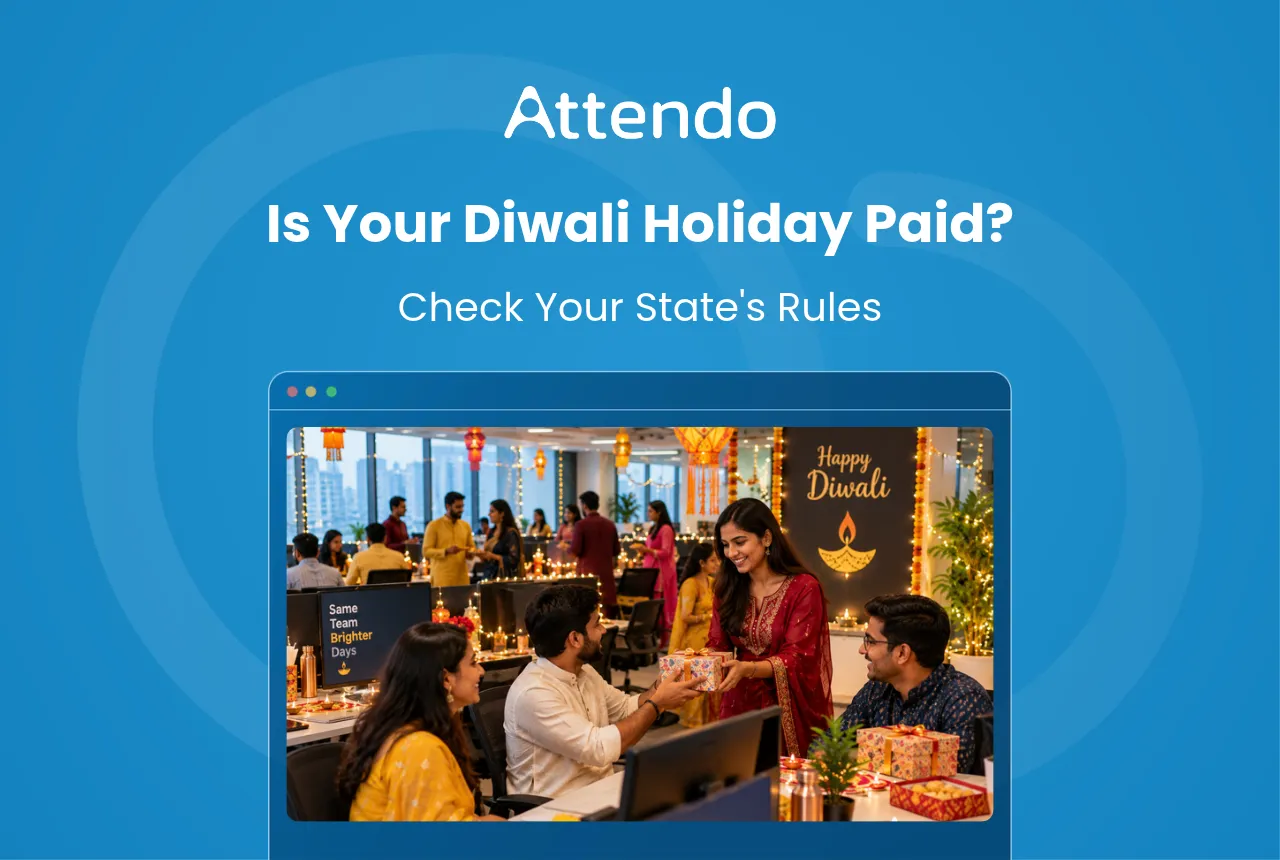
A paid Diwali holiday is not a given in India. It depends on your state’s law, and on the holiday list you publish. No central law settles it.
I never knew that even Diwali is not a fixed holiday in India. Then I worked with companies across India on their attendance and payroll, and I saw how festival holidays really work.
Diwali 2026 falls on Sunday 8 November. If you run branches in two states, you may owe two different things on that day.
Key Takeaways
- Not always. Diwali is a paid holiday where your state’s law or your published holiday list says so. No central law does.
- The labour codes left festivals alone. They run to hours, rest days, leave, wages and safety, and stop short of the calendar.
- States took two different routes. Some passed a holidays Act of their own, others wrote it into the shops law.
- Four national holidays is not a national rule. Tamil Nadu names four, Delhi gives three.
Is Diwali a Paid Holiday in India?
Not by any central law. None of the four labour codes turns Diwali into a paid day off for a private employer.
The four labour codes took effect on 21 November 2025. They now carry most of India’s employment law between them.
They cover working hours, the weekly rest day, overtime and annual leave. They do not cover festivals.
The word festival does not appear in any of the four codes. Neither does Diwali, by either spelling.
In Simple Words
No central law says Diwali must be a paid holiday. Your state may say it, and your own holiday list may promise it. So after the codes, look at your state’s law first, then your own list.
So start with your state’s law, not the labour codes. That is where the answer for your business sits.
Which Law Gives the Diwali Holiday
Your state’s law, and states have taken two different routes to it.
Some states run a separate Act on national and festival holidays. Others put the subject inside their shops and establishments law.
The route matters for two reasons. It decides who is covered, because an Act of one kind may reach only factories and not shops.
It also decides where to go and read. One route puts the answer in a holidays Act, the other buries it in a section of the shops law.
And taking the same route does not mean landing on the same answer. The two places below took it and still differ.
Two Places, Two Different Answers
Both examples below run a separate holidays Act. Delhi’s is the Punjab Act, extended to it. Even so, they do not agree, which is the point.
| State | Its holidays Act, as its department publishes it |
|---|---|
| Tamil Nadu | The 1958 Act on national and festival holidays. Its labour department describes five festival and four national holidays, and names the four |
| Delhi | A 1965 Act giving three national holidays and at least four festival ones. Its page says the Act is applicable on factories covered under provisions of the Factories Act, 1948, so it does not reach shops and offices |
Tamil Nadu names its four national holidays by date: 26 January, 1 May, 15 August and 2 October.
Note the 1 May. Four is not the number everywhere. The Act Delhi applies gives three. That Act, the Punjab Act of 1965, names them as 26 January, 15 August and 2 October.
So the counts differ by one, and a policy written for either place does not simply transfer to the other.
Did You Know?
Delhi’s page gives seven days of casual leave and 14 days of sick leave at half pay, under the same Act. A holidays Act can carry leave rules as well as holidays.
Other states differ again. Read from each state’s own law on 12 October 2026, festival holidays run from four a year under Telangana’s Act to nine under Kerala’s Act. National holidays come on top, three or four of them.
None of those laws makes Diwali a fixed holiday. Some, such as the Punjab Act and Karnataka’s Act, list it among the festivals to choose from. It becomes a paid holiday when it is chosen as one of the year’s festival days, or when your own list promises it.
What the Codes Cover and What They Skip
Hours, rest and leave.
Working time and festival holidays are two different subjects, and they get mixed up constantly.
The weekly rest day is the one that bites this year, because Diwali 2026 is a Sunday. The codes deal with it, though mostly by handing the detail to your state.
Where Sunday is already the rest day, the question becomes rest-day pay rather than festival pay.
A supermarket or a lab that trades every Sunday rests on another day of the week. For them Diwali is an ordinary working day unless their state’s festival list or their own holiday list makes it one.
If somebody works extra hours over the festival week, that is overtime, and the codes do price it at twice the normal rate.
Pro Tip
The government’s own gazetted holiday list binds government offices. It is not a list of days a private employer must pay for. Check your state’s Act instead.
One more trap worth naming. The Occupational Safety, Health and Working Conditions Code, the OSH Code for short, has replaced the Factories Act, 1948. A holiday policy that still cites that Act is citing a law that no longer exists.
What Changed Recently
The Factories Act, 1948 was repealed on 21 November 2025 by the OSH Code. Yet Delhi’s labour department page, read on 9 October 2026, still describes its holiday Act as applying to factories covered by that repealed Act.
So where your state’s holiday Act leans on that repealed Act to say who it covers, do not assume. Read the current state rules.
Attendo (formerly Petpooja Payroll) is a complete workforce management system for every kind of business, running attendance, shifts, leaves, payroll and statutory filings in one place. Attendo has more than 40,000 users today. It is Software By Petpooja, building helpful products for Indian businesses since 2011.
Before You Build a Holiday Calendar
Keep these five points in mind. The first three need your state’s labour department website; the last two you can do from your own records.
- Find the law that governs you. Either a national and festival holidays Act of your state’s own, or the holidays section of its shops and establishments law.
- Write down the national holidays it names, by date, and how many festival holidays it requires.
- Settle the festival days for the year the way your state’s law says. Depending on the state, that is with your employees, as notified by the state government, or through the inspector.
- Publish the list before the year starts, per state and per branch if you operate in more than one.
- Treat the published list as binding on you. Taking back a day you announced changes agreed terms, so expect to pay for it or give the day back.
How Long Does a Holiday Calendar Take?
For one state, it is a short job you can finish in one sitting. Each extra state adds another law to read and another list to publish.
A textile mill in Coimbatore is the quick case: one state’s Act and one list.
A corporate office in Gurugram takes an extra step. Haryana uses the Punjab Act, which reaches only factories and plantations, so the office first has to find the right law, the state’s shops law.
A diagnostic lab chain across two states takes longest. It reads two laws, publishes two lists and owes two sets of holidays at once.
The Diwali holiday notice format is what you circulate once the list is settled.
The list also has to agree with your leave rules, because a holiday falling inside somebody’s leave is not leave. That join is covered in a leave policy format.
Where Attendo Fits
A holiday list is only useful if payroll and attendance both know about it. Otherwise a declared holiday arrives as an absence.
Each branch carries its own holiday calendar. A firm in two states builds one template per state, and each branch gets the holidays its own state requires.
Attendance reads the same calendar. So a Diwali shift arrives marked as a holiday, not as a working day somebody has to correct later.
Holidays are built once on a Holiday Templates screen, then assigned in bulk. A branch, a department or a set of employees, rather than person by person.
A multi-day festival is one entry, because the template screen carries a Date Range Holiday Types option for spans like Diwali week.
If you would rather publish one list and have attendance and payroll follow it, attendo shows how it works.
So, Is Diwali a Paid Holiday?
Only if your state’s law or your own holiday list makes it one. No central law does, and none of the state laws we read fixes Diwali as a holiday.
So settle it before November. Check which law covers each branch, decide whether Diwali is one of this year’s festival days, and publish the list branch by branch.
Diwali 2026 is a Sunday, so check your weekly off first. If Sunday is already the rest day, that rule answers the question.
Attendo keeps a holiday calendar for each branch, so attendance and payroll follow the same list.
Frequently Asked Questions
1. Is Diwali a paid holiday in India by law?
2. Which law decides the Diwali holiday?
3. How many national holidays are compulsory in India?
4. Is Diwali named in any state’s holidays Act?
5. Do the government gazetted holidays apply to private employers?
6. Diwali 2026 is a Sunday. Does that change anything?
Listen to this article
Related Articles You May Like
7 Leave Application for Office Formats You Can Copy and Send
Need a day or a month off? Copy one of these 7 leave application for office formats, from sick leave to maternity, and send a request HR can approve.
Avani Joshi
HR & Payroll Experts

How Much Paternity Leave Do Fathers Actually Get in India?
Central government service gives a father 15 paid days. Private employers decide through their own policy, because the four labour codes are silent on paternity leave.
Ashwiniba Vaghela
HR & Payroll Experts
How Many Festival Holidays Must You Give in Your State?
Seven paid days a year in one state, thirteen in another. Here is what nine states and Delhi put in writing, and how to find the rule for anywhere else.
Avani Joshi
HR & Payroll Experts
Why Dearness Allowance Keeps Rising and Who Actually Gets It
Does dearness allowance reach private pay as well? See the current central DA rate, how it is set, VDA in minimum wages, and how DA is taxed.
Avani Joshi
HR & Payroll Experts