


Attendo (formerly Petpooja Payroll) vs Zimyo: Pricing, Hardware and Fit Compared
Attendo supplies the attendance device itself, on a bill that does not move when you hire. Zimyo charges per user per month and leaves the device to a third-party supplier. Who owns that device turns out to be the decision that matters most.
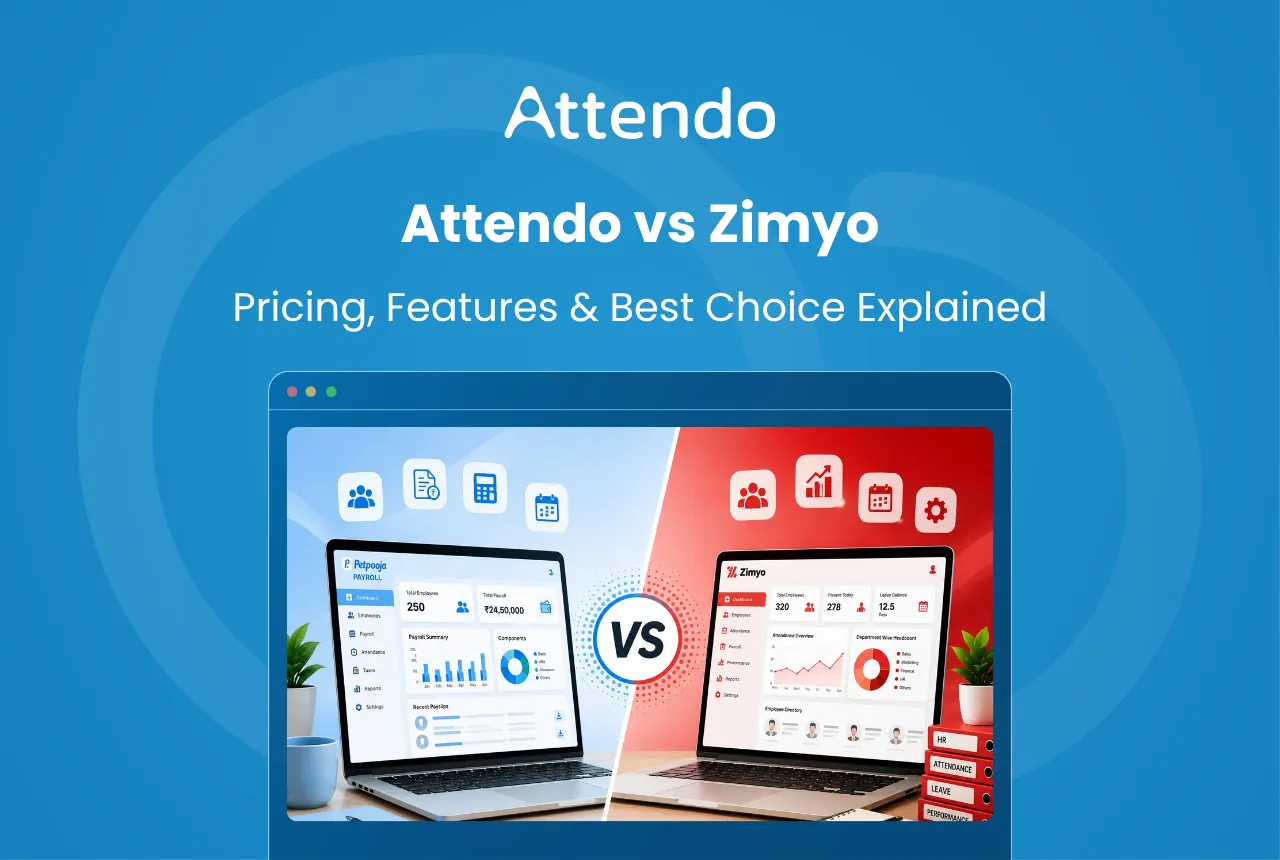
Attendo and Zimyo take different approaches. Attendo is a complete workforce management system for every kind of business, running attendance, shifts, leaves, approvals, payroll and statutory compliance in one place. It ships its own attendance hardware and charges a flat annual fee instead of per-employee pricing. Zimyo is a full HRMS platform that bundles payroll with performance reviews, recruitment, and employee engagement tools.
If what you need is reliable attendance capture tied directly to salary processing, without paying more every time you add staff, Attendo is the better fit. If your business needs a complete HR suite with hiring modules and OKR tracking, Zimyo is built for that.
Key Takeaways
- Attendo includes the attendance device, installation and support inside one flat annual fee, with no per-employee charge
- Attendo charges a flat annual fee; Zimyo charges per user per month
- Attendo includes an attendance device with a lifetime warranty; Zimyo supplies no hardware
- Attendo bundles the device, on-site installation, support and every software feature into one annual fee
Where Do Attendo and Zimyo Differ?
The short answer is hardware and billing. Attendo runs attendance through to payroll on one flat annual fee, with the device included and supported by the same company. Zimyo bills per user per month and leaves hardware to a separate supplier.
What Attendo offers
Attendo started from the other end of the problem. Instead of building outward from HR records, it built inward from attendance hardware. The device at your entrance records punch-ins. The software pulls that data into leave and overtime calculations, and the payroll engine processes salaries on top of it. The attendance to salary run sets out that pipeline step by step. No separate hardware vendor. No integration middleware. The system serves more than 40,000 businesses across manufacturing, corporate offices, retail, healthcare, logistics, education and hospitality.
What Zimyo offers
Zimyo positions itself as an end-to-end HR operating system. Its module list covers core HR records, onboarding, offboarding, helpdesk, asset tracking, performance reviews with 9-box matrices and bell curves, and a separate recruitment tool. Zimyo reports more than 2,500 customers on its own site.
Why This Matters for Indian Businesses
India’s HR technology market was valued at USD 1,208 million in 2025, according to IMARC Group. Much of that growth comes from businesses adopting cloud-based tools for the first time. Many of them run shift-based teams where attendance has to be captured at the workplace itself. A textile unit in Vastrapur or a diagnostic lab in Pimpri does not need a 9-box performance matrix. They need the attendance register and salary sheet to talk to each other without manual data entry on the 28th of every month.
Attendo vs Zimyo: Feature Comparison
| Feature | Attendo | Zimyo |
|---|---|---|
| Businesses served | 40,000+ | 2,500+ |
| Attendance hardware | One device included (fingerprint, fingerprint + card, or face recognition), lifetime warranty, on-site installation | No hardware supplied; third-party device integration |
| Payroll processing | Auto-calculated from attendance, leave, and overtime data | Auto-calculated with salary, compliance, arrears, and full & final |
| PF / ESI / TDS | Yes | Yes |
| Professional tax & LWF | Yes | Yes (Enterprise plan) |
| Flexible shift scheduling | Yes | Yes (Standard plan onward) |
| Geo-tagged mobile attendance | Yes | Selfie attendance (Standard plan onward) |
| Geo Tracking (live route tracking) | Yes (paid add-on) | No |
| Employee app languages | 11 Indian languages | Not stated publicly |
| Employee + admin mobile apps | Both included | Employee self-service app |
| Support | 24×7×365 | Not publicly disclosed |
What the table cannot show is how these modules behave in daily use. geo-tagged attendance and shift management are bundled into the single flat-fee subscription, with no tier to upgrade to. Zimyo groups several of its equivalents, including roster management, overtime and incentive rules and selfie attendance, under its higher tiers.
How Does Pricing Add Up Over 12 Months?
The gap comes from how each bill reacts to headcount. Attendo’s annual fee does not move when the team grows, while per-user billing rises with every seat, every month.
Flat annual fee (Attendo). One price for the software, unchanged by headcount, with no per-employee charges and no tier-based feature unlocking. The subscription includes an attendance device with a lifetime warranty, and the customer chooses which of the three. Talk to the Attendo team to work out which package and device suit the site.
Per-user billing (Zimyo). A charge for each user every month across tiered plans, with a minimum seat count, and recruitment and learning priced separately. Rates and minimums change, so check the current numbers on Zimyo’s pricing page rather than relying on a figure quoted in an article.
Take a 45-employee electronics store chain in Ahmedabad (an example). On per-user billing the software cost is charged against all 45 every month, and it rises again when the business hires 10 more staff for Diwali. On a flat annual fee the bill is the same whether the team is 45 or 55. Per-seat minimums matter too: a vendor with a 50-user floor charges a 45-person business for 50 seats.
Across the businesses running on Attendo, we see this pattern repeat in retail chains and quick-service restaurants, where headcount swings between lean and peak months. A per-head billing model penalises growth; a fixed subscription absorbs it.
Why Does Attendance Hardware Matter in This Comparison?
Because it decides who owns the accuracy of the data feeding payroll. Attendo supplies the device inside the subscription and supports it. Zimyo supplies none, so the business sources a device elsewhere and holds two supplier relationships.
Most payroll comparisons skip the question that comes before the software: how does attendance data get into the system in the first place?
Attendo’s approach
Attendo includes an attendance device with every subscription, and the customer picks which one. Biometric handles fingerprint. Biometric Pro adds an NFC card, and the Face Scanner covers face recognition. The device carries a lifetime warranty and connects to the software without third-party middleware. Face recognition also works where fingerprint scanners fail, like commercial kitchens with wet hands, or construction sites in Thane where dust coats everything by noon.
Zimyo’s approach
Zimyo does not manufacture or supply any attendance hardware. It connects with third-party biometric devices via API, which means the business sources the device separately and holds two supplier relationships instead of one. PF and ESI deductions depend on accurate attendance records, as outlined by EPFO. At a manufacturing unit running three shifts, whoever supplies the device also owns the accuracy of the data feeding payroll.
If your staff sit at office desks, the hardware question is less pressing. If they work on factory floors, behind retail counters, or in clinic reception areas, the device matters as much as the software. Our guide on face recognition attendance covers how devices perform across these settings.
Which Businesses Fit Which Product?
Attendo suits businesses running shift-based attendance that want one predictable software bill. Zimyo suits organisations building structured HR workflows. Here is the breakdown by business type.
Attendo fits better when:
- You want a cost you can budget once. A flat annual fee that does not move when you hire, so the payroll bill is the same at 40 staff as at 400
- You want one vendor, not two. The device and the software come from the same company, so there is no device supplier and software supplier pointing at each other when a punch goes missing
- You want room to grow on the hardware. One device covers up to 750 employees, or 3,000 on the Face Scanner, and extra branches simply get their own device. There is no software-side limit on headcount
- You want support that actually answers. 24×7×365, including weekends and salary-processing days, when a stuck punch has to be fixed before salaries go out
- You want an established Indian company behind it. Attendo is built by Petpooja, running since 2011 with a team of 1,800+, and 40,000+ businesses run on Attendo today
- Your workforce runs on rotating schedules. For example, a supermarket in Maninagar with morning, afternoon and night shifts needs overtime calculated from shift rules, not from manual timesheets
- You take on seasonal workers. For example, a catering operation in Pune adding 20 temporary hands in wedding season should not pay a per-head monthly fee for staff who leave in eight weeks
Zimyo fits better when:
- Your organisation needs structured HR workflows such as onboarding checklists, exit interviews and performance cycles
- You need a recruitment module to manage job postings and applicant pipelines
What Should You Watch When Switching Payroll Tools?
Migrating from one payroll system to another is where most businesses lose a month of clean data. Across the 40,000+ businesses on Attendo, these four steps prevent the most common migration errors:
- Export your historical attendance data before the old subscription expires. Once access lapses, retrieving six months of punch records becomes a support ticket that drags on for weeks
- Verify PF and ESI compliance settings in the new system against your latest challans before running the first salary cycle. Each tool stores statutory configurations differently
- Check the latest contribution rates on the Ministry of Labour and Employment portal. Rates change periodically, and your new tool must reflect the current figures from day one
- Start the switch on the 1st of a month. Running two systems in parallel for a split month creates duplicate entries and reconciliation headaches that take longer to fix than the migration itself
Conclusion
Attendo and Zimyo occupy different positions. Attendo is a complete workforce management system for every kind of business, with its own attendance hardware, flat pricing and 24×7×365 support. Zimyo is a broad HR platform where payroll is one module among many.
If your primary need is getting attendance and salaries right every month without per-employee fees eating into your budget, Attendo is the more practical choice. If you need a full HR operating system with performance management and recruitment, Zimyo covers that ground. The same trade-off runs through the Keka comparison, where the other side is also a broader platform.
Frequently Asked Questions
1. Is Attendo or Zimyo cheaper for a 30-employee business?
2. Does Zimyo include biometric attendance hardware?
3. Which tool works better for businesses with high employee turnover?
4. Does Attendo work for corporate offices, or only for retail and restaurants?
Related Articles You May Like
What a Day of Leave Without Pay Actually Costs
Leave without pay does more than dock a day’s salary. It reaches your provident fund, your ESI, the service behind a gratuity payment and the balance you build for the year ahead.
Ashwiniba Vaghela
HR & Payroll Experts
How to Complete the ESI Registration Process in 8 Steps
Registration is online, real time, and needs no paper at all. The state that wants 20 workers where its neighbour wants 10, what the C-11 letter proves, and why the amnesty no longer helps.
Ashwiniba Vaghela
HR & Payroll Experts
Expected CTC: 7 Ready-to-Use Answers for Your Next Interview
The question asks what you would cost, not what you would receive. Seven lines to use in an interview, the reasoning that backs each of them, and why the law measures a different figure from the one in an offer.
Avani Joshi
HR & Payroll Experts
How the ESIC Claim Process Works for Employees
One form per benefit, one office, and a three-day rule on medical certificates that quietly costs people money. What each claim pays, and how fast ESIC has to pay it.
Avani Joshi
HR & Payroll Experts