


Benefits of Payroll Software for Indian Businesses
Month-end payroll rarely fails loudly. It leaks hours into reconciliation and rupees into corrections, one cycle at a time.
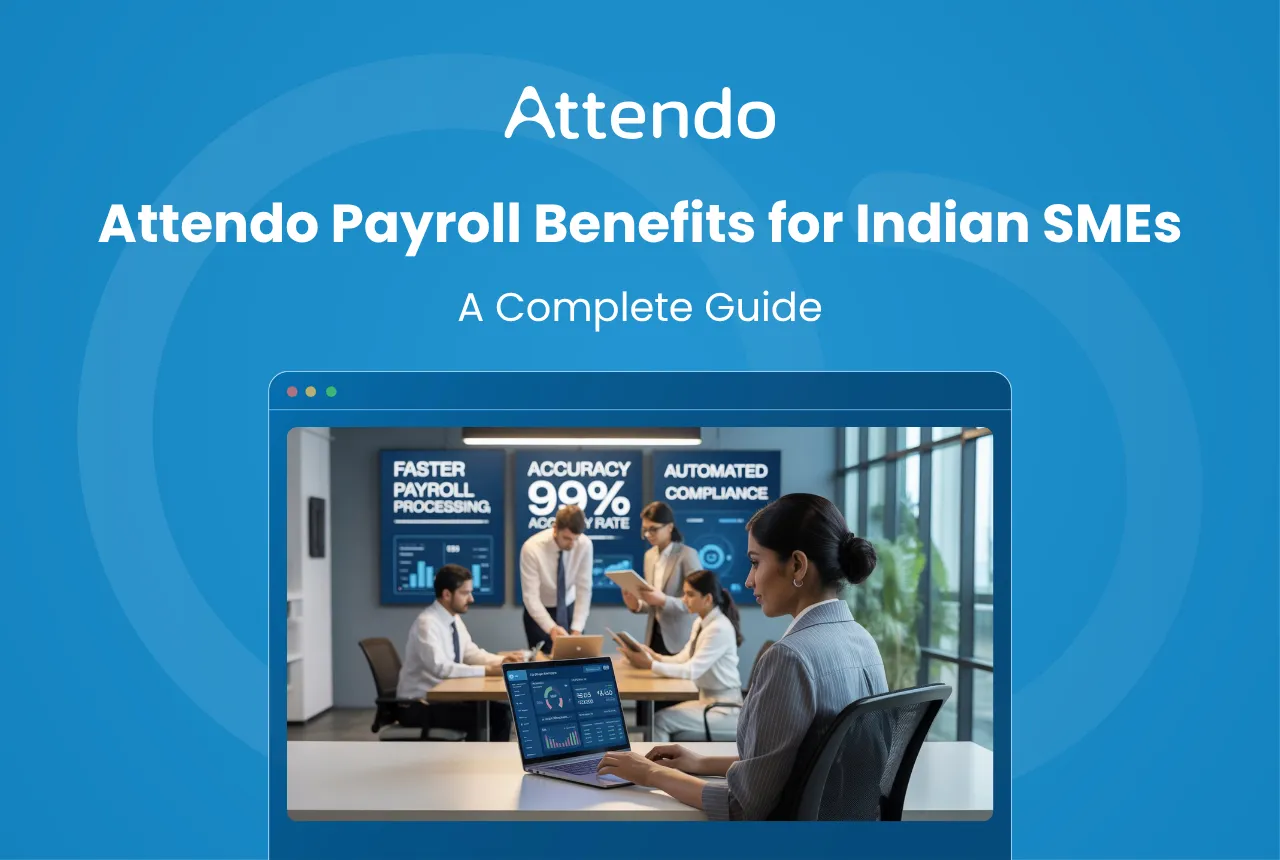
Ask any admin manager what the last week of the month looks like and you will hear the same shape of answer: attendance registers on one desk, a leave file on another, and a spreadsheet that somebody is afraid to touch. Payroll software exists to collapse that into one run.
The short answer on what it gets you: attendance that feeds salary without being retyped, statutory deductions calculated inside the same cycle, and a record you can defend when an employee or an inspector asks. This guide covers the benefits that hold up in practice, then names three tools worth shortlisting in India.
Key Takeaways
- Attendance capture at source removes the retyping step, which is where most salary errors begin
- PF, ESIC, Professional Tax, TDS and LWF are computed inside the payroll run rather than checked afterwards
- Late PF payments carry 12% annual interest under Section 7Q plus 1% damages for every month of default
- The deciding question between products is usually whether the attendance device is included or bought and integrated separately
- Three worth shortlisting: Attendo (formerly Petpooja Payroll) for bundled attendance hardware and flat pricing, greytHR for a desk-based HR suite, Keka for broader HR modules
Why Do Indian Businesses Move from Manual Payroll to Payroll Software?
Spreadsheets hold up at five employees. They stop holding up somewhere around twenty, and the reason is not the arithmetic. It is that attendance, leave and overtime live in three places, updated by three people, and somebody has to reconcile them under time pressure before salaries go out.
That pressure is why the category is growing. India’s HR technology market was valued at USD 1,208.26 Million in 2025 and is projected to reach USD 2,329.11 Million by 2034, a 7.56% compound annual growth rate (IMARC Group). Attendance hardware is moving with it, with India’s biometric system market forecast to grow at more than 17.57% a year between 2026 and 2031 (Bonafide Research).
| Payroll activity | Done manually | Done in payroll software |
|---|---|---|
| Attendance capture | Registers or spreadsheets | Biometric, face scanner or mobile punch |
| Salary calculation | Formulas maintained by hand | Calculated from recorded attendance |
| Attendance visibility | End-of-day checks, if any | Visible during the month |
| Payroll records | Scattered across files and inboxes | Held in one place |
| Statutory deductions | Rechecked against circulars | Applied inside the pay run |
| Reporting | Compiled by hand each time | Exported from the system |
What Does Manual Payroll Actually Cost You?
Very little of it shows up as a single visible loss. It shows up as hours in reconciliation, small corrections carried into the next cycle, and the goodwill spent explaining a payslip somebody does not trust.
There is no reliable published figure for what manual payroll costs Indian businesses specifically, so treat the shape of the problem rather than a percentage as the useful guide. It breaks in three predictable places.
Payroll Errors That Reach the Salary Slip
If an attendance entry is corrected after the register has been totalled, the month’s salary will not match the days actually worked. On a ₹38,500 monthly salary across a 30-day month, a single misrecorded day is about ₹1,283 in the wrong direction. Across a 40-person fabrication unit in Rajkot, a handful of those becomes a visible correction line in the next cycle.
Attendance Gaps Nobody Catches in Time
A paper register cannot prove when somebody arrived. Entries get filled in at the end of the week, sometimes by a supervisor working from memory, and a late arrival quietly becomes a full day. The gap only surfaces once the salary has been paid, which is the point at which it costs the most to fix.
Salary Disputes That Drain Admin Hours
Incomplete records turn into questions. Why was I marked absent on the 14th, where is my overtime for the second shift, why is this month lower than last. Without a verifiable trail somebody spends an afternoon in old registers instead of resolving the query, and the same conversation repeats the following month.
We have set the two approaches side by side, cost and effort included, in our post on running payroll on software against doing it by hand.
How Does Payroll Software Reduce Manual Work?
The saving comes from one structural change: attendance is captured where it happens, so there is no transcription step between the entrance and the salary sheet. Everything downstream inherits that.
- Punches arrive from a biometric device, face scanner or geo-tagged mobile app without re-entry
- Approved leave updates the pay record as it is approved, not at month-end
- Salary structures, basic, HRA and allowances, are configured once and reused each cycle
- Overtime rules and shift buffers apply the same way for every employee on that shift
- Month-end becomes a review and approval step rather than a rebuild
The month-end saving is the visible part. The larger one is that the record was never broken during the month, so there is nothing to reconstruct. Attendo’s own figure for what this returns is more than 40 hours a month per business.
Does Payroll Software Improve Salary Accuracy?
It removes the two most common sources of error, which are transcription and omission. When the days worked are already recorded, the calculation is arithmetic rather than reconstruction.
| Item | Value |
|---|---|
| Monthly salary | ₹38,500 |
| Days in the month | 30 |
| Days present | 27 |
| Payable salary | (27 ÷ 30) × ₹38,500 = ₹34,650 |
If you want to run the same sum against your own figures, our salary per day calculator does the daily and hourly split.
Overtime, half-days and approved leave apply before that figure is finalised. Statutory deductions run in the same cycle, which matters more than convenience suggests. Employers who delay PF contributions pay 12% annual interest under Section 7Q, plus damages of 1% of the arrears for every month of default. EPFO moved to that flat monthly rate on 14 June 2024, replacing a slab that ran from 5% to 25% a year depending on how long the default had lasted, and removing the 25% ceiling along with it (EPFO). A default that runs long enough is therefore no longer capped.
The employee-facing half matters too. When staff can see their own attendance before payday, the disputed-payslip conversation mostly stops happening, because the disagreement surfaces while it can still be corrected.
Which Business Types Benefit Most from Payroll Software?
The benefit scales with how directly attendance drives pay. Where everyone is salaried and desk-based, the gain is mostly compliance and record-keeping. Where shifts, sites or hourly wages are involved, it is the whole month.
- Manufacturing. Two or three shifts, overtime buffers and a gate that everyone passes through. A fabrication unit in Rajkot or a textile mill in Tiruppur gets shift-wise calculation without anyone sorting punches by hand
- Corporate offices and IT services. Largely a compliance and audit case: PF, Professional Tax and TDS applied consistently, with a record that survives a review
- Retail. Rotating schedules across outlets, where an owner needs one view rather than a call to each store manager
- Healthcare. A diagnostic lab chain in Pune running early and late collection rounds, where half-days and overtime are routine rather than exceptional
- Hospitality. Seasonal hiring and high turnover, where paying for a no-show or missing an overtime claim both happen easily
What Should You Look for in Payroll Software?
Before comparing names, it helps to know which five things actually separate these products. Most feature lists look identical until you press on these.
- Where attendance comes from. Does the vendor supply the device, or do you buy a biometric machine separately and integrate it? This is the single biggest practical difference, and it decides whether you have one support contract or two
- How the price moves as you hire. A flat annual fee and a per-employee rate behave very differently at 40 employees than at 400. Seasonal hiring makes the gap wider
- What sits behind a higher tier. Attendance, geo-fencing and overtime rules are standard in some products and a tier upgrade in others. Check where your must-haves sit
- Who handles statutory changes. PF, ESIC, Professional Tax, TDS and LWF all move. Either the product tracks the change or somebody in your office has to notice it
- When support answers. Payroll gets processed at night and at month-end. Business-hours support is fine until the one evening it is not
Those five are the lens for the three below. A quick note on how we checked them: pricing models come from each vendor’s own published pricing page rather than a review aggregator, because aggregator figures for this category disagree with the vendors and with each other. Where a vendor changes rates often, we describe the model rather than quote a number that will age badly.
Which Payroll Software Should Indian Businesses Consider?
Three are worth shortlisting, and they are genuinely different products rather than three versions of the same one. The right pick depends on whether your problem is attendance capture or HR administration.
| Criteria | Attendo | greytHR | Keka |
|---|---|---|---|
| Attendance hardware | Included with the subscription | Bought and integrated separately | Bought and integrated separately |
| Pricing model | Flat annual fee, no per-employee charge | Monthly base fee plus a per-employee rate above the included seats | Tiered plans, base fee plus per-employee charges above a seat threshold |
| Strongest fit | Shift, site and hourly-wage operations | Desk-based teams needing an HR suite | Businesses wanting hiring and performance modules |
| Support | 24×7×365 | Standard business hours | Not publicly disclosed |
1. Attendo
Attendo is a complete workforce management system for every kind of business, running attendance, shifts, leaves, approvals, payroll and statutory compliance in one place. It is built by Petpooja, which has been serving Indian businesses since 2011, and more than 40,000 businesses run on it.
The structural difference is that the attendance device comes with the subscription, with a lifetime warranty and installation included, so there is no second vendor between the punch and the payslip. Pricing is a flat annual fee with no per-employee charge, which means the software bill does not move as you hire. Support runs 24×7×365, including the nights when payroll is actually being processed. Our post on face recognition attendance covers the hardware side.
Best for: manufacturing, retail, healthcare, hospitality and any operation where attendance decides pay, at any headcount.
2. greytHR
greytHR is an established Indian HR and payroll platform, strongest with desk-based teams that want employee self-service, leave workflows and payroll in one portal. It publishes tiered plans on its own pricing page, charged as a monthly base fee covering a set number of employees with a per-employee rate above that.
It does not include attendance hardware, so a biometric device is bought and integrated separately. For a small desk-based office that is often not a problem. For a shift operation it means two vendors. We compare the two in detail in our Attendo and greytHR comparison.
Best for: corporate offices and HR-led organisations.
3. Keka
Keka is a broader HR platform where payroll sits alongside performance reviews, goal tracking, hiring and learning modules. Which of those you get depends on the plan, and add-ons are priced separately. It prices tiered plans as a base fee with per-employee charges above a seat threshold; rates change, so check Keka’s pricing page for current figures.
If performance management and hiring are genuinely part of the brief, that breadth is the reason to pick it. If the actual problem is getting attendance into salary correctly, most of the platform goes unused. Our Attendo and Keka comparison sets the two side by side.
Best for: businesses buying an HR suite, not an attendance system.
Which One Fits Your Business?
Three questions usually settle it, and they are worth answering before you sit through any demo.
- Does attendance decide what people get paid? If shifts, overtime or hourly wages drive the payslip, the attendance device matters more than the HR modules. That points to a bundled system
- Will your headcount move a lot this year? Seasonal hiring and high turnover punish per-employee billing, because the bill moves every time the team does. A flat fee does not
- Is anyone going to use the HR modules? Performance reviews and hiring tools are worth paying for when somebody owns them. Without an HR team, they usually go unopened
There is no single best product here, which is why all three are on the list. A 60-person diagnostic lab chain and a 60-person software firm should end up with different answers.
When Should Your Business Switch to Payroll Software?
Not every business needs it on day one. A five-person team manages on a spreadsheet without much pain. These are the signals that the spreadsheet has stopped working:
- Headcount has crossed roughly 15 to 20 and tracking has become somebody’s weekly job
- You run more than one shift, or schedules differ between employees
- You are correcting the previous month’s salary during the current month
- You operate from more than one branch and consolidate records by phone or WhatsApp
- A PF or ESIC filing has been late, or you are not certain it was right
If you are weighing the cost side specifically, our post on flat versus per-employee pricing covers how the two models behave as a team grows.
Conclusion
The benefit of payroll software is not that it calculates faster. It is that the data was correct before the calculation started, because attendance was captured at the door rather than copied from a register a fortnight later. Statutory deductions follow the same logic: applied during the run, not verified after it.
Shortlist against your actual problem. If attendance drives pay and you want the device, the software and the support from one vendor, see what Attendo includes. If you need an HR suite for a desk-based team, greytHR and Keka are the stronger fits. All three are worth a demo before you commit.
Frequently Asked Questions
Which benefit of payroll software shows up first?
Is payroll software worth it for a business with 20 employees?
Does payroll software handle PF and ESIC automatically?
Do I need a biometric device to use payroll software?
Which payroll software is best for a manufacturing unit?
Related Articles You May Like
What a Day of Leave Without Pay Actually Costs
Leave without pay does more than dock a day’s salary. It reaches your provident fund, your ESI, the service behind a gratuity payment and the balance you build for the year ahead.
Ashwiniba Vaghela
HR & Payroll Experts
How to Complete the ESI Registration Process in 8 Steps
Registration is online, real time, and needs no paper at all. The state that wants 20 workers where its neighbour wants 10, what the C-11 letter proves, and why the amnesty no longer helps.
Ashwiniba Vaghela
HR & Payroll Experts
Expected CTC: 7 Ready-to-Use Answers for Your Next Interview
The question asks what you would cost, not what you would receive. Seven lines to use in an interview, the reasoning that backs each of them, and why the law measures a different figure from the one in an offer.
Avani Joshi
HR & Payroll Experts
How the ESIC Claim Process Works for Employees
One form per benefit, one office, and a three-day rule on medical certificates that quietly costs people money. What each claim pays, and how fast ESIC has to pay it.
Avani Joshi
HR & Payroll Experts