


6 Stipend vs Salary Differences Every Employer Should Know
What separates a stipend from a salary, the new minimum for apprentices, and the checks to run before paying interns.
Listen to this article
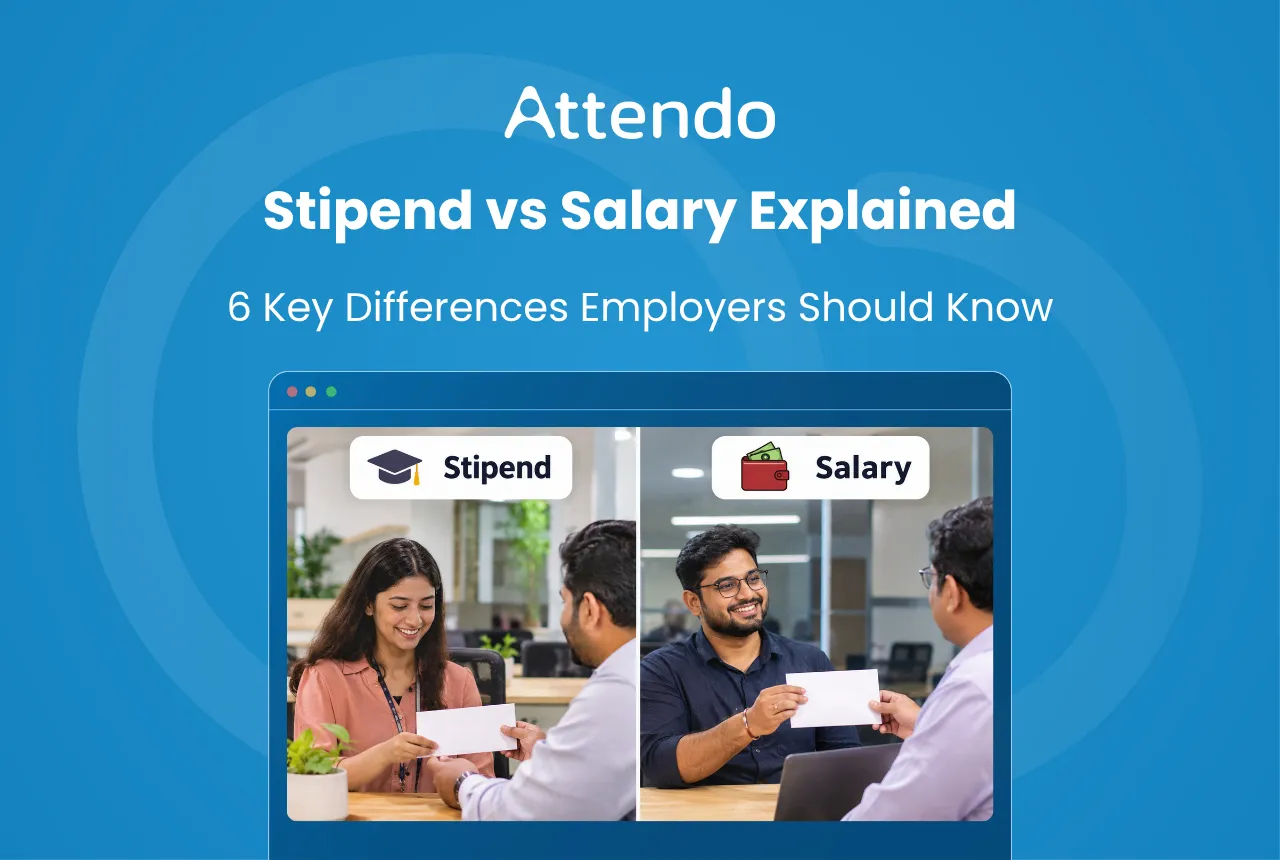
When an owner or human resources (HR) team hires its first interns or apprentices, the stipend vs salary question decides what goes into payroll. A stipend is a fixed amount paid while someone learns; a salary is pay for work done by an employee.
In Indian labour law, the word on the letter matters less than how the person was taken on.
Below are the 6 differences between a stipend and a salary that matter to an employer, the apprentice stipend rates in force since September 2025, and a checklist for interns. In my view, the hiring route should be settled before the offer letter goes out.
Key Takeaways
- A stipend supports learning, and a salary pays for work. The legal line is whether the person signed a contract of apprenticeship.
- An intern hired to do paid work is an employee, whatever the payment is called, so minimum wages, Provident Fund (PF) and Employees’ State Insurance (ESI) follow the usual tests.
- Apprentice stipends have their own legal minimum, which rose for every category in September 2025.
- Apprentices stay off piece rates and compulsory bonus schemes, but they keep injury cover.
Latest Update on Apprentice Stipends
Since 11 September 2025, the minimum apprentice stipend runs from ₹6,800 to ₹12,300 a month, up from ₹5,000 to ₹9,000. The Central Apprenticeship Council had recommended the rise in May 2025.
Stipend vs Salary: 6 Key Differences
Here is how a stipend and a salary differ for an employer, row by row:
| Difference | Stipend | Salary |
|---|---|---|
| 1. Purpose | Supports learning during training | Pays for work done |
| 2. Who receives it | Apprentices under the Apprentices Act | Employees, including interns hired to do paid work |
| 3. The law behind it | Apprentices Act, 1961, for apprentices | Code on Wages, 2019 |
| 4. Minimum amount | ₹6,800 to ₹12,300 a month for apprentices | Minimum wages set by the government |
| 5. PF and ESI | Not for apprentices under the Act | Yes, on the usual tests |
| 6. Piece rate and incentive schemes | No piece rate, and apprentices cannot be required to join an incentive scheme | Allowed, within minimum wage rules |
The stipend column applies only to apprentices engaged under the Apprentices Act. An intern hired directly to do paid work sits in the salary column for every row.
Keeping these two kinds of pay apart is a payroll setup job as much as a legal one.
Attendo (formerly Petpooja Payroll) is a complete workforce management system for every kind of business, running attendance, shifts, leaves, payroll and statutory filings in one place. Attendo has more than 40,000 users today. It is Software By Petpooja, building helpful products for Indian businesses since 2011.
1. Purpose: Learning vs Work
A stipend exists to support someone while they learn a trade or skill, so the training comes first and the output second. Salaried work is paid for because the business needs it done, and the employee is expected to deliver it every month, like any other member of staff.
On a bank statement the two can look the same. A diagnostic lab in Chennai may pay a trainee technician and a junior technician the same amount, and only a contract of apprenticeship under the Apprentices Act makes one of them a stipend.
2. Who Receives a Stipend vs a Salary
In law, a stipend belongs to an apprentice engaged under the Apprentices Act, 1961, through a contract of apprenticeship. Interns and freshers hired to do paid work receive wages, even if the offer letter calls the amount a stipend.
So the same monthly amount can be a stipend for one person and a salary for another in the same office. Settle the route for every new joiner before the offer letter goes out, because payroll rules follow the route, not the job title.
3. The Law: Apprentices Act vs Code on Wages
A stipend is governed by the Apprentices Act, 1961 and the Apprenticeship Rules, 1992, which set the minimum rate, the payment date and injury cover. A salary is governed by the Code on Wages, 2019 and the other labour codes now in force.
This is why an apprentice’s pay is checked against the stipend table, while an employee’s pay is checked against state minimum wages. Checking an apprentice against minimum wages, or an intern against the stipend table, is an easy slip when a business takes both in the same season.
4. Minimum Amount: Stipend vs Minimum Wages
Apprentices have a minimum stipend set by their education, shown in the rate table further down, and an employer may always pay more. Employees have minimum wages, which the central and state governments set by skill level and many states revise during the year.
Check the right floor before you fix the amount. A stipend that is legal for a class 12 apprentice can be lower than the minimum wage for a semi-skilled employee in the same state, so the route decides which number you must meet.
5. PF and ESI: Stipend vs Salary
An apprentice engaged under the Apprentices Act sits outside the definition of employee in the Code on Social Security, 2020, so Provident Fund and Employees’ State Insurance do not apply to the stipend. A salaried employee is covered on the usual tests of headcount and pay.
An intern hired directly to do paid work is tested the same way as any other employee. Their pay goes through the same PF and ESI settings as the rest of the payroll from the first month, not from the day they are made permanent.
6. Piece Rate and Incentives: Stipend vs Salary
Section 13(2) of the Apprentices Act bars paying an apprentice on piece work and bars requiring them to join an output bonus or other incentive scheme. An employer can still pay an apprentice more than the minimum stipend.
Salaried employees can earn piece rates or incentives, as long as their total pay meets minimum wages. A supermarket chain can run a sales incentive for its shop-floor staff, but it cannot pay its apprentices by piece rate or make them join that scheme.
Salary vs Stipend: The Legal Test
What the Code on Wages Says About Pay
Section 2(y) of the Code on Wages, 2019 defines wages as all pay “whether by way of salaries, allowances or otherwise”. The word stipend does not appear in any of the four labour codes, so renaming pay does not take it out of wages.
So a business that pays interns, or any trainee who is not an apprentice, a fixed monthly amount cannot change the rules with a label. Whatever the letter calls it, that pay is tested against minimum wages like any other wage.
The Apprentice Carve-Out
Both codes then carve out apprentices. Section 2(k) of the Code on Wages and section 2(26) of the Code on Social Security, 2020 leave “an apprentice engaged under the Apprentices Act, 1961” out of the definition of employee. There is no such carve-out for interns.
So the one question to ask about anyone on a stipend is whether a contract of apprenticeship exists. If it does not, treat the person as an employee on wages, with the same payroll rules as the rest of your staff.
In Simple Words
The law does not care what you call the money. It asks how you hired the person. An apprentice gets a stipend. Anyone else who works for pay gets wages.
Stipend for Interns vs Salary: HR Checks
When an Intern Counts as an Employee
Interns are where most businesses get this wrong. Take an IT services firm in Pune that pays summer interns a stipend but signs no contract of apprenticeship. If the interns do real work for that pay, the codes treat them as employees and the pay as wages.
A coaching institute in Indore or a hotel in Jaipur faces the same test. Section 2(k) of the Code on Wages covers anyone employed to do work “for hire or reward”, so an intern doing real work for pay is an employee.
5 Checks Before Paying a Stipend for Interns
These checks keep the stipend for interns on the right side of the law. Run them before the first payment, because fixing a minimum wage gap later means paying the shortfall for every month already paid, along with any PF and ESI that was missed.
- Write down the route for each intern: a contract of apprenticeship, a college placement for credit, or a direct hire.
- Check the pay against the right minimum. A direct hire doing real work is tested against the minimum wages for that state.
- Apply PF and ESI on the usual tests for interns who count as employees, including the ESI salary limit.
- Give a written letter that states the duration, the hours and the amount, like an appointment letter.
- Review college placements on their own: an unpaid placement for academic credit may fall outside that definition, so record what the intern will actually do.
Keep the signed letter and the payment records together for each intern. If the internship turns into a job, the same file shows the dates, the route and what they were paid in each month of the internship, which helps if a question comes up later.
Pro Tip
I’d suggest writing the route on every offer in one plain line, such as “This is an apprenticeship under the 1961 Apprentices Act” or “This is employment on wages”. A letter that only says “stipend” leaves the route open to argument later.
Stipend vs Salary Rules for Apprentices
For a person engaged under a contract of apprenticeship, the Apprentices Act, 1961 sets its own rules on the amount, how it is paid and what happens if the apprentice is hurt. Each one differs from the rules for a salary.
Minimum Stipend Rates From September 2025
Section 13(1) of the Act says the stipend cannot be less than the prescribed minimum rate. The table below shows those minimums by the apprentice’s education, as set by gazette notification G.S.R. 610(E) and the Skill Development Ministry’s circular on stipend rates. An employer may always pay more.
Apprentices already in training on 11 September 2025 also moved to the new rate that day, according to the same circular. Check which category each apprentice falls into, as the rate depends on their education, not on the job.
| Category | Old rate | From 11 September 2025 |
|---|---|---|
| School pass-outs, class 5 to 9 | ₹5,000 | ₹6,800 |
| School pass-outs, class 10 | ₹6,000 | ₹8,200 |
| School pass-outs, class 12 | ₹7,000 | ₹9,600 |
| National or State Certificate holder | ₹7,000 | ₹9,600 |
| Technician (vocational) apprentice, vocational certificate holder, or sandwich course student from a diploma institution | ₹7,000 | ₹9,600 |
| Technician apprentice, diploma holder, or sandwich course student from a degree institution | ₹8,000 | ₹10,900 |
| Graduate or degree apprentice | ₹9,000 | ₹12,300 |
A fabrication unit in Ahmedabad with a class 12 apprentice on the old ₹7,000 rate must now pay at least ₹9,600 a month. Under the circular, it also owes the shortfall for any month since 11 September 2025 paid at the old rate.
Stipend vs Salary Payment Dates
Rule 11(3) of the Apprenticeship Rules, 1992 says each month’s stipend is paid by the 10th of the next month. It must go into the apprentice’s own bank account. Paying in cash, or after the 10th, does not meet that rule. Keep each bank transfer record as proof.
A salary follows a different clock. Under section 17 of the Code on Wages, monthly wages are due by the seventh day of the next month, so apprentices and salaried staff in the same payroll can have different deadlines.
Injury Cover: Apprentices vs Employees
Section 18 says an apprentice in a designated trade is a trainee, not a worker, so general labour laws, including the usual injury rules for employees, do not reach them. Its opening words, “save as otherwise provided in this Act”, keep the Act’s own rules in force.
Section 16 is one of those rules. If an apprentice is hurt in an accident during training, the employer must pay compensation. It is worked out under the employees’ compensation law, with the stipend counted as wages.
This matters because apprentices sit outside ESI, which gives injury cover to employees earning within the ESI salary limit. Employees above that limit fall under the employee’s compensation chapter of the Code on Social Security; for an apprentice, section 16 is the cover.
Stipend vs Salary in Attendo
Attendo processes payroll by Payroll Group, a set of employees who share the same rules for attendance, compliance, salary structure and pay frequency. Payroll Group is the setting’s name on screen.
Apprentices can sit in a group with statutory deductions switched off, like the ready-made Monthly Payroll (No Compliance) group on screen, while salaried staff stay in one with PF and ESI on. Each group is finalised separately.
If you want stipends and salaries to run on their own rules, attendohr.com shows how it works.
Salary vs Stipend: The Short Answer
Not when it is paid to an apprentice under a contract of apprenticeship: then it is a stipend, with its own minimum of ₹6,800 to ₹12,300 a month.
Paid to anyone else who works for you, it is wages, whatever the letter calls it.
Settle the route before the offer, check the minimum pay, and use the labour codes readiness checklist to review your hiring letters. For owners and HR teams who want trainees and staff on separate payroll rules, see how Attendo handles them.
Frequently Asked Questions
1. What is a stipend?
2. Is a stipend given per month?
3. Does a stipend attract PF and ESI?
4. Do minimum wages apply to a stipend?
5. Can an apprentice get an incentive on top of the stipend?
6. What happens when an internship ends?
Listen to this article
Related Articles You May Like

6 Rules for Paying Salary in Cash, With a Cash Salary Slip Format
How to pay staff in cash without trouble: the legal rules, a Form V based slip, a voucher, a certificate and the books.
Avani Joshi
HR & Payroll Experts
8 Advance Salary Policy Rules (+ Template and Request Format)
Eight rules for advance salary, a copy-paste policy template and ready request formats, with the legal limit on recovering it from pay.
Ashwiniba Vaghela
HR & Payroll Experts

4 New Labour Codes Explained, and What Each Changes at Work
The Code on Wages, IR Code, Social Security Code and OSH Code replaced 29 labour laws in November 2025. Here is what each changes for salary, hours, leave and gratuity.
Ashwiniba Vaghela
HR & Payroll Experts
6 RazorpayX Payroll Alternatives I’d Shortlist in 2026
RazorpayX Payroll’s published pricing, and six payroll tools compared on how attendance reaches the payslip.
Nisarg
Nisarg Kansara is Senior Marketing Manager at Petpooja. What he brings to table is the tactical layer, meaning the features most users never find, the automations that remove a daily chore, and the exact fix for a workflow that keeps breaking. He spends his weeks with Indian business owners working out where billing, purchase entries and task follow-ups fall apart in practice, and that input shapes how the products change. India has over 1.5 crore active GST registrations, and most of those businesses still handle compliance by hand. Nisarg writes for the owners trying to change that, with a focus on where AI removes manual work rather than adding another button.