


40 Employee Engagement Activities Your Team Will Enjoy
From a two-minute win round to a family day: free and low-cost ideas, and how HR can run them every month.
Listen to this article
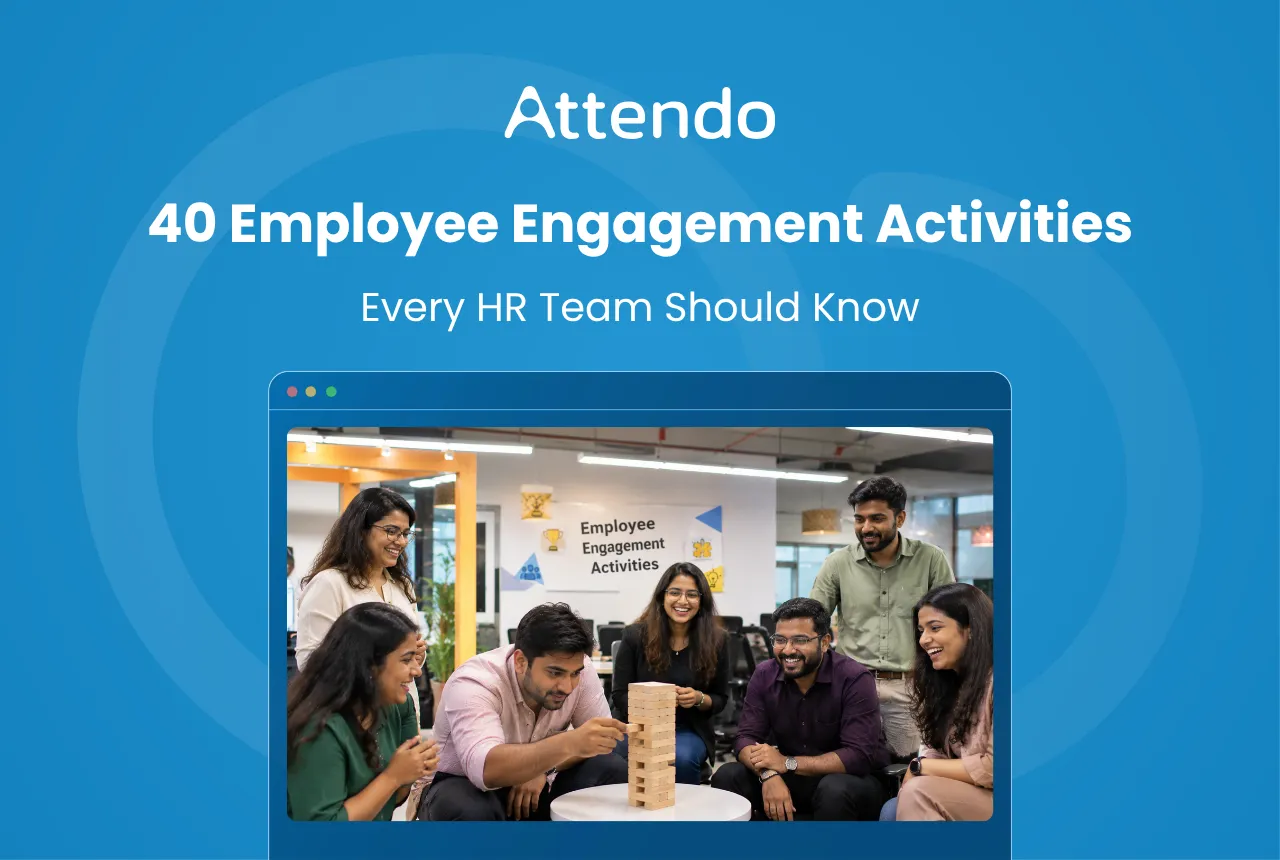
Employee engagement activities are the small, regular things that make people glad to come to work: a win round in Monday’s meeting, a festival lunch, a thank-you from the owner.
Here are 40 of them, from free ideas to low-cost events, for offices, shop floors, shift teams and remote staff.
In my view, one free activity done every month does more for a team than one big party a year.
Key Takeaways
- The best employee engagement activities are simple and regular: a weekly win round, a shout-out board, a team breakfast and festival celebrations.
- Many cost nothing. At least 12 of the 40 ideas here need no budget at all.
- Include every shift. Factory, hospital and store teams need ideas that fit a shift change, not only office hours.
- Keep them voluntary and within working hours, so they feel like a reward, not extra work.
Employee Engagement Activities Compared
Here is how the 40 ideas compare on cost and time:
| Type | Examples | Cost | Time needed |
|---|---|---|---|
| Free | Win round, shout-out board, skill swap | Nothing | 5 to 60 minutes |
| Low-cost | Team breakfast, yoga, festival lunch | Small budget | Five minutes to an afternoon |
| Shift teams | Shift-change huddle, night-shift tea | Nothing to small | 5 minutes to an hour |
| Remote teams | Virtual coffee pairs, online quiz | Nothing to small | 15 minutes to a day |
| Rewards | Employee of the month, thank-you notes | Nothing to moderate | Ongoing |
Of the 40 ideas, 12 are free, 12 are low-cost, 6 suit shift teams, 5 suit remote teams and 5 are rewards.
Run a quick poll on the next idea, then pick one free activity, such as a win round or a skill swap, and one low-cost event, such as a breakfast or a festival lunch.
End the month on a thank-you: name an employee of the month. Repeat every month, and include every shift. Plan the dates around your holidays with a holiday calendar generator.
What to Watch
Diwali falls on Sunday, 8 November 2026, per the central government holiday list, so plan the festival lunch or decoration for a working day that week.
Free Employee Engagement Activities
These ideas need time and goodwill, not money. Most take under an hour and work in an office, a store or a factory.
1. A Two-Minute Win Round
Start the weekly team meeting by asking each person to share one thing that went well, such as a closed sale, a fixed machine or a happy customer. Go round quickly, so the whole round takes about two minutes, even in a team of ten.
Let people pass if they have nothing to share, and keep the manager’s own win for last. In a store or a clinic, run it at the morning briefing instead, standing at the counter for a couple of minutes before the doors open.
2. A Shout-Out Board
Put up a board near the entrance, or use the team WhatsApp group, where anyone can thank a colleague by name for something specific. A note that says who helped and how takes under a minute, and it can be written in any language the team uses.
Read out three or four shout-outs at the next team huddle, so the thanks are heard as well as seen. Clear the board each month but keep the notes, because they are useful reminders of each person’s work when appraisals come round.
3. Lunch-and-Learn Talks
Once a month, one employee teaches a skill, from a Tally shortcut to a safety habit, in a 20-minute session on paid time, right after lunch. Book a meeting room or a corner of the canteen, and share the topic a week ahead.
Offer tea or snacks if you have the budget, and let the speaker choose the topic. Others learn something useful, the person teaching is recognised for what they know, and you find out who could later train new joiners.
4. Walking One-to-Ones
Hold one-to-one meetings on a short walk outside the office, around the factory compound or to a nearby tea stall. Fifteen to twenty minutes is enough, and talk often comes more easily side by side than across a desk.
Keep the walk on a safe route, in the shade during summer, and offer a normal sit-down meeting to anyone who prefers one. Note any action you agree as soon as you are back, so the employee sees the talk lead somewhere.
5. A Skill Swap
Pair two people who can teach each other, such as one who knows Excel and one who wants to practise English, or a billing clerk and a store supervisor. Each pair meets for half an hour a week in working hours, for a month.
Let people choose their own partner where they can, and invite each pair to show one thing they learned at the end of the month. It costs nothing, and it often brings out skills that a manager did not know the team had.
6. Birthday and Work Anniversary Wishes
Ask each employee once, not only new joiners, whether they want their birthday shared, because some would rather keep the date private. Then mention birthdays and work anniversaries in the morning huddle or the team group, with a short wish by name.
For a work anniversary, add one line on what the person did in the past year. Keep a simple list of dates so no one is missed, including people on night shifts, and if a date falls on a weekly off, send the wish on the next working day.
7. A Suggestion Box That Acts
Collect ideas from staff through a box, a form or a group message, and promise to act on at least one each month. A suggestion box that is never opened tells people their ideas do not matter, which is worse than having none.
Announce which idea was picked, whose it was and what will change, even if it is small, like a new water cooler or a moved break time. Reply to the ideas you cannot use as well, with the reason, so people keep sending them.
8. Reverse Mentoring
Let a younger employee show a senior manager how to use a new app, a phone feature or a social media page, over a few short sessions. The usual direction of teaching is flipped, and both people see the other in a new light.
Keep the sessions private and relaxed, so the senior person feels free to ask basic questions. The younger employee, in turn, gets time with someone senior they would rarely have a chance to speak to, and often shares ideas the manager had not heard.
9. A Quiz Hour
Run an hour-long quiz on general knowledge, cricket, films, the company or your own products, with teams of four. Mix departments in each team, so people from accounts and the shop floor get to work together for once.
Keep the questions fair for everyone, in the languages your team speaks, and avoid topics that need a degree to answer. A small prize, such as a box of chocolates or a certificate for each winner, is more than enough.
10. A State Food and Culture Day
Invite staff to bring a dish or wear clothes from their home state on a chosen day, if they wish. It suits teams that come from many parts of India, such as an IT services firm in Bengaluru or a hospital in Chennai.
Keep it fully optional, and label each dish with its main ingredients, including nuts, egg and meat, so everyone can choose by faith, diet or allergy. A short talk from two or three people about their state’s festivals adds to the day.
11. An Open Hour With the Owner
Once a month, the owner or a senior manager sits in an open room for an hour and answers any question from staff, about pay, plans or problems. Honest answers, including “I do not know yet”, build more trust over time than polished ones.
Let people send questions in advance without their names, for those who will not ask aloud. For formal complaints, a grievance redressal policy gives staff a proper route outside the open hour, with a written record.
12. A Desk or Work-Area Makeover
Give each team an hour to tidy and personalise its space, with plants from home, photos or a fresh notice board. Use what people already have, so it costs nothing, and a neat counter or tool rack is simply nicer to work at.
Agree the safety rules first on shop floors and in hospitals, where nothing should block an exit, a machine or a corridor. A before-and-after photo of each team’s space, shared on the shout-out board, adds a little friendly rivalry.
Low-Cost Employee Engagement Activities
These fun employee engagement activities need a small budget from the company. Plan one or two a month, around festivals and quieter weeks, so people have something to look forward to.
13. A Monthly Team Breakfast
Order breakfast for everyone on the first working day of the month, such as idli, poha or sandwiches from a local caterer. Serve it in the first half hour of the working day, so people eat together rather than alone at their desks.
Rotate the menu so different tastes get a turn, and keep vegetarian options for everyone. Where the business runs shifts, set out the same breakfast at the start of each later shift, including the night shift, so no team misses out.
14. Festival Celebrations for Every Faith
Mark Diwali, Eid, Christmas, Pongal, Onam, Baisakhi and the other festivals your team celebrates, with a lunch, sweets or a small decoration. Plan the year’s list in January, so no faith is left out and the budget is clear.
Hold each celebration on a working day close to the festival, because many festivals fall on holidays or weekends. Holidays also differ by state, and this festival holiday list shows which days are off in each state.
15. An Indoor Games Tournament
Run a carrom, chess or table tennis tournament over a few quiet afternoons, in 20-minute matches during working hours. Put the draw on the notice board, so everyone can follow the results, and give the winner a small trophy.
A tournament is easy to join, whatever a person’s job or age, which makes it one of the simplest team building activities for employee engagement. Add a doubles category, so beginners can play alongside someone with more experience.
16. A Yoga or Stretch Session
Invite a trainer for a short yoga or stretch session at the start of the working day, once a week, in a meeting room or open space. Keep the moves gentle, so most people can join in their work clothes, and repeat the session for the night shift.
Or try the Ministry of Ayush’s Y-Break yoga protocol, a five-minute routine made for the workplace. Anyone should be free to skip it without giving a reason, and a chair-based version suits those who prefer to stay seated.
17. A Health Check-Up Camp
Tie up with a local diagnostic lab for a morning of basic tests at the office or factory, such as blood pressure, sugar and eye checks. Share the date a week ahead, so people know to come fasting if a test needs it.
Keep it voluntary, and make sure every result goes only to the employee, never to the manager or HR. A short talk from the doctor on how to read the report helps people understand what their own results mean and when to follow up.
18. A Blood Donation Camp
Invite a nearby blood bank to hold a voluntary donation camp on your premises for a morning. The eRaktKosh camp schedule lists camps already planned by blood banks, which helps you find blood banks that run camps in your city.
Not everyone can donate, for health or other reasons, so no one should feel pushed, and no list of donors should be shared. Give donors time to rest with water and a snack, and light duties for the rest of their shift.
19. A Fitness Challenge
Set an optional team goal for steps over a month, counted only by those who sign up, using any free phone app. Share the team total each week, not a ranking of individuals, so slower walkers and beginners feel just as welcome as fast ones.
End the month with a small reward for the whole team, such as fruit baskets or a breakfast. Staff who enjoy running can also look out for national drives listed on the Fit India portal and join them as a team, if they wish.
20. A Green Drive
Plant saplings around the office, factory or store car park, and give each team one plant to look after. Pick native trees that suit your city’s weather, and plant them once the monsoon has reached your area, when the soil is soft.
Put a name board by each plant with the team’s name, and check on them together once a month, watering them in the dry months. A school or a hospital can make it a yearly event, with each class or ward caring for its own plant through the year.
21. A Match or Movie Screening
Show a big cricket match on television in the canteen or meeting room, with tea and snacks, when it falls in working hours on a day the team can spare an hour or two. A screen and a few rows of chairs are enough, even for a big team.
Check first that your screening is licensed for a workplace, whether a live match or a film, as public showings can need permission from the rights holder. Keep the volume low near work areas, and pick a film people of all ages can watch.
22. A No-Fire Cooking Contest
Teams of three or four make a dish without a stove, such as a salad, a sandwich, bhel or fruit chaat, in 30 minutes. The company buys the basic ingredients, and each team can bring one extra item from home if it likes.
A senior judges on taste and presentation, and everyone can taste the dishes afterwards if they wish. Label every dish with its ingredients, especially nuts, and keep vegetarian and Jain-friendly options in the mix for those who need them.
23. A Monthly Photo Contest
Pick a theme each month, such as “my workplace”, “monsoon” or “teamwork”, and invite staff to send one photo taken on their phone. Display all the entries on the notice board or in the team group in the last week of the month.
Let the team vote for the winner, and give a small prize, such as a voucher or a printed frame of the photo. Ask before posting anyone’s face, and keep machines, patient areas and customer details out of every shot.
24. A Family Day
Invite families on a working afternoon to see where their relatives work, with a short tour and tea. It builds pride, especially in factories and hospitals, where families rarely see up close the work their relatives do.
Plan a safe visitor route away from machines, wards and stockrooms, and give children a guide at all times. A group photo and a simple certificate give each family something to take home. Hold a second, shorter visit for night-shift families.
Engagement Activities for Shift Teams
Factory, hospital, store and warehouse teams rarely all meet at once. These ideas fit a shift change.
25. A Shift-Change Huddle
Take five minutes at handover for the outgoing shift to share one result and one thing to watch with the incoming shift. A fabrication unit near Gurugram can run it at the gate, and a hospital at the nurses’ station.
Keep it standing and short, so no one stays late, and let a different person lead it each week. The same five minutes also passes on small problems early, so the incoming shift is not caught out by a fault the last one already knew about.
26. Festival Meals for Every Shift
When the canteen serves a festival meal, serve the night shift too, at their own meal time and with the same menu. Leaving them out undoes the good, because people on odd hours are the first to notice when they are forgotten.
Ask the canteen or caterer to plan the night portion in advance, and have a manager there to wish the team. In units without a canteen, a box of sweets kept aside for each shift keeps the day fair for the people who work nights.
27. A Safety Champion of the Month
Each month, name the employee who spotted or fixed a safety risk, such as a loose wire, a blocked exit or a spill. It suits factories and warehouses well, where one person noticing a hazard early can prevent an accident.
Announce the reason at the shift huddle and put the name on the safety board, with a small reward. Ask supervisors to send in names, and let any employee nominate a colleague too, by dropping a note in a box at the gate.
28. Night-Shift Tea With the Manager
Once a month, a manager visits the night shift with tea and snacks and spends half an hour talking and listening to the team. A hospital in Pune can do this on each ward, and a warehouse can do it at the loading bay.
Ask what would make the night easier, and come back with an answer the following month. If you pay extra for night work, this guide to night shift allowance explains how Indian businesses usually set, calculate and pay it.
29. An Inter-Branch Cricket Match
Let two stores or two branches play a short friendly match, such as a six-over game, during working hours on a quieter day. A tennis ball, a bat and an open space nearby are all you need, and the branches can take turns to host it.
Keep it optional, with a mixed team for those who want to play and a cheering group for those who do not. Choose a safe spot away from parked vehicles, and keep water and a first-aid box ready at the side, especially in summer.
30. A “Show Me Your Job” Day
Staff from one team spend an hour seeing how another team works, such as billing staff visiting the stockroom, or a sales executive watching the support desk. Each host explains one task and one problem they often face.
Rotate the pairs each month, and invite visitors to share one thing they learned at the next huddle if they wish. It helps each team see what the others deal with, which makes handovers and requests between them smoother.
Engagement Activities for Remote Teams
Remote and field staff miss the small chats of an office. These ideas bring some of that back.
31. Virtual Coffee Pairs
Pair two people at random each week for a 15-minute video chat with no work agenda. A simple draw of names keeps it fair, and people get to know colleagues from other teams and cities, which helps when they later need each other’s help at work.
Share a light question to start, such as a favourite local food or festival, and let pairs skip a week when they are busy. Field staff can join by phone at a paid break in their day, never while they are driving or riding a bike.
32. An Online Quiz
Run a 30-minute quiz on a video call, with teams in breakout rooms and one person as quiz master. Five rounds of five questions, on general knowledge, the company, films and festivals, keep it moving and give every team a fair chance.
Share the scores live, and give the winning team a small online voucher. Check that everyone can join from a phone, because not all remote staff work on laptops, and test the call link with the quiz master the day before.
33. Show and Tell From Home
Anyone who wishes shows one thing from home, or a photo of it, such as a plant, a book or a childhood toy, and says why it matters to them. Keep each turn to about two minutes, and hold it at the end of the weekly team call.
Keep it optional, and never ask people to show their homes on camera, as some would rather not. A few turns a week is enough, and over a month the team learns something new about each person it rarely meets in person.
34. A Learning Streak Online
Invite remote staff to spend ten minutes of work time a day on a free online course or language app, and post a tick in the team chat when they do. Share the team’s total ticks at the end of the week, not individual scores, so no one feels behind.
At the end of the month, ask two or three people to share one useful thing they learned on the team call, if they wish. It keeps a remote team learning together, and the topics often suggest the next lunch-and-learn talk.
35. A Quarterly Meetup
Bring remote staff together in person once a quarter, even if only for a lunch in the city where most of them live or work. Fix the date a month ahead, so people can plan their travel and family duties around it. Count the day as working time.
Pay the travel costs for everyone who has to travel, so no one is left out, and keep the agenda light: a short update, a lunch and one activity. Field sales teams can combine it with their monthly review, so one trip covers both and saves a second journey.
Rewards and Recognition on a Budget
Recognition is often the cheapest engagement activity of all. Most of these cost little.
36. Employee of the Month
Choose one person at month end for a clear reason, such as fixing a problem or helping a new joiner, and say what they did in front of the team. Use simple criteria that everyone knows in advance, and pin them on the notice board.
Rotate nominations across teams and shifts, so it is not always the most visible person who wins. A certificate, a photo on the board and a small gift are enough, because the public thanks is what people remember most.
37. A Handwritten Note From the Owner
A short, specific thank-you note from the owner, written by hand, is the kind of thing people keep. Name what the person did, such as training two new joiners or solving a customer’s problem, and how it helped the team or the business.
Write two or three notes a month, so they stay special, and hand them over yourself where you can. For staff in other branches, send the note with the branch manager to hand over at the next huddle, or post it to the branch.
38. A Paid Half-Day Off
Reward a big effort, such as finishing an audit or covering for a sick colleague for a week, with a paid half-day off. Let the employee choose the day within what the roster allows, and make sure it is taken within the month.
Write the rule into your leave policy so it is fair to all, including who can approve it and how often. Record it as a separate leave type, not as regular leave, so it does not reduce the employee’s own paid leave balance.
39. Meal or Shopping Vouchers
Small vouchers for a meal, groceries or a local store work well for shift and store teams who prefer something practical to a certificate. Choose shops close to where your staff live, so the voucher is easy to use on a day off.
Keep the value modest and the same for the same achievement, so it feels fair, and record who got each one. Check with your accountant how vouchers are treated in payroll and tax before you make them a regular part of your rewards.
40. A Learning Budget
Set aside a small yearly amount that each employee can spend on a short course of their choice, from spoken English to a Tally or Excel class. It rewards the person and builds skills the business can put to use over time.
Invite employees to share what they learned in a lunch-and-learn talk, if they would like to. Agree in writing whether the course must relate to the job, so there is no confusion when it is time to approve or pay the fee.
In Simple Words
Fun things at work make people glad to come in. Many cost nothing. Ask your team what they like, and do one thing each month.
Activities like these work best when every notice and wish reaches every employee on time.
Attendo (formerly Petpooja Payroll) is a complete workforce management system for every kind of business, running attendance, shifts, leaves, payroll and statutory filings in one place. Attendo has more than 40,000 users today. It is Software By Petpooja, building helpful products for Indian businesses since 2011.
Choosing the activities is the easy part. Running them well every month is where HR makes the difference.
Employee Engagement Activities in HR
In human resources (HR), engagement activities are the planned things that help staff feel valued and stay longer. For HR teams and owners, a few habits decide whether the activities help or feel like a chore:
- Keep every activity voluntary. No one should be marked down for skipping a game.
- Hold them within working hours. An activity on paid time feels like a reward; one after hours feels like work.
- Include every shift and branch. Repeat the activity for the night shift, or run it at a shift change.
- Respect every faith and diet. Rotate festivals, keep food vegetarian-friendly, and keep events alcohol-free.
- Ask before you plan. A two-question poll tells you what people actually want.
- Watch the results. Use an attrition rate calculator to track how many people leave, and read what leavers say in an exit interview form.
Activities should be open to everyone on equal terms. An equal opportunity policy sets that out in writing.
Pro Tip
I’d suggest ending each monthly event with a paper slip that carries no name and asks: “Would you join this again?” and “What should we change?” People write more honestly without a name, and three months of slips show what to keep.
A poll, a reminder and a birthday wish each need to reach every employee on time, which is where an HR app helps.
Where Attendo Fits
Engagement runs on small, regular messages: what is planned, when, and who to thank.
Attendo’s Announcements screen lets you post to everyone, or to chosen departments, under the built-in Event category, with photos attached and a Poll of up to five options to choose the next activity.
Schedule Publishing sends the notice at a date and time you pick, and Pin to Top of Feed keeps it at the top of the Employee App.
Auto Birthday & Work Anniversary posts wishes from each employee’s profile. The words in bold are the screen labels.
If you want engagement notices and polls handled this way, attendohr.com shows how it works.
Which Engagement Activity to Start With?
The easiest employee engagement activities to start with are free: a two-minute win round or a shout-out board. Add one low-cost event a month, such as a team breakfast or a festival lunch, and make sure every shift is included.
For HR teams and owners who want polls, notices and wishes in one place, see how Attendo handles them.
Frequently Asked Questions
1. What are employee engagement activities in HR?
2. What are some free employee engagement activities?
3. How often should we run engagement activities?
4. How do you engage employees who work in shifts?
5. How much should a small business spend on engagement?
6. How do you know if engagement activities are working?
Listen to this article
Related Articles You May Like

25 Christmas Decoration Ideas for the Office on Any Budget
Wreaths, trees, garlands and star lanterns: 25 ideas to decorate the office, factory, shop or clinic for Christmas, with DIY ideas and safety tips.
Ashwiniba Vaghela
HR & Payroll Experts
60 New Year Wishes for Boss, From Formal to Heartfelt
Professional, short, heartfelt, Gen Z and Ugadi or Vishu wishes for your boss, plus family and sir or madam wishes, an email format and when to send each.
Avani Joshi
HR & Payroll Experts
60 Birthday Wishes for Boss, From Formal to Heart Touching
Professional, short, heart touching, funny and Gen Z birthday wishes for your boss, plus wishes for sir and madam, an ex boss, and office birthday tips.
Avani Joshi
HR & Payroll Experts
7 Salary Increment Request Letter Samples for Employees
Seven samples for asking your employer for a raise, a blank template, tips on the figure, and how HR should reply.
Ashwiniba Vaghela
HR & Payroll Experts