


5 Steps to Handle Employee Absconding, With 3 Letter Formats
Check, write, wait and hear them out: a fair process for unexplained absence, with ready letters and the rules on final pay.
Listen to this article
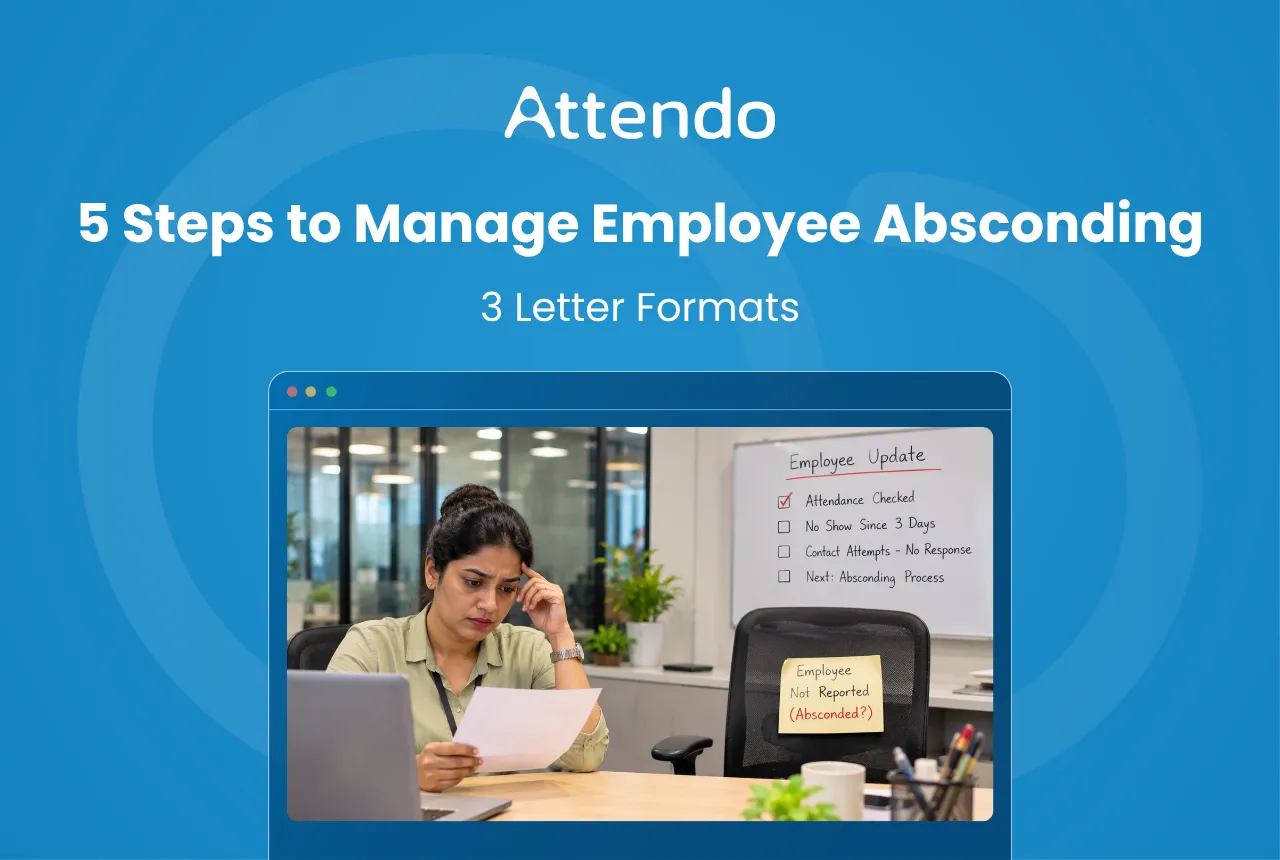
When an employee stops coming to work without a word, the safe way to handle it is to check the records, reach out, write, hear them out and only then decide.
Below are 5 steps for an absconding employee, 3 letter formats you can copy, and what the law says about absence and final pay.
In my view, the first letter matters most. A clear, polite note often brings a reply, and sometimes brings the person back.
Key Takeaways
- Five steps keep it fair: records first, then contact, written letters and a hearing, and only then a decision.
- Put everything in writing. Each letter, call and reply becomes your record if the decision is ever questioned.
- Give a fair chance to explain. An illness or a family emergency can look like absconding at first.
- Earned wages are still owed. Absconding does not cancel pay for days already worked.
What Is Absconding in a Job?
In a job, absconding means an employee stops coming to work without permission or notice, and does not reply. This absconding glossary entry gives the short definition.
Employee Absconding at a Glance
Here is the whole process in one table, with the letter that goes with each step:
| Step | What you do | Letter |
|---|---|---|
| 1. Check | Leave records, attendance, sick notes | None |
| 2. Reach out | Calls, messages, emergency contact | None |
| 3. Ask them back | Set a date to return or explain | Return-to-work letter |
| 4. Show cause | Ask for a written reply, offer a hearing | Show-cause notice |
| 5. Decide | End employment if needed, pay dues | Termination letter |
In this example, the absence passes ten days before the show-cause notice goes out. The Model Standing Orders, 2026 list continuous absence without permission and without satisfactory cause for more than ten days as misconduct.
5 Steps for an Absconding Employee
Follow these steps in order when you face employee absconding. Each one gives the employee a fair chance and gives you a clear record.
1. Check the Records First
Before calling anyone absconding, look for a leave request, a sick note or a message to a manager. A request may simply be sitting unapproved.
2. Try to Reach Them
Call, message and, if needed, contact the emergency number on file. Your first worry should be whether they are safe. Note the date and time of each attempt.
A store manager in Andheri, for example, might find that a sales associate is in hospital after a road accident. A hospital in Pune might learn that a nurse had to rush home to a sick parent.
3. Send a Return-to-Work Letter
If there is no reply, send Letter 1 by registered post to the last known address, and by email. Ask the employee to return or explain by a set date, usually about a week away.
4. Issue a Show-Cause Notice
If the absence continues, send Letter 2. It asks the employee to explain in writing why action should not be taken, and offers a hearing where they may bring a co-worker or an office-bearer of their trade union.
Keep the tone factual. A warning letter is a better fit when someone is late or absent now and then, not gone altogether.
5. Decide and Settle the Dues
If there is still no reply, or the explanation does not hold, tell the employee in writing the penalty you propose and give them a few days to respond. A short note is enough, for example: “The proposed penalty is termination. You may reply in writing by [date].”
Only then end the employment with Letter 3. Pay the wages already earned, collect company property and close system access.
A business process outsourcing (BPO) firm in Noida and a factory in Coimbatore should follow the same principle here: the decision comes after the hearing, never before it.
3 Absconding Letter Formats
Copy these absconding letter formats and fill in the parts in square brackets. Send each one by registered post and email, and keep copies.
What an Absconding Letter Should Contain
Every absconding letter should include the parts that fit its stage:
- The date the absence began, and the dates of any earlier letters.
- The calls or messages you tried, with dates.
- A clear date by which to return or reply.
- What happens if there is no reply, and the policy or rule behind it.
- A way to explain, such as asking for leave if unwell.
- The sender’s name and designation.
Letter 1: Return-to-Work Letter
Subject: Absence from work since [date]
Dear [Name],
You have not reported for work since [date], and we have not received a leave request from you. We tried to reach you on [dates] by [phone / message].
Please return to work, or reply in writing explaining your absence, by [date]. If you are unwell or facing an emergency, tell us and we will consider leave.
If we do not hear from you by [date], we may begin disciplinary action under [the company’s standing orders / service rules].
Regards,
[Name, Designation]
Letter 2: Show-Cause Notice for Absence
Subject: Show-cause notice for unauthorised absence
Dear [Name],
You have been absent without permission since [date], for [number] days, and did not reply to our letter dated [date].
This may amount to misconduct under [clause] of [the company’s standing orders / service rules]. Please explain in writing, within [7] days of receiving this notice, why disciplinary action should not be taken.
You may also attend a hearing on [date] at [time and place]. You may bring a co-worker or an office-bearer of your trade union.
Regards,
[Name, Designation]
Letter 3: Termination Letter for Absconding
Subject: Termination of employment
Dear [Name],
We wrote to you on [date] and [date]. [Keep Option A or B]:
Option A: You have not reported for work or replied, and did not attend the hearing on [date].
Option B: You have not returned to work, and after the hearing on [date], your explanation was not accepted.
We wrote to you on [date] about the proposed penalty, and [received no reply / considered your reply dated (date)].
Your employment ends with effect from [date]. Your earned wages and other dues of ₹[amount] will be paid to your bank account by [date, within two working days].
Please return the company property listed below: [ID card, laptop, keys]. Your relieving letter will be issued once your final settlement is complete.
Regards,
[Name, Designation]
For other exits, these termination letter formats cover resignation, performance and closure cases.
In Simple Words
If someone stops coming to work, first check they are safe. Then write to them, wait for a reply, and hear their side. Decide only after that.
Attendo (formerly Petpooja Payroll) is a complete workforce management system for every kind of business, running attendance, shifts, leaves, payroll and statutory filings in one place. Attendo has more than 40,000 users today. It is Software By Petpooja, building helpful products for Indian businesses since 2011.
The steps and letters work best when they follow the rules your business already has, and the law behind them.
What the Law Says on Employee Absconding
None of the labour codes uses the word absconding, but the rules on absence and discipline cover it. The main ones are below.
- Standing orders. The Industrial Relations (IR) Code, 2020 requires standing orders for industrial establishments with 300 or more workers.
- Ten days. The Model Standing Orders treat continuous absence without permission and without satisfactory cause for more than ten days, and habitual absence, as misconduct.
- A fair enquiry. The worker may appear in person, with a co-worker or with a trade union office-bearer. The enquiry should finish within 90 days unless extended for recorded reasons, and the worker can respond to the penalty proposed.
- Final pay. Wages earned and other dues are paid before the end of the second working day after termination.
The IR Code’s standing-order and enquiry rules cover workers. The term leaves out people employed mainly in a managerial or administrative role, and supervisors earning more than ₹18,000 a month. The two-day final pay rule under the Code on Wages still covers all employees, managers included.
A smaller business is not bound by the model orders, but following the same steps is the fairest and safest route. This standing orders template helps you prepare your own.
If You Have Been Marked Absconding
If your employer says you have absconded, reply in writing as soon as you can. Explain why you were away and attach any proof, such as a medical certificate.
You are still owed wages for the days you worked. Under the Code on Wages, 2019, wages of an employee who resigns or is removed must be paid within two working days.
If you have decided to leave, resign in writing and serve your notice. These notice period rules explain what applies, and a resignation keeps your relieving and experience letters on track.
Absconding Policy Tips for HR
For human resources (HR) teams and owners, a few habits make absconding cases rarer and easier to handle:
- Keep contact details current. Update phone numbers, addresses and emergency contacts every year.
- Write the rule into your policy. Say how many days of unapproved absence lead to a letter, and who sends it.
- Treat every case the same. A hotel in Jaipur and a head office in Gurugram should follow the same steps.
- Mark unpaid days correctly. Days away without leave are usually leave without pay, not a reason to hold back earned wages.
Pro Tip
I’d suggest sending each letter to two addresses: the current one and the permanent home address from the joining papers. An employee who stops coming may have gone home, and a letter returned from an empty rented room proves little.
Spotting the first missed day quickly depends on clear, daily attendance records.
Where Attendo Fits
Absconding cases start with a pattern of absent days, so the attendance record is your first piece of evidence.
Attendo marks each day with a clear status, such as Present, Late, Absent or Leave, so an unexplained absence shows up the same day.
The Approval Requests screen shows every leave request as Pending, Approved or Rejected, so you can check whether the employee applied. The words in bold are the screen labels.
Edits to attendance are kept in an audit trail, which helps if the case is ever reviewed.
If you want absences tracked this way, attendohr.com shows how it works.
What to Do When an Employee Absconds
Handle employee absconding in five steps: check, reach out, write, hear the person out and decide. The three letters above put each stage in writing. Pay the wages already earned on time, whatever the outcome.
For owners and HR teams who want attendance and leave records in one place, see how Attendo handles them.
Frequently Asked Questions
1. What is an absconding letter?
2. How many days of absence count as absconding?
3. Can an absconding employee get their salary?
4. Can I terminate an absconding employee straight away?
5. Should absconding letters go by post or email?
6. What if the employee comes back after the letters?
Listen to this article
Related Articles You May Like

25 Christmas Decoration Ideas for the Office on Any Budget
Wreaths, trees, garlands and star lanterns: 25 ideas to decorate the office, factory, shop or clinic for Christmas, with DIY ideas and safety tips.
Ashwiniba Vaghela
HR & Payroll Experts

60 New Year Wishes for Boss, From Formal to Heartfelt
Professional, short, heartfelt, Gen Z and Ugadi or Vishu wishes for your boss, plus family and sir or madam wishes, an email format and when to send each.
Avani Joshi
HR & Payroll Experts

60 Birthday Wishes for Boss, From Formal to Heart Touching
Professional, short, heart touching, funny and Gen Z birthday wishes for your boss, plus wishes for sir and madam, an ex boss, and office birthday tips.
Avani Joshi
HR & Payroll Experts
7 Salary Increment Request Letter Samples for Employees
Seven samples for asking your employer for a raise, a blank template, tips on the figure, and how HR should reply.
Ashwiniba Vaghela
HR & Payroll Experts