


6 Late Coming Policy Rules, With 3 Letter Formats to Copy
Six rules for a fair late coming policy, a copy-paste template and warning, explanation and apology letter formats.
Listen to this article
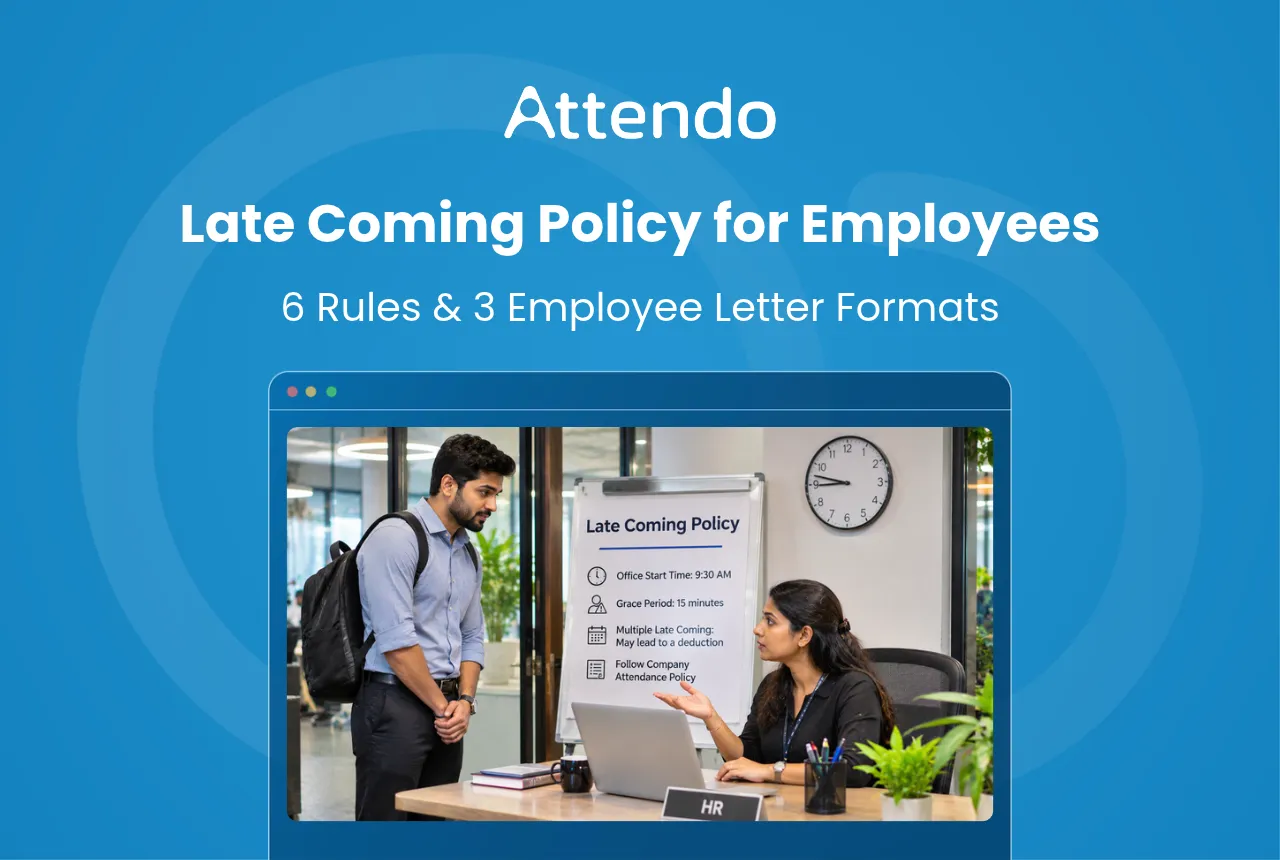
Late coming means an employee arrives after the fixed start time of their shift. A late coming policy sets the grace period, what counts as a late mark, and what happens when it keeps happening.
A written policy keeps the response the same for everyone, from a receptionist at a clinic to a machine operator on the night shift.
Below are 6 late coming policy rules, a copy-paste policy template and 3 letter formats. In my view, the pay-cut rule needs the most care, because the law limits it.
Key Takeaways
- Late coming is arriving after the shift’s start time. A written policy sets a grace period, a late mark and the steps that follow.
- Cut pay only for the minutes lost. Where standing orders let you refuse entry, the whole day can count as absence.
- Fines are a separate route with their own conditions, including a government-approved notice and a 3% cap.
- Warn in writing before any disciplinary step, and give the employee a chance to explain.
Late Coming Rules for HR and Owners
Here is what each rule covers, with an example you can adapt:
| Rule | What to set | Example |
|---|---|---|
| 1. Start time and grace | Shift start and grace minutes | 9:30 am, with 10 minutes’ grace |
| 2. Late mark | When a late mark is recorded | First punch after 9:40 am |
| 3. Genuine reasons | Who approves late permission | The manager, by message before the shift |
| 4. Deductions | Only for time actually missed | 20 minutes missed, 20 minutes cut |
| 5. Steps | Reminder, warning, explanation letter | After 3, 5 and 7 late marks a month |
| 6. Habitual late coming | Treated as misconduct, fairly | Only after written warnings and a reply |
Take an example: an employee earns ₹1,000 for an 8-hour day. Three late arrivals of 20 minutes add up to one hour missed, worth ₹125. A half-day cut would take ₹500, four times the pay for the time missed.
Latest Update on Standing Orders
The Labour Ministry published the 2026 Model Standing Orders on 8 May 2026. Where they apply, a late worker can be refused entry and marked absent, and habitual late attendance is misconduct.
6 Late Coming Policy Rules to Set
These rules answer the questions that otherwise turn into arguments at month end. Set each one before you need it.
1. Fix the Start Time and a Grace Period
Set the start time for each shift and a short grace period, such as 10 minutes, after which a late mark is recorded. A school with an 8 am assembly may allow 5 minutes, and an information technology (IT) office may allow 15.
Keep the grace period the same for everyone on a shift, and say whether it applies every day. Put the times on the notice board and in the appointment letter, so no one can say they did not know the rule. Review it once a year.
2. Define What Counts as a Late Mark
Say exactly when a late mark is recorded: the first punch after the grace period ends, whether on a biometric device, a face scanner or an app. One clear rule stops arguments about clocks that run a few minutes apart.
Also say whether arriving late and leaving early are counted together, and how a late mark is treated on a day of half-day leave. A hospital ward and a retail store may need different answers, so set one rule for each type of shift.
3. Allow for Genuine Reasons
Late coming is not always carelessness. Heavy rain, a train delay, a sick child or a hospital visit can hold anyone up, so let employees ask for late permission by message before their shift starts. A short note is enough.
Name who approves it, usually the reporting manager, and how often it can be used in a month. Approved late permission should not count as a late mark, and should never lead to a pay cut or a warning letter. Track how often it is used.
4. Keep Deductions in Proportion to Time Missed
Section 20 of the Code on Wages, 2019 allows a cut when an employee is away for all or part of their working time. The cut cannot be larger, in proportion, than the time they were away, so 20 minutes missed allows a cut for 20 minutes.
A rule like “three late marks equal a half-day cut” can take more pay than the time missed, which goes beyond what section 20 allows. Where standing orders apply and a late worker is refused entry, the day can be treated as absence instead.
Fines are a separate route: only for acts in a government-approved notice, after a chance to explain, and within 3% of the wages for that wage period. This per-day salary guide shows how to work out the pay for a day, and from it, an hour.
5. Escalate Step by Step
Most late coming stops after a quiet word. Add the next steps to the policy, for example a reminder after three late marks in a month, a warning letter after five, and an explanation letter after seven. Adjust the numbers to suit your team.
Start the count again each month for these steps, but keep late marks and letters on file for 12 months, since the Standing Orders judge “habitual” over a year. Share the steps with every new joiner and every manager.
6. Treat Habitual Late Coming as Misconduct, Fairly
The 2026 Model Standing Orders list “habitual late attendance” as misconduct, and say a worker (their word for an employee) who comes late is liable to a wage deduction under the Code on Wages. Under the Industrial Relations Code, 2020, standing orders apply at 300 or more workers.
In a smaller business, follow the same fair steps before any action: written warnings, a chance to explain in writing, and a hearing if the matter is serious. Never dismiss anyone for late coming without these steps. Give the employee a copy of every letter.
Pro Tip
I’d suggest giving the employee a printout of the month’s late marks to check and sign before any warning letter goes out. A signed list settles disputes about missed or faulty punches early.
Late Coming Policy Template
Copy this late coming policy and fill in the parts in square brackets. It follows the 6 rules above.
Late Coming Policy of [Company Name]
1. Start time and grace. Work starts at [9:30 am] for the [general shift]. A grace period of [10] minutes applies.
2. Late mark. A first punch after [9:40 am] is recorded as a late mark.
3. Late permission. Employees may ask [the reporting manager] for late permission by message before the shift. Late permission may be used up to [2] times a month. Approved late arrivals are not late marks and carry no pay cut.
4. Deductions. Pay is deducted only for the time actually missed, in line with the Code on Wages, 2019.
5. Steps. A reminder after [3] late marks in a month, a warning letter after [5], and an explanation letter after [7]. The count for these steps starts again each month; records are kept for 12 months.
6. Habitual late coming. Repeated late coming after written warnings may lead to disciplinary action, after a chance to explain and a hearing.
Approved by: [Name, Designation], [date].
Share the policy with every employee and keep a signed copy. If your business needs certified standing orders, this standing orders template covers the wider rules.
In Simple Words
Late coming means you come to work after your start time. The policy says how late is late. It says what comes next. Pay can only be cut for the time you missed.
A late coming policy is only as fair as the attendance record behind it.
Attendo (formerly Petpooja Payroll) is a complete workforce management system for every kind of business, running attendance, shifts, leaves, payroll and statutory filings in one place. Attendo has more than 40,000 users today. It is Software By Petpooja, building helpful products for Indian businesses since 2011.
When late coming carries on, the next step is a letter, and every letter needs the same few details.
What a Late Coming Letter Should Contain
Every late coming letter, from the employer or the employee, should be short and factual. It should include:
- The dates and times of each late arrival, taken from the attendance record.
- The policy rule the late coming breaks, in employer letters.
- What happens next, or what will change.
- A reply date, if a reply is needed.
- The name, designation, signature and date of the person writing.
Keep the tone calm. The aim is for the late coming to stop, not to embarrass anyone in front of their team.
Late Coming Letter Formats for Employers
Copy each late coming letter format below and fill in the parts in square brackets. Both come from the employer: a warning first, then a request to explain.
Warning Letter for Late Coming
Send this at the step your policy sets, such as five late marks in a month. List the exact dates and times from the attendance record, so the facts are clear and the employee can check each one. Send it privately, never on a group chat.
Keep it firm but polite, and say what will happen if the late coming continues. For other tones, see these warning letter formats, or use the free warning letter generator. Keep a signed copy in the employee’s file, with the attendance printout.
Subject: Warning for late coming
Dear [Name],
Our attendance records show that you reported late on [dates and times], after the [9:40 am] grace time. This breaks clause [1] of our late coming policy.
Please report on time from now on. If something makes it hard to reach work on time, speak to [manager] so we can help.
If late coming continues, we will ask you for a written explanation and may take further action under the policy.
[Signature]
[Name], [Designation], [Date]
Explanation Letter for Late Coming
Also called a show-cause letter, this asks the employee to explain repeated late coming in writing before any further step. It gives them a fair chance to share a reason, such as a health or family problem. It is not a punishment in itself.
Give a clear reply date, usually a few working days, and read the reply before deciding anything. If the reason is genuine, a different shift or late permission may solve it better than any penalty. Note the decision in writing.
Subject: Explanation needed for late coming
Dear [Name],
Despite our warning letter dated [date], our records show that you reported late on [dates and times]. This breaks clause [1] of our late coming policy.
Please explain the reason in writing by [date]. If we do not hear from you, we will decide the next step on the records we have.
[Signature]
[Name], [Designation], [Date]
Apology Letter for Late Coming
This is the employee’s reply, often sent after a warning or an explanation letter. Human resources (HR) teams can share the format, so replies stay short and honest and are easy to file with the attendance records. The format also helps the employee find the right words.
A good apology letter gives the reason without excuses, names the dates and says what will change, such as taking an earlier bus. A few lines are enough to show the employee is taking the matter seriously. Keep it to a few short lines.
Subject: Apology for late coming on [dates]
Dear [Manager’s name],
I apologise for reporting late on [dates and times]. The reason was [reason].
From now on, I will [plan, for example take the 8:30 am bus]. If I am delayed again, I will tell you before my shift starts.
[Signature]
[Name], [Designation], [Employee code], [Date]
How Attendo Tracks Late Coming
Attendo records each punch from biometric or face devices and the Employee App, and marks the day with a clear status: Present, Late, Half-day, Absent, Week Off, Leave or Holiday. The words in bold are the status labels.
The late threshold is set for each shift, so a factory’s night shift and an office’s general shift can each have their own grace time.
The same statuses appear across the dashboard and reports, so HR can see each employee’s late marks for the month before sending a letter.
If you want late coming tracked this way, attendohr.com shows how it works.
Which Late Coming Rule to Start With?
Start with the grace period and the late mark, since every other rule depends on them. Then add the steps and the letters, and keep every pay cut to the time actually missed. A clear duty roster helps too, so everyone knows their start time.
For owners and HR teams who want late marks and payroll in one place, see how Attendo handles them.
Frequently Asked Questions
1. What is late coming in office?
2. Can salary be deducted for late coming?
3. How many late marks make a half-day?
4. How do I write a warning letter for late coming?
5. What is an explanation letter for late coming?
6. Is late coming misconduct?
7. Can an employee be dismissed for late coming?
Listen to this article
Related Articles You May Like

3 Ways to Calculate Attendance Percentage, and the One Payroll Uses
One month, one employee, three ways to calculate attendance percentage. The formula is never the problem. What you divide by is, and it decides what a day of absence costs.
Avani Joshi
HR & Payroll Experts
Night Shift Allowance in India and Who Actually Decides It
No Code names a night shift allowance rate. What it settles is the calendar, the consent and the deductions, and those cost more than the figure most employers argue over.
Avani Joshi
HR & Payroll Experts
How to Prepare a Duty Roster Format That Holds Up
Most duty roster format templates give you a grid and stop. The grid is the easy half: the Code decides the hours, the handover and how often you may change it.
Avani Joshi
HR & Payroll Experts

Geo Tracking Attendance in Attendo (formerly Petpooja Payroll)
What gets recorded when a field employee is tracked, how the licence is billed, and when plain attendance with a geofence is the better answer.
Avani Joshi
HR & Payroll Experts