


Do You Get Double Pay for Working on Diwali?
A Diwali shift pays extra on a declared holiday, after eight hours, or on a weekly off worked. Here is what each case pays.
Listen to this article
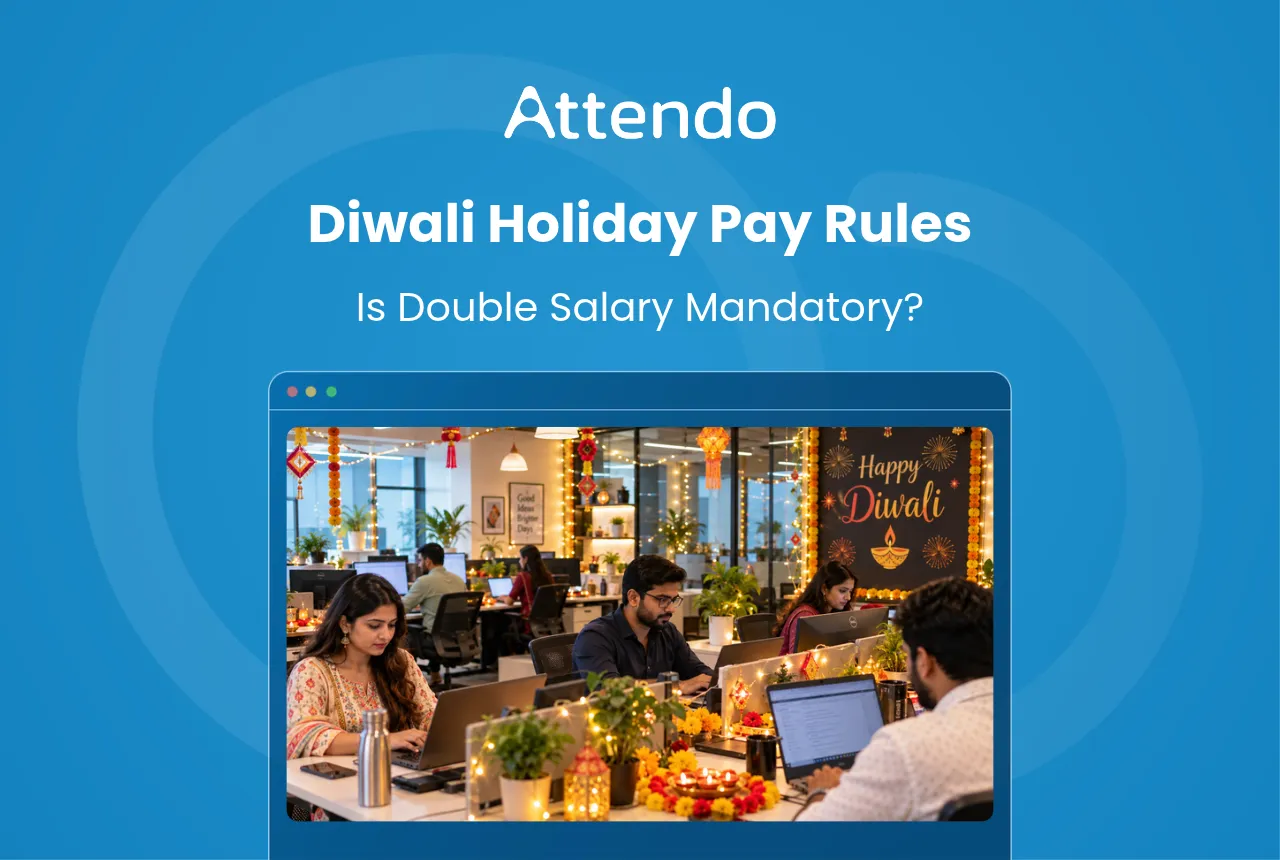
Working on Diwali does not always mean double pay. You get more only in three cases, and the date alone is not one of them.
I used to think a festival shift was paid double by law. Then I worked with companies across India on their attendance and payroll, and saw it depends on three things: whether Diwali is a holiday where you work, how long you work, and whether it is your weekly off.
Diwali 2026 falls on Sunday 8 November. If Sunday is your weekly off, that changes the answer too.
Key Takeaways
- Not always. The festival date by itself adds nothing to your pay.
- A declared holiday pays more. In the states we checked, working it usually earns twice your wages, or your day’s pay with an extra day off.
- Extra hours pay double. Time beyond your daily hours, usually eight, earns twice your rate.
- Overtime needs your consent. Your employer cannot force extra hours on you.
Three Cases Where Diwali Pays More
Only in three cases. In each one, the extra pay comes from a different rule.
- Diwali is a declared holiday where you work. Your state’s law or your company’s holiday list makes it a paid day off. If you work it, most state laws we read pay double wages, or normal wages plus another day off.
- You work past the daily limit. Usually that is eight hours, and the hours past it are overtime, paid at twice your normal rate.
- Diwali is your weekly off. Your state may set extra pay for working it, or you may get another day off instead.
If none of these fits, Diwali is an ordinary working day for you. Eight hours on it earn your normal wages.
Why is that? India’s four labour codes, in force since 21 November 2025, do not mention festivals at all. The extra pay comes from overtime rules, weekly off rules and state holiday laws.
In Simple Words
Diwali is not double pay by itself. You get more if it is a holiday where you work, if you work extra hours, or if it is your weekly off.
The sections below take each case in turn.
When Diwali Is a Declared Holiday
Diwali becomes a declared holiday when it is chosen as one of the year’s festival holidays under your state’s law, or when your company’s holiday list names it.
None of the state laws we read makes Diwali a fixed holiday. Some list it among the festivals to choose from. That is why two shops on the same street can close on different days.
Pay for Working a Declared Holiday
Under Tamil Nadu’s Act, you choose: twice your wages, or normal wages plus another paid day off within three days of the holiday.
Karnataka, Telangana and Andhra Pradesh give the same choice, and so does the Punjab Act used in Punjab, Haryana and Delhi. The day off comes within three days in Telangana and Andhra Pradesh, within ninety days under the Punjab Act, and with no fixed limit in Karnataka.
Kerala’s Act gives both, double wages and a day off. So do the shops laws of Maharashtra and Gujarat.
Take a supervisor at a Tamil Nadu plant, paid ₹124 an hour, where Diwali is a declared holiday. Eight hours that day earn ₹1,984. Or the supervisor takes ₹992 and another paid day off.
Pro Tip
Ask HR for this year’s holiday list before Diwali. If Diwali is on it, a shift that day should pay more, and you can check your payslip against it.
Working on Diwali Past Eight Hours
Time past the daily limit is overtime, on Diwali or any other day. The OSH Code (the Occupational Safety, Health and Working Conditions Code) sets that limit at eight hours a day.
The Code on Wages, 2019 sets overtime pay at not less than twice the normal rate of wages.
Some states’ shops laws, such as Maharashtra’s and Gujarat’s, start overtime after nine hours instead.
Normal rate means the wage your job is paid at, not your full cost-to-company figure. Only the extra hours are doubled, never the whole day.
Hours can also be counted by the week. The weekly limit comes from your state’s rules, and the count that favours you, daily or weekly, is the one that applies.
Example: Ten Hours on Diwali
Say you earn ₹124 an hour and work ten hours on Diwali, at a plant where it is not a declared holiday. The first eight hours earn ₹992. The two extra hours earn ₹496 instead of ₹248.
So the day pays ₹1,488 instead of ₹1,240. The extra ₹248 comes from the overtime, not from the date.
| Where it sits | What it sets |
|---|---|
| Code on Wages, section 14 | Overtime at not less than twice the normal rate of wages |
| OSH Code, section 25 | The daily limit, eight hours in a day |
| OSH Code, section 27 | Overtime counted daily or weekly, whichever favours the employee, and only with their consent |
| Code on Wages, section 13 | Lets the government set a weekly day of rest, and pay for working on it |
| OSH Code, section 26 | A day off in its place where an exemption cost somebody a weekly off |
None of these rules is about the date. Each one is about hours, rest or consent. The overtime rules under the codes explain which code covers which kind of business.
What Changed Recently
The eight-hour day now sits in the OSH Code, and the Factories Act, 1948 that payroll policies used to cite is repealed. The weekly hours limit is no longer in the code at all; it sits in your state’s rules.
Working on Diwali on Your Weekly Off
Diwali falls on Sunday 8 November this year. If Sunday is your weekly off and you are called in, the question is about your rest day, not the festival.
If you work in a supermarket or a lab that opens every Sunday, your weekly off is another day. For you, Diwali is an ordinary day unless it is a declared holiday.
The Code on Wages says the government may set a weekly day of rest, and may set pay for working it at no less than the overtime rate. So extra pay for working your weekly off depends on what your state has notified.
A day off in its place is the other route. The OSH Code gives you a day off for each weekly off lost, within that month or the next two. That applies only where your employer works under a written exemption from the state.
Many employers offer a day off anyway. If yours does, ask for the date in writing.
Can You Say No to Working on Diwali?
You can refuse overtime. The OSH Code makes extra hours subject to the consent of the employee, so saying no to extra hours is not misconduct.
Normal hours are different. If Diwali is not a declared holiday and not your weekly off, it is a normal working day, and normal rostering applies.
If Diwali is a declared holiday and you are asked to work, you must be paid as your state’s law or your company’s holiday policy says.
In Tamil Nadu, Kerala, Telangana and Andhra Pradesh, the law lets the employer require it, but only with written notice at least 24 hours before, and a copy to the inspector.
Working a night shift into Diwali? The night shift allowance guide covers that payment.
What Employers Should Do Before Diwali
If you run the business, the rules above become a checklist. Settle these six things before the festival.
- Check whether Diwali is a declared holiday for each branch, under your state’s law or your own holiday list. If it is, note what your state pays for a holiday worked and whether it wants notice.
- Mark who is rostered, and whether Diwali is that person’s weekly off. The two are owed different things.
- Take consent in writing for anyone doing overtime, and keep it with that day’s attendance record.
- Work out overtime on a daily and a weekly basis, and pay whichever is better for the employee.
- Fix the date of any day off in place of the holiday before the festival, not after.
- Tell each person what they will be paid before the payslip reaches them.
A fabrication unit on a skeleton shift, a diagnostic lab keeping its branches open and a supermarket at its busiest week all need the whole list. A school closed for the day needs only the first step.
I would write the Diwali pay rule on the Diwali holiday notice itself, so nobody argues about it in November.
Attendo (formerly Petpooja Payroll) is a complete workforce management system for every kind of business, running attendance, shifts, leaves, payroll and statutory filings in one place. Attendo has more than 40,000 users today. It is Software By Petpooja, building helpful products for Indian businesses since 2011.
Where Attendo Fits
The hard part of a festival week is not the rate. It is knowing who was rostered, who was on their weekly off, and who agreed to the extra hours.
Attendo holds the roster, the attendance and the holiday calendar in one place. A Diwali shift reaches payroll already marked as a holiday, a weekly off or a normal day.
Holiday lists are set per branch, so a business in two states can give each branch the holidays its own state requires.
Overtime comes through on the attendance record, not a separate sheet. The hours that earn twice the rate are the hours the system actually saw.
Where you settle a festival shift with a day off instead of cash, the Comp-Off Carry Forward setting carries comp-offs earned by working a holiday or a week-off across periods, so the day owed does not get lost.
If you would rather a festival week reached payroll already sorted, attendo is the place to see how it works.
So, Do You Get Double Pay?
Sometimes, but never because of the date. Working on Diwali pays more when it is a declared holiday where you work, when you work past the daily limit, or when your state pays extra for a weekly off worked.
Before Diwali, check your company’s holiday list and ask how a shift that day will be paid. Ask before the festival, not after the payslip arrives.
If you run payroll, see how Attendo keeps the roster, overtime and holiday list in one place.
Frequently Asked Questions
1. Do I get double pay for working on Diwali?
2. What is the overtime rate under the labour codes?
3. Diwali 2026 is a Sunday. What does that change?
4. Can I refuse to work overtime on Diwali?
5. Is Diwali a paid holiday by law?
6. Is a day off enough instead of extra pay?
Listen to this article
Related Articles You May Like
Why Dearness Allowance Keeps Rising and Who Actually Gets It
Does dearness allowance reach private pay as well? See the current central DA rate, how it is set, VDA in minimum wages, and how DA is taxed.
Avani Joshi
HR & Payroll Experts
Retention Bonus Means Extra Pay for Staying, Taxed as Salary
Offered money to stay on? A retention bonus falls due on the agreed date, is taxed as salary, and is hard to claw back once paid.
Avani Joshi
HR & Payroll Experts
5 Examples to Calculate Bonus for Employees
The statutory bonus follows the Code on Wages, while performance and festival bonuses follow policy. Five worked examples show how each is calculated.
Avani Joshi
HR & Payroll Experts
Is a Diwali Bonus Taxable? What TDS You Must Deduct
Tax on a festival payout is not a flat percentage, and the money does not always move in the same tax year the charge lands. Both catch payroll teams out.
Ashwiniba Vaghela
HR & Payroll Experts